The Role of Cryogenics in the Production and Distribution of Industrial Gases
Industrial gases such as oxygen, nitrogen, and argon play a vital role in various industries, including healthcare, manufacturing, and electronics. Producing these gases at high purity levels requires advanced cryogenic separation and distillation technologies. Cryogenics ensures efficient gas liquefaction, separation, and distribution, making it the preferred method for large-scale industrial gas production.
In this article, we will explore how cryogenic distillation is used to produce high-purity gases, the processes involved, and how these gases are distributed safely and efficiently.
Understanding Cryogenic Distillation
Cryogenic distillation is the most widely used method for separating atmospheric gases due to its efficiency in producing high-purity gases at large scales. This process relies on the principle that different gases have distinct boiling points, allowing them to be separated through controlled cooling and condensation.
Why Use Cryogenic Distillation?
- High Purity – Achieves 99.9%+ purity for oxygen, nitrogen, and argon.
- Large-Scale Production – Supports industrial applications requiring vast amounts of gases.
- Energy Efficiency – Although energy-intensive, cryogenic separation is the most economical process for bulk production.
- Versatility – Produces multiple industrial gases from the same process.
The Cryogenic Air Separation Process
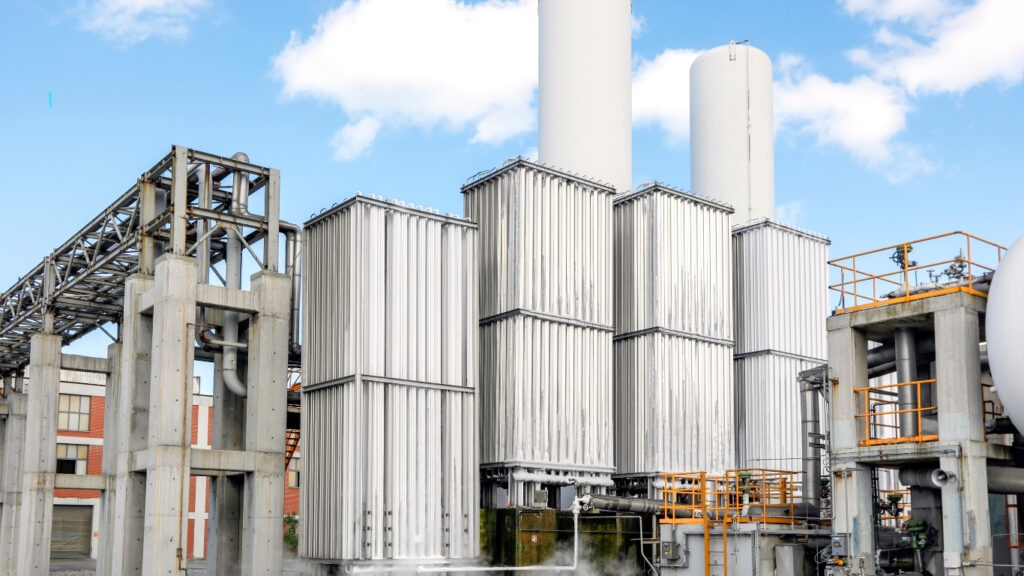
The cryogenic air separation unit (ASU) is the primary system used to produce industrial gases. The process involves several key steps:
1. Air Intake and Compression
- Ambient air is drawn into the ASU and passed through filters to remove dust and impurities.
- The air is then compressed to increase its density and prepare it for cooling.
2. Purification of Air
- Water vapor and carbon dioxide are removed using adsorption systems to prevent ice formation during cryogenic cooling.
- This step ensures that only clean, dry air enters the distillation process.
3. Cooling Through Heat Exchangers
- The purified air is cooled to approximately -185°C (-301°F) using advanced plate-fin heat exchangers.
- This temperature allows gases to condense at different points, aiding separation.
4. Separation in the Distillation Columns
- The cooled air enters a high-pressure distillation column, where it partially liquefies.
- Due to different boiling points:
- Nitrogen (BP: -196°C) remains mostly in gaseous form and rises to the top.
- Oxygen (BP: -183°C) and Argon (BP: -186°C) become liquid and settle at the bottom.
- Further low-pressure distillation refines the separation, producing high-purity gases.
5. Gas Collection and Storage
- Liquid oxygen (LOX), liquid nitrogen (LIN), and liquid argon (LAR) are stored in cryogenic tanks.
- Some gases are vaporized into high-pressure cylinders for industrial use.

Distribution of Cryogenically Produced Industrial Gases
Once separated and stored, industrial gases must be efficiently transported to end-users. The distribution process involves:
1. Cryogenic Tanker Transport
- Bulk quantities of liquid oxygen, nitrogen, and argon are transported in vacuum-insulated tankers.
- These tankers maintain low temperatures and prevent gas evaporation during long-distance shipping.
2. Pipeline Distribution
- In industrial zones, gases can be directly transported via pipelines to manufacturing facilities.
- This method is cost-effective for large-scale continuous supply.
3. High-Pressure Cylinder Delivery
- For smaller quantities, gases are compressed into cylinders and distributed to hospitals, laboratories, and factories.
- Cylinders provide a portable and versatile gas supply for various industries.
Applications of Cryogenic Industrial Gases
The gases produced through cryogenic separation serve multiple industries:
1. Oxygen (O₂) Applications
- Medical Use – Supports respiratory therapy and life-support systems in hospitals.
- Steel Manufacturing – Enhances combustion efficiency in blast furnaces.
- Aerospace – Used as an oxidizer in rocket propulsion systems.
2. Nitrogen (N₂) Applications
- Food Industry – Preserves food through freezing and modified atmosphere packaging.
- Electronics Manufacturing – Used in semiconductor fabrication to prevent oxidation.
- Oil & Gas – Provides inert blanketing for chemical processes.
3. Argon (Ar) Applications
- Welding and Metal Fabrication – Used in shielding gases for TIG and MIG welding.
- Lighting Industry – Fills energy-efficient fluorescent and LED bulbs.
- Laboratories – Used as an inert gas for sensitive chemical reactions.
Advancements in Cryogenic Gas Production
As demand for industrial gases grows, new technologies and innovations continue to enhance the efficiency of cryogenic gas production.
1. Energy-Efficient Cryogenic Distillation
- New heat exchanger designs reduce energy consumption.
- Waste heat recovery systems improve overall efficiency.
2. Digital Monitoring and Automation
- IoT-based sensors allow real-time monitoring of ASU operations.
- Automated control systems optimize separation efficiency and reduce downtime.
3. Sustainable Gas Production
- Green technologies, such as renewable-powered ASUs, lower carbon footprints.
- Carbon capture integration enables the use of cryogenic processes for CO₂ reduction.
KAF Cryogenics: Pioneering Excellence in Industrial Gas Production
At KAF Cryogenics, we specialize in state-of-the-art cryogenic gas production and distribution solutions. Our advanced air separation units, vacuum-insulated transport systems, and automated gas monitoring technologies ensure superior performance and safety.
With years of expertise, KAF Cryogenics delivers high-purity industrial gases tailored to meet the evolving needs of healthcare, manufacturing, aerospace, and energy industries.
Cryogenic technology remains the backbone of industrial gas production and distribution, enabling a sustainable and efficient supply chain. As innovations continue to shape the future, cryogenic separation will remain the gold standard for high-purity gas production.
For more information on cryogenic gas solutions, visit KAF Cryogenics today!