
Carbon Capture and Cryogenics: A Game-Changer for Emission Reduction
Introduction
As industries and governments strive to combat climate change, carbon capture and storage (CCS) has become a critical strategy for reducing greenhouse gas emissions. One of the most promising advancements in CCS is cryogenic carbon capture (CCC), which leverages ultra-low temperatures to separate and store carbon dioxide (CO₂) efficiently. Unlike traditional chemical or membrane-based carbon capture methods, cryogenic techniques offer high purity, scalability, and integration with industrial processes.
This article explores the role of cryogenic processes in CO₂ capture, storage, and utilization, highlighting their benefits, technological advancements, and the contribution of KAF Cryogenics in delivering state-of-the-art cryogenic solutions for emission reduction.
The Importance of Carbon Capture in Emission Reduction
Why Carbon Capture is Essential
- Reducing Industrial Emissions: Industries such as power generation, cement manufacturing, and steel production contribute significantly to global CO₂ emissions. Capturing these emissions prevents their release into the atmosphere.
- Meeting Climate Targets: International agreements, such as the Paris Agreement, emphasize the importance of CCS technologies to achieve net-zero emissions by 2050.
- Enhancing Energy Efficiency: Many carbon-intensive processes can integrate CCS to improve operational efficiency while reducing environmental impact.
Traditional vs. Cryogenic Carbon Capture
| Feature | Traditional CCS (Chemical/Membrane) | Cryogenic CCS |
|---|---|---|
| Capture Efficiency | Moderate | High |
| CO₂ Purity Level | Lower (mixed with impurities) | Near 100% |
| Energy Consumption | High (chemical processing) | Moderate |
| Scalability | Limited | High |
| CO₂ Storage Readiness | Requires additional processing | Direct storage possible |
How Cryogenic Carbon Capture Works
Cryogenic carbon capture employs low-temperature cooling to condense and separate CO₂ from industrial flue gases. This process ensures high-purity CO₂ recovery and reduces energy consumption compared to chemical scrubbing methods.
Step-by-Step Cryogenic CO₂ Capture Process
- Pre-cooling: Flue gases from industrial plants are cooled to sub-zero temperatures.
- CO₂ Condensation: At cryogenic temperatures, CO₂ turns into a liquid or solid while other gases, such as nitrogen and oxygen, remain in gaseous form.
- Separation & Collection: The condensed CO₂ is separated and collected for further use or storage.
- Compression & Storage: The liquid CO₂ is compressed and transported for either underground storage or utilization in industries like enhanced oil recovery (EOR), beverage carbonation, and chemical production.
Advantages of Cryogenic Carbon Capture
- High Purity CO₂: Enables direct storage or use without additional purification steps.
- Energy Efficiency: Integrates with industrial processes, reducing additional energy input.
- Modular & Scalable: Can be adapted for both small and large-scale facilities.
- Integration with Liquefied CO₂ Transport: Easier transportation and storage due to liquefaction compatibility.
Cryogenic CO₂ Storage and Utilization
Safe Storage of CO₂
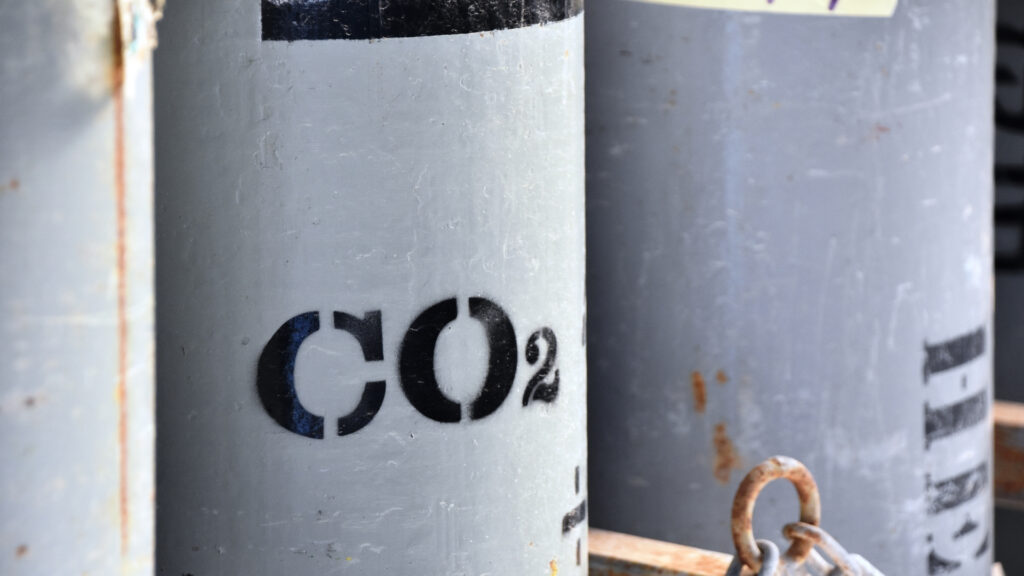
Long-term CO₂ storage requires secure containment methods to prevent leakage. Cryogenic storage solutions, such as those developed by KAF Cryogenics, provide vacuum-insulated tanks and ISO containers designed to maintain CO₂ in a liquefied state at optimal pressure and temperature.
Applications of Captured CO₂
- Enhanced Oil Recovery (EOR): Injecting CO₂ into depleted oil reservoirs increases oil extraction efficiency.
- Food & Beverage Industry: Used in carbonated drinks, food preservation, and freezing applications.
- Chemical & Industrial Uses: CO₂ is a key raw material in the production of fertilizers, synthetic fuels, and polymers.
KAF Cryogenics: Leading the Way in Cryogenic Carbon Capture Solutions
Innovative Cryogenic Equipment for CO₂ Capture & Storage
KAF Cryogenics specializes in cutting-edge cryogenic storage and processing solutions tailored for carbon capture applications. Their product offerings include:
- Cryogenic Storage Tanks: Engineered for safe and efficient liquefied CO₂ storage with double-walled, vacuum insulation to minimize heat transfer.
- Cryogenic ISO Containers: Designed for global transportation of liquefied CO₂ while meeting international safety standards.
- PU Insulated Storage Tanks: Featuring advanced polyurethane insulation for superior thermal efficiency in CO₂ storage.
- Microbulk Systems: On-site solutions for industries requiring continuous CO₂ supply without frequent refills.
- Cryogenic Vaporizers: Converts liquid CO₂ into gaseous form for industrial applications using energy-efficient ambient air heat exchangers.
Why Choose KAF Cryogenics?
- Industry Expertise: Decades of experience in cryogenic engineering and gas storage.
- Custom Solutions: Tailored equipment designs based on client requirements and industry applications.
- Sustainability Focus: Commitment to environmentally friendly technologies supporting emission reduction initiatives.
- Global Reach: Internationally certified equipment, making it easier for industries worldwide to adopt carbon capture solutions.
Future of Cryogenic Carbon Capture
The demand for cryogenic CCS is growing as industries and governments prioritize carbon neutrality. Future advancements include:
- Improved Energy Efficiency: Ongoing R&D in cryogenic cooling cycles to reduce energy consumption.
- Integration with Hydrogen Production: Utilizing captured CO₂ in green hydrogen and synthetic fuel production.
- Enhanced Carbon Utilization: Expanding CO₂ applications beyond storage, into areas like carbon-negative building materials and biofuels.
- AI & Automation: Smart monitoring and AI-driven cryogenic systems for optimized CO₂ capture and storage.
Final Thoughts
Cryogenic technology is revolutionizing carbon capture and emission reduction efforts, providing a highly efficient and scalable solution for industrial applications. By utilizing ultra-low temperatures, cryogenic carbon capture ensures high-purity CO₂ recovery, energy efficiency, and seamless integration with industrial processes.
With industry leaders like KAF Cryogenics at the forefront, businesses can adopt state-of-the-art cryogenic solutions to minimize their carbon footprint and contribute to a more sustainable future.
For more information on advanced cryogenic carbon capture and storage solutions, visit KAF Cryogenics today!