
Autogas Station Equipment: What You Need
Planning an LPG autogas station? See the full equipment list: storage tank, dispenser, pump, pipework, safety and metering, plus how to size it.
KAF Cryogenics6 min read
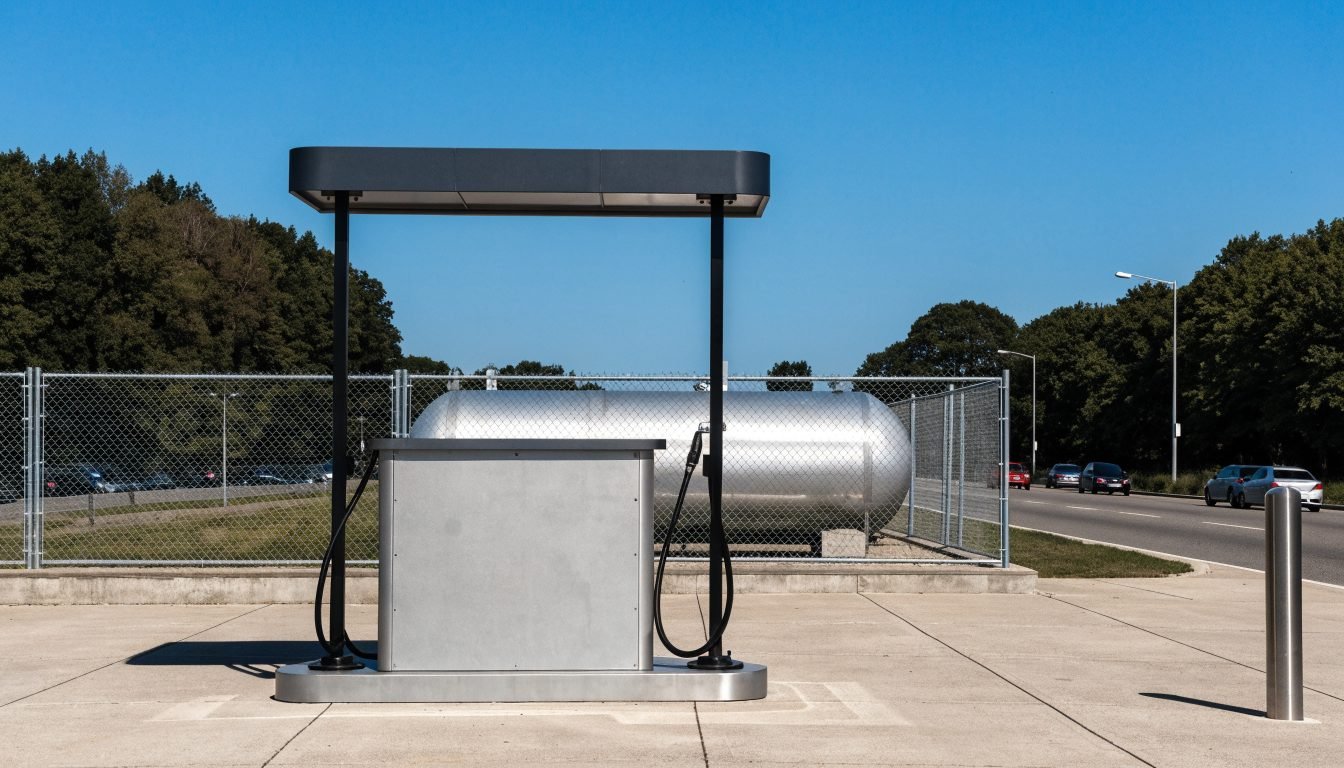
An LPG autogas station needs a storage tank, a transfer pump, a dispenser, pipework and valves, and a safety and metering system, all sized to the fuel volume you expect to sell. The storage tank is the central asset, and its capacity drives delivery frequency and station uptime.
This guide gives an equipment overview for an investor or project manager planning an autogas station, with the sizing logic that ties the parts together. Autogas is LPG dispensed as a motor fuel, stored as a pressurized liquid at ambient temperature, so the equipment is pressure-vessel and pump technology rather than cryogenic.
KAF Cryogenics supplies LPG storage tanks new to specification and as certified second-hand units delivered from stock in weeks, and can advise on the storage side of a station project.
What equipment does an autogas station need?
An autogas station is a chain of components that moves LPG from a road tanker delivery into a vehicle safely and with accurate measurement. Each part has to match the others in flow and pressure.
- Storage tank: the pressure vessel that holds bulk LPG on site, above ground or below ground.
- Transfer pump: moves liquid LPG from the tank to the dispenser at the required flow and pressure.
- Dispenser: the fuelling unit at the forecourt, with meter, nozzle and controls for the driver.
- Pipework and valves: the lines connecting tank, pump and dispenser, with isolation and non-return valves.
- Metering system: measures dispensed volume for sale and for stock reconciliation.
- Safety systems: relief valves, emergency shutoff, gas detection, fire protection and the fixed maximum fill device on the tank.
- Delivery point: the fill connection where the road tanker discharges into the storage tank.
How do you size the storage tank for an autogas station?
The storage tank is sized from expected sales volume, delivery frequency and the reserve you want to hold. The logic is the same as for any LPG filling station: cover the days between deliveries plus a safety reserve, allowing for the fact that the tank fills to a maximum level rather than to the brim.
Inputs to gather
- Expected daily autogas sales, from forecourt projections or comparable sites.
- Delivery frequency, set by your supplier and route.
- Autonomy days you want as reserve against demand peaks and delivery delays.
- The usable delivery volume of the road tanker that resupplies the tank.
The sizing logic
Required usable volume equals daily sales multiplied by the sum of delivery interval and reserve days. Convert that to nominal water capacity by dividing by the tank's maximum fill fraction. Then confirm the tank can accept a full delivery load near its reorder level without exceeding the fill limit. Undersizing forces frequent deliveries and risks running dry at peak; oversizing raises upfront cost and footprint.
Above ground or below ground storage for autogas?
Both are used at autogas sites, and the choice interacts with land, layout and local regulation more than with sales volume.
- Above ground tanks are simpler and usually lower in installed cost, with easier inspection and maintenance access, but they take visible forecourt space and need separation distances.
- Below ground or mounded tanks free up surface area and can suit space-constrained forecourts, at higher installation complexity and corrosion protection needs.
- Confirm the required safety distances and permitting for your chosen layout early, since they can decide the option.
What pump and dispenser flow does an autogas station need?
The pump and dispenser must deliver a fuelling rate that keeps forecourt throughput acceptable without cavitation. Pump capacity should match the number of dispensing points and the flow each dispenser needs at once, with margin for peak periods.
Match pump and pipework so pressure and flow reach the dispenser reliably. If a station has multiple dispensers, the pump and line sizing must support simultaneous fuelling at the busiest times, not just a single vehicle.
What safety and metering equipment is required?
Autogas is a flammable pressurized fuel, so safety systems are integral rather than optional, and metering is what makes each sale accurate. Requirements are set by local regulation, but the categories are consistent.
- Relief valves sized to the tank to protect against overpressure.
- Emergency shutoff and remotely operated valves to isolate flow quickly.
- Gas detection and, where required, fire protection at the tank and dispenser.
- The fixed maximum fill device that prevents overfilling the tank on delivery.
- A calibrated dispenser meter for sales and a system for stock reconciliation against deliveries.
- Signage, earthing and separation distances per the applicable regulation.
New or certified second-hand equipment for an autogas station?
For the storage tank, the supply route affects both budget and schedule. New fabrication to specification takes months, while a certified second-hand tank of matching size can ship from stock in weeks, which helps a station open on time.
KAF Cryogenics supplies LPG storage tanks through both channels. Certified second-hand tanks pass inspection, non-destructive testing (NDT) and pressure testing, and are sold with a document dossier and a written warranty. Ask for the pressure vessel certificate, ASME or PED as your market requires, with the tank.
What lead time and documents should you plan for?
A station project has a critical path, and the storage tank is often on it. Planning the supply route early avoids the tank holding up commissioning.
- For a new tank, plan for months of fabrication in the project schedule.
- For a certified second-hand tank, delivery from stock in weeks can compress the timeline.
- Collect the pressure vessel code certificate, material and welding records, and pressure test reports.
- For a used tank, add the NDT and inspection reports and the written warranty to the file.
- Verify the nameplate water capacity, design pressure and design temperature against your specification.
Frequently Asked Questions
What are the main components of an autogas station?
An autogas station needs an LPG storage tank, a transfer pump, a dispenser with meter and nozzle, connecting pipework and valves, a metering and reconciliation system, and safety equipment such as relief valves, emergency shutoff and gas detection. The storage tank is the central asset that the rest is sized around.
How big should the storage tank at an autogas station be?
Size it from expected daily sales multiplied by the days between deliveries plus your reserve days, then convert to nominal water capacity using the tank's maximum fill fraction. The tank should also accept a full delivery load without exceeding the fill limit. Undersizing forces frequent deliveries and risks running dry at peak.
Is autogas the same as cryogenic gas equipment?
No. Autogas is LPG dispensed as motor fuel, stored as a pressurized liquid at ambient temperature in a pressure vessel. Cryogenic liquids are stored cold in vacuum-insulated tanks. Autogas station equipment is pressure-vessel and pump technology, so it does not involve vacuum insulation or boil-off management.
Should an autogas storage tank be above or below ground?
Both are used. Above ground tanks are simpler and usually lower in installed cost with easier maintenance access, while below ground or mounded tanks free up forecourt space where land is tight. Local safety distances, permitting and site layout usually decide the choice.
What pressure code should the storage tank meet?
It depends on the destination market. ASME Section VIII is the United States code and PED 2014/68/EU with CE marking is the European code. The correct one is set by where the station is regulated, not by quality. KAF builds LPG tanks to both codes.
Can I get an autogas storage tank quickly?
A new tank built to specification takes months. A certified second-hand tank of a matching size can be delivered from stock in weeks, inspected, NDT and pressure tested, with a document dossier and written warranty, which helps a station commission on schedule.
Related reading
Planning an autogas station?
Share your expected sales volume, delivery frequency and site constraints and KAF will help you confirm the storage tank size and pressure class, then quote a new build or a certified second-hand tank from stock. Price depends on specification, so we give an accurate quote.
Get started with KAF