
LPG Storage Tank Sizing for Filling Stations
Size an LPG storage tank for a filling or autogas station by throughput, delivery frequency, autonomy and pressure. A practical method plus stock.
KAF Cryogenics6 min read
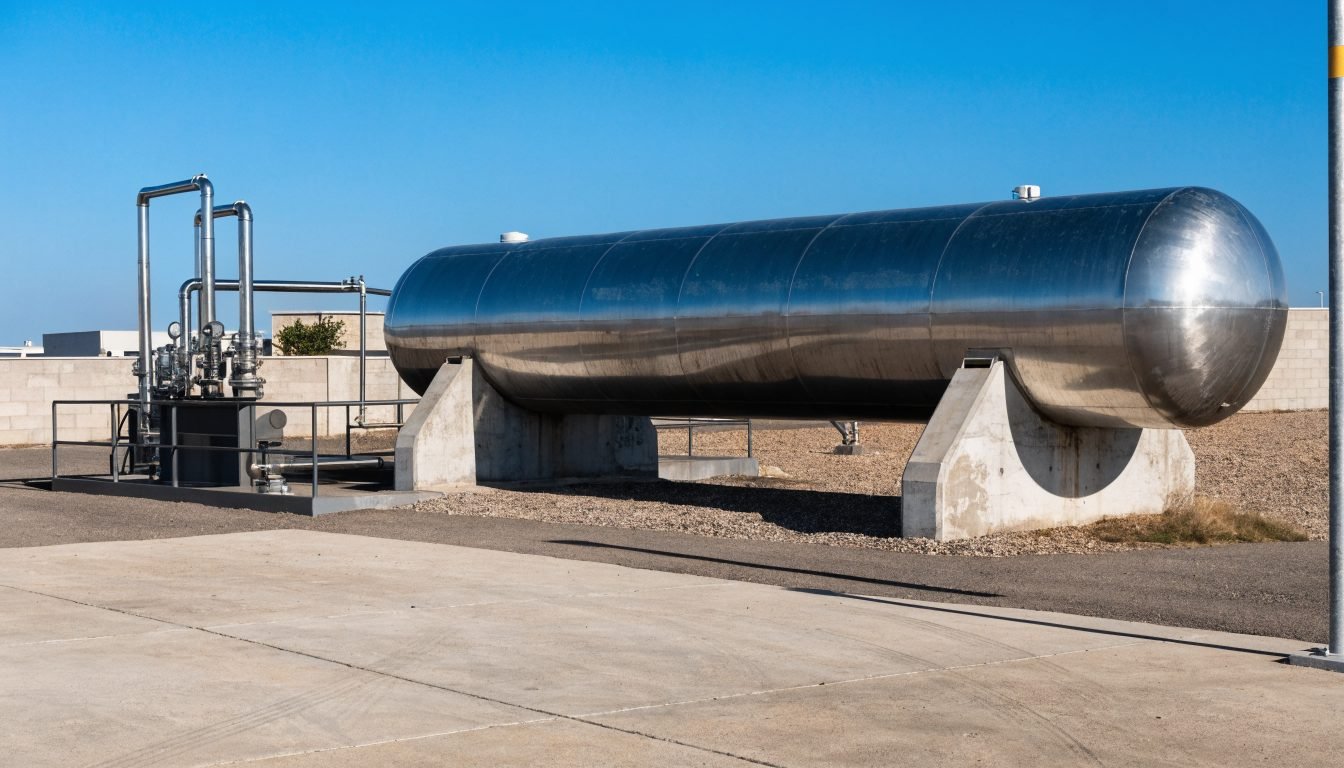
LPG storage tank sizing for a filling station starts from daily throughput multiplied by the number of autonomy days you want between deliveries, then adjusted for usable fill limits, peak demand and delivery truck volume. Size the tank so a single delivery refills it without exceeding the maximum fill level.
This guide walks through the sizing logic step by step so a station owner or project manager can reach a defensible tank volume before requesting a quote. LPG is stored as a pressurized liquid at ambient temperature, so the numbers behave differently from cryogenic service, and we note where that matters.
KAF Cryogenics supplies LPG storage tanks both new to specification and as certified second-hand units, so once you know your target volume you can compare a fabrication lead time against delivery from stock in weeks.
What determines LPG storage tank size for a filling station?
Tank size is not a single number you pick from a catalogue. It is the result of how much LPG you sell, how often a delivery truck can reach you, and how much reserve you want to hold against demand spikes and supply delays. Get these inputs right and the volume follows.
The main factors are:
- Daily throughput: the average volume of LPG dispensed per day, in litres or kilograms.
- Delivery frequency: how many days pass between road tanker deliveries to the site.
- Autonomy: the reserve days you want to keep so the station never runs dry if a delivery slips.
- Peak demand: seasonal or weekly highs that exceed the average, common for autogas in cold months.
- Delivery volume: the usable payload of the bobtail or semi-trailer that resupplies the site.
- Usable capacity: the fill limit, since an LPG tank is filled to a maximum liquid level and not to the brim.
How do you calculate LPG storage tank sizing step by step?
Work from consumption outward. The goal is a nominal water capacity that holds enough usable LPG to cover the days between deliveries plus your reserve, and that can absorb a full delivery without overfilling.
Step 1: establish daily throughput
Use recorded dispenser data if the station is operating, or a demand estimate from comparable sites if it is a new build. Separate autogas sales from cylinder filling if the station does both, because their patterns differ.
Step 2: set autonomy days
Decide how many days of supply you want on site. Autonomy protects against delivery delays and demand peaks. A remote station on a long supply route needs more autonomy than one near a filling depot.
Step 3: multiply and add reserve
Required usable volume equals daily throughput multiplied by the sum of delivery interval days and reserve days. This is the liquid you must be able to hold and use between resupplies.
Step 4: convert usable volume to tank water capacity
An LPG tank is not filled to 100 percent. A fixed maximum fill level leaves an ullage space for vapour and thermal expansion of the liquid. Divide your required usable volume by the fill fraction the tank allows to reach the nominal water capacity to specify.
Step 5: reconcile with delivery volume
The tank should accept a full delivery from your road tanker when it is near its reorder level, without exceeding the maximum fill level. If the tank is too small relative to the delivery volume, the truck cannot discharge a full load and delivery cost per litre rises.
Above ground or below ground LPG tank: which suits a filling station?
Both are common. The choice affects footprint, safety distances, cost and appearance, and it interacts with the volume you calculated.
- Above ground tanks are simpler to install, inspect and maintain, and are usually lower in installed cost. They occupy visible yard space and require separation distances from boundaries and ignition sources.
- Below ground or mounded tanks free up surface area and can allow shorter separation distances at some sites, which matters where land is constrained. Installation, corrosion protection and inspection access are more involved.
- Site layout, local regulation and available land usually decide the outcome more than the tank volume itself.
What pressure rating does an LPG storage tank need?
LPG is stored as a liquid under its own vapour pressure at ambient temperature, so the tank is a pressure vessel rated for that vapour pressure with margin. Vapour pressure rises with temperature and depends on the LPG composition, since propane develops higher pressure than butane at the same temperature.
Specify the design pressure and code for the destination market. ASME Section VIII applies to United States practice, while PED 2014/68/EU with CE marking applies in Europe. The correct code depends on where the tank is installed and regulated, not on quality. KAF builds to both and can advise which your project requires.
How does delivery frequency change the tank you should buy?
Delivery logistics and tank size trade off against each other. A larger tank means fewer deliveries, lower delivery cost per litre and more buffer against supply interruptions, at a higher upfront tank cost and footprint. A smaller tank costs less to install but needs more frequent deliveries and carries less reserve.
If your supplier delivers by full bobtail loads, sizing the tank so it comfortably receives one full load per delivery keeps transport efficient. Stations on infrequent or long delivery routes generally justify more autonomy and therefore a larger tank.
Should you buy a new or certified second-hand LPG storage tank?
Once the target volume and pressure class are set, the supply route affects both budget and schedule. New fabrication to your exact specification typically runs to months of lead time. A certified second-hand tank of a matching size can ship from stock in weeks.
KAF Cryogenics offers both channels. Certified second-hand units pass inspection, non-destructive testing (NDT) and pressure testing, and are sold with a document dossier and a written warranty. KAF also buys used equipment and accepts trade-in against a new order, which helps if you are replacing an undersized tank.
What documents should come with an LPG storage tank?
Ask for the full document dossier before purchase. For a pressure vessel this typically includes:
- The manufacturer data report and design calculations.
- The pressure vessel code certificate, ASME or PED as applicable to your market.
- Material and welding records, including the welding quality standard the fabricator works to.
- Pressure test records and, for a used unit, NDT and inspection reports.
- Nameplate details confirming water capacity, design pressure and design temperature.
- For a certified second-hand tank, the written warranty and service history.
Frequently Asked Questions
How do I calculate the storage volume for an LPG filling station?
Multiply average daily throughput by the number of days between deliveries plus your reserve days to get the usable volume you must hold. Then divide by the tank's maximum fill fraction to reach the nominal water capacity to specify. Confirm the result can accept a full delivery load without exceeding the fill limit.
Why can an LPG tank not be filled to 100 percent?
An LPG tank keeps an ullage space above the liquid for vapour and for thermal expansion as temperature rises. It is filled to a fixed maximum liquid level rather than to the brim, so usable capacity is lower than the nominal water capacity.
Is an LPG storage tank the same as a cryogenic tank?
No. LPG is stored as a pressurized liquid at ambient temperature in a pressure vessel, while cryogenic liquids are stored cold in vacuum-insulated tanks. LPG tanks do not need vacuum insulation, so sizing and design follow pressure-vessel practice rather than boil-off management.
What pressure code should an LPG storage tank meet?
It depends on the destination market. ASME Section VIII is the United States code and PED 2014/68/EU with CE marking is the European code. The right one is set by where the tank is installed and regulated, not by quality. KAF builds LPG tanks to both.
How long does it take to get an LPG storage tank?
New fabrication to specification usually takes months. A certified second-hand tank of a matching size can be delivered from stock in weeks, which shortens project timelines when a station needs to open or expand quickly.
Can I trade in an undersized tank when I upgrade?
Yes. KAF buys used equipment and accepts trade-in against a new order. If you are replacing a tank that has become too small for your throughput, the trade-in credit can offset part of the new or certified second-hand unit.
Related reading
Get an accurate LPG storage tank quote
Share your throughput, delivery frequency and site constraints and KAF will help you confirm the volume and pressure class, then quote new fabrication or a certified second-hand unit from stock. Price depends on specification, so we give an accurate quote rather than a list price.
Request a quote