
Cryogenic Road Tankers: Semi-Trailer vs Bobtail
Semi-trailer or bobtail for your cryogenic road tanker? Compare payload, range, delivery model, and ADR, then choose by route.
KAF Cryogenics6 min read
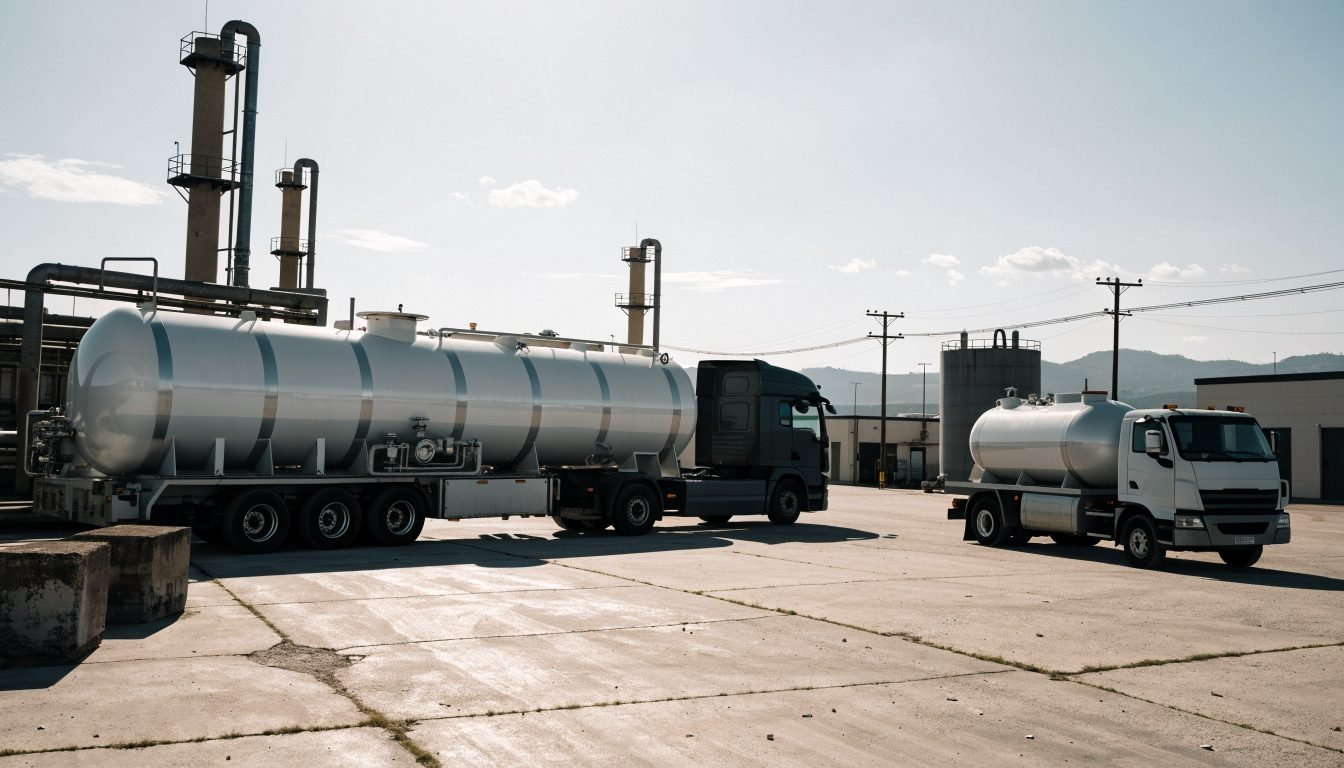
A cryogenic road tanker moves liquefied gas such as LIN, LOX, LAR, LNG, or LCO2 in a vacuum-insulated vessel. The choice between a semi-trailer and a bobtail comes down to route and delivery model: semi-trailers carry high payload over long distances to a small number of stops, while bobtails are rigid trucks built for short-haul, multi-drop delivery to many customers per shift.
Both formats are cryogenic vessels on wheels, subject to the same insulation, pressure, and transport certification requirements. The difference is how they fit your logistics, so the right answer depends on how far you haul and how many stops you make.
This guide compares payload, range, maneuverability, delivery model, and ADR considerations, then explains how KAF Cryogenics supplies both formats new or as certified second-hand units from stock.
What is a cryogenic road tanker?
A cryogenic road tanker is a vacuum-insulated vessel mounted for road transport that keeps liquefied gas cold and under controlled pressure while it moves. Like a stationary tank, it uses a double wall design with a vacuum-insulated jacket to limit heat ingress and boil-off during transit.
Two formats dominate. A semi-trailer is a tank on a trailer pulled by a separate tractor unit. A bobtail is a rigid truck with the tank mounted on the chassis, usually fitted with an onboard pump and metering for delivering measured quantities at each stop.
- Vacuum-insulated vessel built for road transport
- Semi-trailer: tank on a trailer, tractor unit separate, high payload
- Bobtail: rigid truck with tank, pump, and metering for multi-drop delivery
- Both governed by transportable cryogenic vessel standards and road transport rules
When does a semi-trailer make sense?
A semi-trailer suits long-haul movement of large volumes to a small number of destinations. It carries a high payload, which lowers the cost per unit delivered over distance, and the trailer can be dropped and swapped while the tractor stays productive.
- Long-haul routes between plants, terminals, and large customers
- High payload that reduces cost per unit over distance
- Point-to-point or few-stop delivery rather than many small drops
- Trailer can be decoupled while the tractor runs other work
- Bulk resupply of large storage tanks and satellite stations
If you are moving LNG specifically, our comparison of LNG ISO tanks versus semi-trailers covers the intermodal angle. For buying a used LNG trailer, see our used LNG semi-trailer checklist.
When does a bobtail make sense?
A bobtail suits short-haul, multi-drop delivery where a single vehicle serves many customers in one shift. Because the tank sits on a rigid chassis, the vehicle is more maneuverable in tight yards and urban sites, and the onboard pump and meter let the driver deliver and bill measured quantities at each stop.
- Short-haul routes with many customer stops per shift
- Onboard pump and metering for measured, billed deliveries
- Better maneuverability in tight or urban delivery sites
- Topping up customer station tanks and smaller vessels
- Lower payload than a semi-trailer, offset by delivery flexibility
For a related buying guide on rigid delivery trucks in the LPG world, see our LPG bobtail new versus used guide, which shares much of the fleet logic.
How do semi-trailer and bobtail compare?
Neither format is better in the abstract; each fits a different logistics pattern. Compare them against your own routes and delivery model rather than against a generic ideal.
- Payload: semi-trailer higher, bobtail lower
- Range: semi-trailer for long-haul, bobtail for short-haul
- Stops per trip: semi-trailer few, bobtail many
- Maneuverability: bobtail easier in tight and urban sites
- Delivery model: semi-trailer bulk resupply, bobtail measured multi-drop
- Utilization: semi-trailer allows drop-and-swap trailers, bobtail is a single integrated unit
Many distributors run both: semi-trailers to move bulk from source to depots and large customers, and bobtails to distribute from depots to many smaller sites.
What ADR and certification factors apply?
Cryogenic road tankers that carry dangerous goods on European roads fall under ADR, the agreement governing international road transport of dangerous goods. A road tanker must carry a valid ADR periodic inspection, and when you buy a used unit, the next inspection date directly affects when the vehicle can keep working.
- Valid ADR periodic inspection and a clear next-inspection date
- Conformity with EN 13530, the standard for transportable cryogenic vessels
- PED 2014/68/EU or ASME certification matched to the operating market
- Complete document file: certificates, inspection records, and vessel history
For how the periodic inspection works and why the date matters at purchase, see our ADR inspection guide for cryogenic trailers. Always confirm the next inspection date before committing to a used unit.
How do you buy and inspect a used cryogenic road tanker?
A used road tanker can be a sound purchase when it is verified before sale. KAF Cryogenics supplies certified second-hand units that are inspected, NDT tested, and vacuum and pressure tested, then sold with a document dossier and written warranty. When you evaluate any used tanker, work through a clear checklist.
- ADR validity and the next inspection date
- Vacuum condition, checked for frost or sweating on the outer shell and abnormal boil-off
- Inner vessel and piping non-destructive testing
- Pump, vaporizer, and metering condition on a bobtail
- Chassis, running gear, and trailer or truck structure
- Complete certification and service history file
Certification does not just reduce risk; it also supports resale value later. KAF buys used equipment and accepts trade-in against new orders, so an aging tanker can carry credit toward a replacement.
Should you buy new or certified second-hand?
KAF supplies road tankers in both formats new, built to specification, and as certified second-hand units. Lead time is often the deciding factor. New fabrication typically takes months, while a certified used tanker held in stock can ship in weeks, which helps when you need to add or replace fleet capacity quickly.
- New: built to spec in either format with the certification your market requires
- Certified second-hand: inspected, NDT tested, vacuum and pressure tested, warranty and document file, stock delivery in weeks
- Trade-in: return an aging tanker against a new order as your fleet evolves
Choose the format by route and delivery model first, then decide new or certified used by budget and timeline. KAF can advise on both once you share your routes, volumes, and destination market.
Frequently Asked Questions
What is the difference between a cryogenic semi-trailer and a bobtail?
A semi-trailer is a tank on a trailer pulled by a separate tractor, built for long-haul, high-payload delivery to few stops. A bobtail is a rigid truck with the tank, pump, and metering onboard, built for short-haul, multi-drop delivery to many customers per shift. The right choice depends on your route and delivery model.
Which is better for multi-drop delivery?
A bobtail is designed for multi-drop delivery. Its rigid chassis is more maneuverable in tight and urban sites, and the onboard pump and meter let the driver deliver and bill measured quantities at each stop. A semi-trailer suits bulk resupply to a small number of destinations instead.
Do cryogenic road tankers need ADR inspection?
Cryogenic road tankers carrying dangerous goods on European roads fall under ADR and must carry a valid periodic inspection. When buying a used unit, the next inspection date matters because it determines how long the vehicle can keep working before reinspection.
What standard applies to transportable cryogenic vessels?
EN 13530 covers transportable cryogenic vessels, while EN 13458 covers static ones. A road tanker should conform to EN 13530 and carry PED 2014/68/EU or ASME certification matched to the market where it operates.
Can I buy a certified used cryogenic road tanker?
Yes. KAF supplies certified second-hand road tankers that have passed inspection, NDT, and vacuum and pressure testing, with a document dossier and written warranty. Certified used units can ship from stock in weeks, which helps when you need fleet capacity quickly.
Should I run semi-trailers, bobtails, or both?
Many distributors run both: semi-trailers to move bulk from source to depots and large customers, and bobtails to distribute from depots to many smaller sites. Match the format to each leg of your logistics rather than standardizing on one for every route.
How quickly can I add a road tanker to my fleet?
New fabrication typically takes months. A certified used tanker held in stock can ship in weeks. If you need to add or replace capacity quickly, ask KAF whether a suitable certified used unit is available from stock.
Related reading
Choose the right cryogenic road tanker for your routes
Share your routes, volumes, and delivery model. KAF Cryogenics will recommend semi-trailer or bobtail and supply it new or certified second-hand from stock.
Discuss your fleet