
LNG ISO Tank Containers vs Semi-Trailers: Which for Your Route
LNG ISO tank containers vs semi-trailers compared for distribution: multimodal reach, payload, cost and route fit. Get a quote from KAF Cryogenics.
KAF Cryogenics6 min read
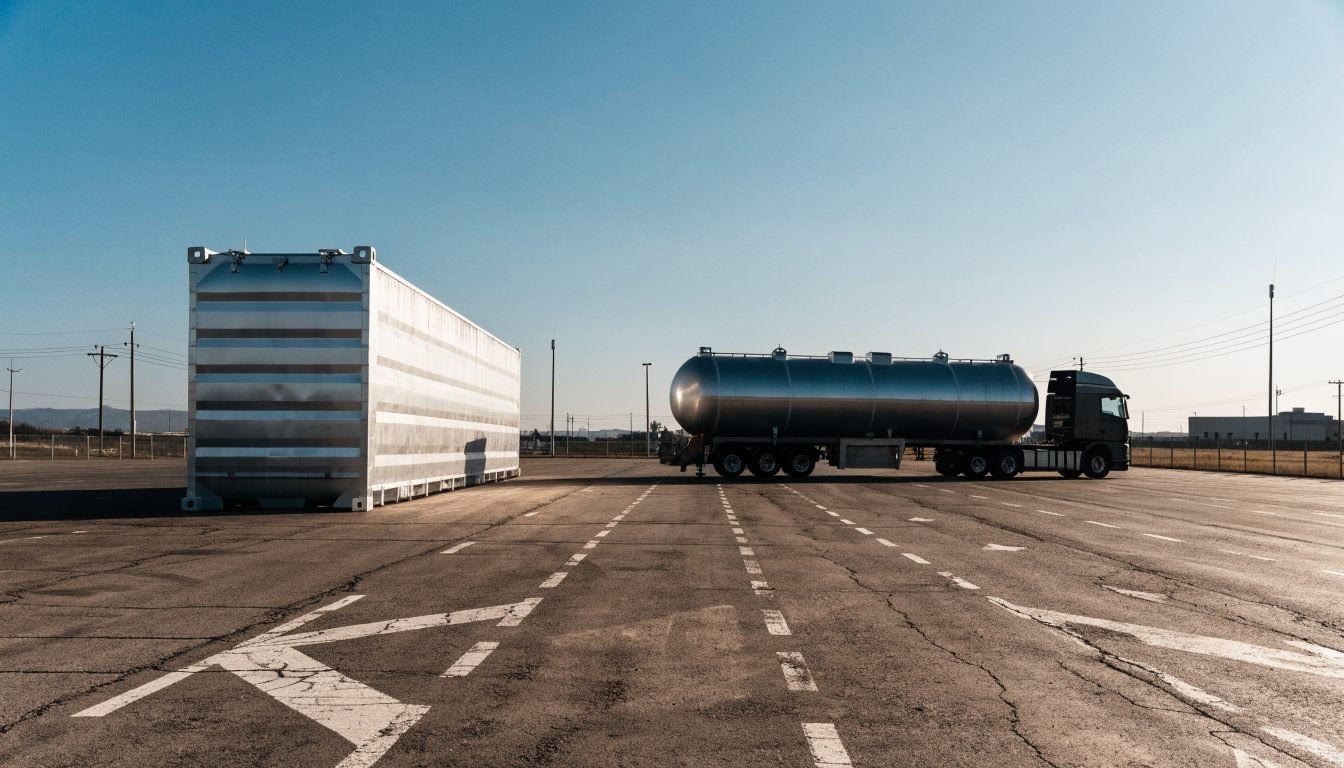
Choose an LNG ISO tank container over a semi-trailer when the route mixes sea, rail, and road or crosses borders, because it moves between all three without transferring the liquid. Choose an LNG semi-trailer for road only transport, where you want higher payload flexibility and simple point to point delivery.
Both carry LNG at cryogenic temperature in a vacuum insulated vessel, and both need the same certification discipline. The difference is how they fit a logistics chain. This guide compares the two on the factors that actually change the decision, so a distributor or logistics manager can match the equipment to the network rather than to a habit.
KAF Cryogenics supplies both LNG ISO tank containers and semi-trailers, new to specification or as certified second hand units from stock, so the choice can be made on route economics rather than on what one supplier happens to hold.
What is the difference between an LNG ISO tank and a semi-trailer?
An LNG ISO tank container is a cryogenic vessel built inside a standard ISO frame, so it can be lifted and locked onto a ship, a rail wagon, or a road chassis. For cryogenic service the relevant type is the T75 ISO tank. A semi-trailer carries the cryogenic vessel permanently mounted on its own road going chassis and travels by road only.
In short, the ISO tank is a container that any suitable vehicle or vessel can carry, while the semi-trailer is a complete road unit. That single structural difference drives most of the trade offs below, from intermodal reach to payload and handling.
When does an LNG ISO tank container win?
The ISO tank earns its place when the journey is not purely road. Because it moves between sea, rail, and road without decanting the LNG, it suits long distance, cross border, and import linked supply where the liquid arrives by ship or rail and continues inland.
- Multimodal routes that combine sea, rail, and road on one leg
- Cross border and export flows where standard container handling simplifies logistics
- Supply chains where the tank waits as buffer storage at a site before return
- Networks that already run container handling equipment and depots
When does an LNG semi-trailer win?
The semi-trailer is the straightforward choice for road distribution within a region or country. As a single road unit it is quick to hitch and dispatch, and it usually offers strong payload for direct deliveries between a source and customers.
- Road only distribution inside a region or between neighbouring countries
- Point to point deliveries where the same driver and tractor run the route
- Operations that value payload and quick turnaround over intermodal reach
- Fleets already set up for tractor and trailer maintenance
How do payload and capacity compare?
Payload depends on the specific unit, its pressure rating, and the road weight limits in the countries it runs through, so treat exact figures as a specification question rather than a rule. As a general pattern, a road semi-trailer is engineered around road weight limits and can offer strong usable payload for direct delivery, while an ISO tank has to fit standard container dimensions and framing, which shapes its capacity.
For a real comparison, put the two candidate units side by side on delivered volume per trip for your actual route, including any weight limits and handling steps. KAF can confirm the payload and pressure rating of each unit so the comparison uses real numbers rather than assumptions.
What about intermodal handling and turnaround?
An ISO tank is designed to be lifted and stacked, which makes it easy to hand off between transport modes and to leave on site as temporary storage. That flexibility needs container handling equipment and depot space at each transfer point.
A semi-trailer does not need lifting equipment. It is hitched, driven, and unhitched, which keeps turnaround simple for pure road work. If your network has no rail or sea leg and no container yard, the trailer removes handling steps that an ISO tank would add.
How do cost and lead time compare?
There is no single list price for either unit. Cost depends on capacity, pressure class, material, certification, and options, so the accurate way to compare is a quote against your specification. New fabrication of either unit commonly takes months.
Certified second hand ISO tanks and semi-trailers that KAF holds in stock can ship in weeks. When a route needs to open on a fixed date, that lead time difference can matter more than the unit price. Each certified used unit is inspected, NDT tested, vacuum and pressure tested, and sold with a document dossier and written warranty.
What certification and inspection should each carry?
Transportable cryogenic vessels follow EN 13530, and road units for dangerous goods transport must hold a valid ADR periodic inspection. When buying used, check the next ADR inspection date, because a unit close to its inspection deadline carries a hidden cost and downtime risk.
- EN 13530 for transportable cryogenic vessels
- Valid ADR periodic inspection with a clear next inspection date
- Vacuum condition and boil off performance verified
- Inner vessel and piping non destructive testing, or NDT
- A complete certification and service document file
Which should you choose for your route?
Decide by mapping the route first. If any leg is sea or rail, or the flow crosses borders through ports, the ISO tank container usually fits better. If the whole route is road inside a region, the semi-trailer is simpler and often carries more per trip.
Then confirm the numbers on the specific units: payload, pressure rating, certification, and lead time. Some networks run both, using ISO tanks for the long intermodal leg and trailers for last leg delivery. KAF can quote either or both and advise on the mix.
Frequently Asked Questions
Is an LNG ISO tank or a semi-trailer better?
Neither is better in general. An ISO tank container suits multimodal and cross border routes that combine sea, rail, and road, while a semi-trailer suits road only distribution with quick turnaround. The route and volume decide.
What ISO tank type is used for LNG?
Cryogenic service, including LNG, uses the T75 ISO tank container. It is a vacuum insulated cryogenic vessel built inside a standard ISO frame so it can move by sea, rail, and road without transferring the liquid.
Does an ISO tank carry less than a semi-trailer?
Payload depends on the specific unit, its pressure rating, and the road weight limits on the route, so compare the actual candidate units rather than assume. A semi-trailer is built around road weight limits, while an ISO tank must fit standard container dimensions.
What certification does an LNG road unit need?
Transportable cryogenic vessels follow EN 13530, and road units carrying dangerous goods need a valid ADR periodic inspection. When buying used, always confirm the next ADR inspection date and ask for the full document file.
Can I buy LNG transport equipment second hand?
Yes. KAF supplies certified second hand ISO tanks and semi-trailers from stock, which can ship in weeks against months for new fabrication. Each unit is inspected, NDT tested, vacuum and pressure tested, and sold with a document dossier and written warranty.
Can a network use both ISO tanks and trailers?
Yes, and many do. A common pattern uses ISO tank containers for the long intermodal leg, then semi-trailers for last leg road delivery. KAF can supply either or both and help plan the mix.
Related reading
Choosing between LNG ISO tanks and trailers?
Send KAF Cryogenics your route and volume, and we will compare an ISO tank container and a semi-trailer on payload, certification, and lead time, with new and certified second hand options.
Request a quote