
MicroBulk vs Bulk Storage: Which Fits Your Gas Usage
Compare microbulk vs bulk cryogenic storage by gas usage, cost, and site fit. See where each pays off and how to size supply. Get an accurate quote from KAF.
KAF Cryogenics6 min read
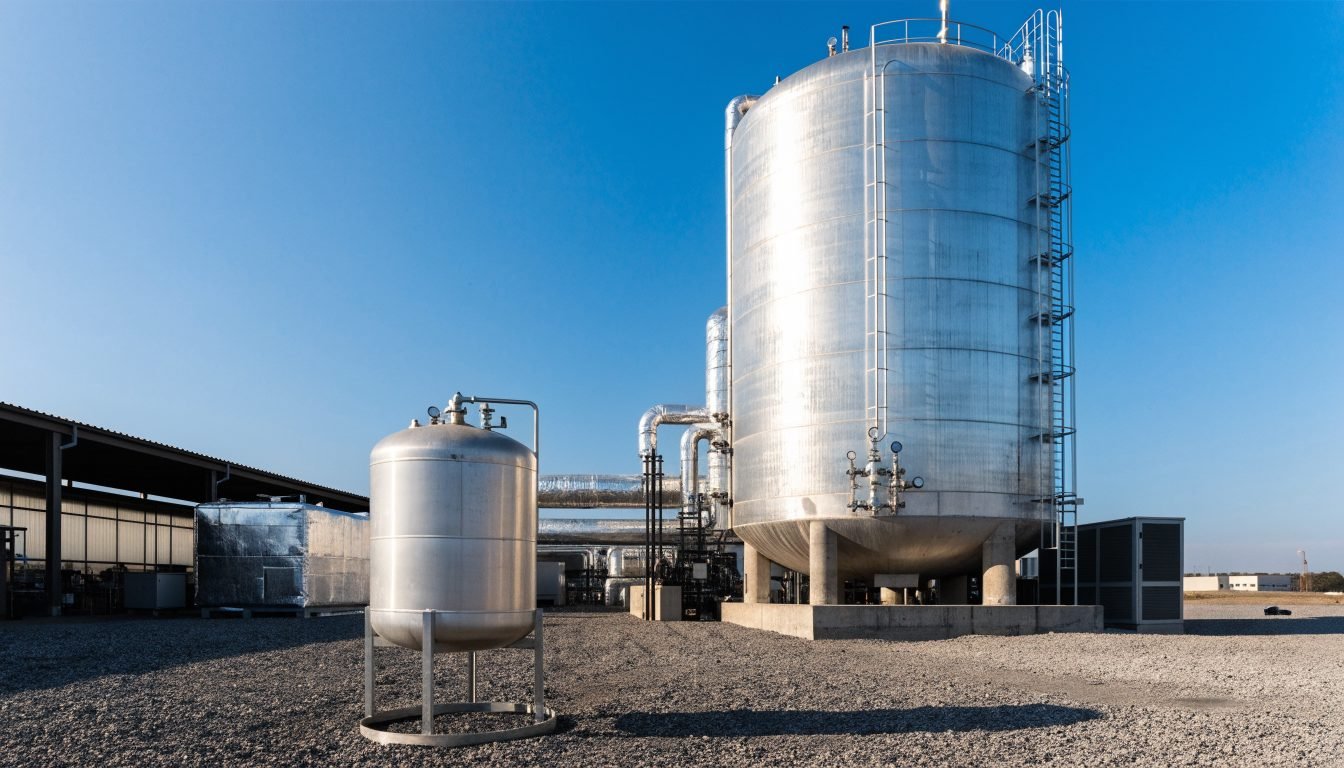
In the microbulk vs bulk storage decision, microbulk suits sites using more gas than cylinders can serve economically but not enough to justify a large bulk tank, roughly a few hundred to a few thousand cubic meters per month. Bulk storage fits higher, steadier demand where deliveries by cryogenic tanker are frequent.
This guide compares the two supply models across consumption, delivery logistics, footprint, telemetry, and cost, so you can match the right system to your actual gas usage.
The figures here are general ranges. KAF sizes both microbulk and bulk supply to your measured demand and gives an accurate quote based on the specification you need.
What is the difference between microbulk and bulk cryogenic storage?
Both microbulk and bulk systems store liquefied gas such as liquid nitrogen, oxygen, or argon in a vacuum-insulated tank and deliver it as gas or liquid to a process. The difference is scale and how the tank is refilled.
A microbulk tank is a smaller vacuum-insulated vessel installed on site and refilled from a small delivery vehicle that tops up the tank in place. A bulk tank is larger, refilled by a full cryogenic road tanker, and built for higher throughput.
- Microbulk: compact on-site tank, refilled by a top-up delivery vehicle, sits between high-usage cylinder packs and small bulk tanks.
- Bulk: larger fixed tank refilled by a semi-trailer or bobtail, built for steady mid to high volume demand.
- Both use the same vacuum-insulated construction, relief devices, and pressure-building circuit.
When does microbulk make more sense than cylinders?
Microbulk usually earns its place when cylinder handling becomes a recurring cost and safety burden. If your team swaps and moves many cylinders each week, a microbulk tank removes most of that labor while keeping a small footprint.
- You are changing cylinders often and paying repeated rental and handling costs.
- Manual cylinder movement is creating a safety or ergonomics concern.
- Gas purity matters and you want to avoid the pressure and contamination variation of frequent cylinder changeovers.
- You want telemetry so refills are scheduled automatically rather than reacting to an empty cylinder.
Microbulk keeps a continuous supply without the constant changeover, and remote level monitoring lets the supplier plan a top-up before you run low.
When is bulk storage the better fit?
Bulk storage fits sites with higher and more predictable consumption. When your monthly volume grows past what a microbulk tank can hold between practical delivery intervals, a larger bulk tank lowers your delivered cost per unit of gas and reduces delivery frequency.
- Consumption is steady and high enough to justify frequent tanker deliveries.
- You need a larger reserve to cover peak demand or delivery route gaps.
- The site has space for a horizontal or vertical bulk tank and its foundation.
- You want the lowest delivered cost per cubic meter at volume.
For guidance on capacity, autonomy, and pressure class when specifying a bulk tank, see our worked approach to tank sizing.
How does consumption decide the break-even point?
There is no single universal threshold, because the break-even depends on your gas type, delivery distance, and how much cylinder handling costs you today. The method, though, is the same for every site.
Work from measured demand
- Record average daily and monthly consumption over a representative period, not a single busy week.
- Add the fully loaded cost of your current supply, including cylinder rental, handling labor, and lost production during changeovers.
- Estimate delivery frequency for a microbulk tank versus a bulk tank at your volume.
- Compare delivered cost per cubic meter for each option at that frequency.
As a general pattern, cylinders serve low intermittent use, microbulk serves the middle band, and bulk serves high steady demand. The exact crossover is a calculation on your own numbers, and KAF can run it with you.
What about footprint, siting, and installation?
Microbulk wins where space is tight. Its compact vessel fits sites that cannot host a full bulk installation, and it needs a smaller foundation and clearance zone.
- Microbulk: small pad, limited clearance, suits constrained or shared sites.
- Bulk: larger foundation, defined safety distances, and a delivery approach for a full tanker.
- Both require code-compliant siting, relief venting, and access for periodic vacuum and relief-device checks.
If your site is space-constrained but volume is rising, a vertical tank can bridge the gap. Compare the layout trade-offs before you commit the pad.
How do telemetry and delivery logistics differ?
Telemetry changes the ordering model. With remote level monitoring, the supplier sees your tank level and schedules a refill before it runs low, which suits both microbulk and bulk but is often the main reason sites move off cylinders.
- Microbulk top-ups are quick and frequent, filling the on-site tank in place.
- Bulk deliveries are less frequent but move a large volume per visit.
- Telemetry reduces emergency deliveries and run-out risk for either model.
How do maintenance and reliability compare?
Both systems use the same vacuum-insulated construction, so the maintenance principles are shared. Neither is maintenance-free, and both benefit from a simple routine that keeps insulation performance and safety devices in good order.
- Relief-device checks on both microbulk and bulk tanks to keep pressure protection working.
- A vacuum reading every 6 to 12 months to catch any slow decline in insulation before boil-off rises.
- External inspection scaled to tank size, with more access planning for a larger bulk tank.
- Watching for frost or sweating on the outer shell, which signals vacuum loss on either system.
Because the failure modes are the same, the choice between microbulk and bulk should come down to volume, footprint, and delivered cost rather than a difference in reliability.
What does it cost, and how is a quote built?
There is no fixed list price for either system. The tank cost depends on capacity, pressure class, material, insulation, and options, while the delivered gas cost depends on your volume and delivery distance. A larger bulk tank usually lowers cost per cubic meter at high volume, while microbulk lowers handling cost at moderate volume. The right comparison is delivered cost per cubic meter at your real consumption, not the sticker price of the tank alone.
KAF supplies microbulk tanks and bulk storage tanks both new, built to your specification, and as certified second-hand units that have passed inspection, non-destructive testing, and vacuum and pressure testing, sold with a document dossier and written warranty. Certified used units can ship from stock in weeks, while new fabrication typically takes months. To get an accurate figure, share your measured demand and site details and KAF will size the system and quote it.
Frequently Asked Questions
Is microbulk cheaper than bulk?
Not automatically. Microbulk usually lowers cost at moderate volume by cutting cylinder handling and rental, while a larger bulk tank lowers cost per cubic meter at high steady volume. The better value depends on your measured consumption and delivery distance, so the two should be compared on your own numbers.
What gases can microbulk and bulk tanks hold?
Both store cryogenic liquids such as liquid nitrogen, oxygen, and argon, and the same construction principles apply to LNG and LCO2 tanks. KAF supplies vacuum-insulated storage for these services in both microbulk and bulk sizes.
How much gas usage justifies moving from cylinders to microbulk?
When repeated cylinder changeovers, rental, and handling labor start to add up, microbulk often becomes worthwhile. There is no fixed cylinder count that fits every site, so the decision comes from comparing your fully loaded cylinder cost against a microbulk supply at your delivery frequency.
Does a bulk tank need more maintenance than microbulk?
The maintenance principles are the same for both, including relief-device checks and a vacuum reading every 6 to 12 months. A bulk tank is larger, so external inspection and access planning are scaled up, but neither system is maintenance-free.
Can I start with microbulk and move to bulk later?
Yes. Many sites begin with microbulk and move to bulk as demand grows past the practical microbulk range. KAF can also buy used equipment and accept trade-in on a new order, which helps when you upgrade from microbulk to a larger bulk tank.
How fast can KAF deliver a microbulk or bulk tank?
Certified second-hand units can ship from stock in weeks, while new units built to specification typically take months of fabrication. If speed matters for your project, ask KAF what is currently in stock for your capacity and pressure class.
Related reading
Not sure whether microbulk or bulk fits your site?
Share your measured gas usage and site details, and KAF will size the right system and give you an accurate quote across new and certified second-hand options.
Request a sizing and quote