
Vertical vs Horizontal Cryogenic Tank: Which to Choose
Vertical vs horizontal cryogenic tank compared on footprint, capacity, installation, cost and use cases. A practical guide to choosing the right orientation.
KAF Cryogenics7 min read
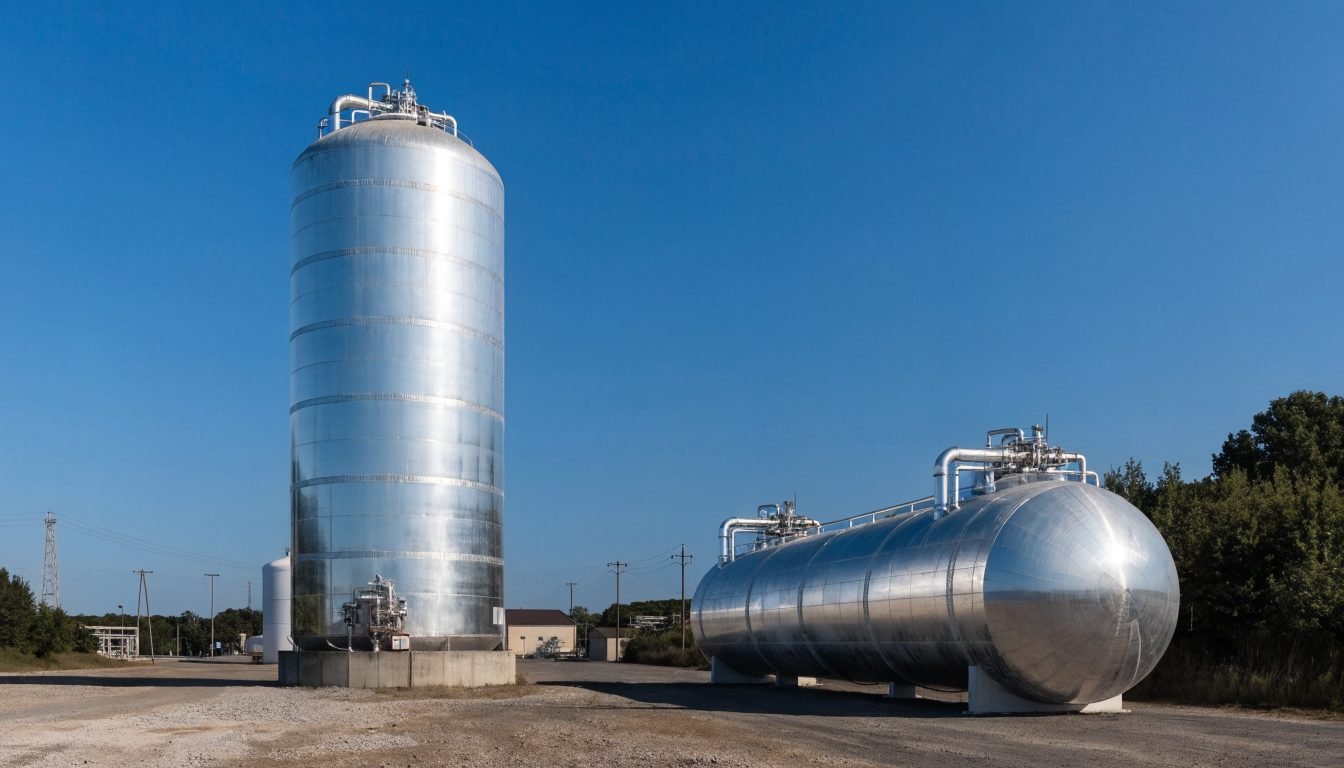
Choosing between a vertical vs horizontal cryogenic tank comes down to footprint and capacity. Vertical tanks stand upright and use a small ground area, which suits space constrained sites. Horizontal tanks lie on saddle supports and reach very large volumes more readily, which suits high volume storage where ground space is available.
Both hold the same liquefied gases, use the same vacuum insulation, and meet the same codes. The orientation does not change the safety or the certification. What it changes is how much ground the tank occupies, how large a volume is practical, how it is installed, and where it fits best on your site.
This guide compares the two on footprint, capacity range, installation, cost and typical use cases, so you can match orientation to your plot and your demand without absolute claims about one being universally better.
What is the difference between a vertical and horizontal cryogenic tank?
A vertical cryogenic tank stands upright on a base, with the inner vessel oriented along a vertical axis. A horizontal cryogenic tank lies on its side, supported by two saddle supports. Both are double walled, vacuum insulated vessels holding liquefied gas such as LIN, LOX, LAR, LNG, LCO2 or LPG. The working parts, valves, relief devices, pressure building circuit and gauges, are the same in principle.
The orientation is a physical and layout choice, not a difference in what the tank can store or how it is certified. Both are built to codes such as PED 2014/68/EU or ASME and follow the same low temperature material requirements.
Which tank uses less space?
A vertical tank uses less ground area for a given volume because it builds upward rather than outward. On a crowded site, inside a compound with limited plot, or where a footprint is restricted by neighbouring equipment, the vertical form is often the only one that fits. It trades height for ground area.
- Vertical: small footprint, greater height, suited to tight or built up sites
- Horizontal: larger footprint, lower profile, needs open ground space
- Height restrictions, such as overhead lines or roofing, can rule out a tall vertical unit
- Ground area restrictions often favour the vertical orientation
Before deciding, check both constraints on your site. A location can be tight on ground area, favouring vertical, or limited in height, favouring horizontal. The winning orientation is the one that fits the constraint you actually have.
Which orientation reaches larger capacities?
Horizontal tanks are generally used where very large volumes are required. As volume grows, a vertical tank becomes tall, and height brings foundation, stability and transport considerations. A horizontal vessel spreads that volume along its length on saddle supports, which makes large capacities more practical to build, transport and install.
Vertical tanks cover small to mid volumes comfortably and are common at customer stations and space limited plants. When a site needs a large bulk reserve and has the ground for it, horizontal is the more natural choice. The capacity you sized the tank for often points to the orientation on its own.
How does installation differ between the two?
Both need a proper foundation, but the load pattern differs. A vertical tank concentrates its weight on a smaller base and must be secured against overturning, especially where wind or seismic loads apply. A horizontal tank distributes its weight across two saddle supports over a longer foundation. Access for filling connections, relief valves and gauges is arranged differently for each.
- Vertical: compact foundation, attention to stability and anchoring
- Horizontal: longer foundation across saddle supports, lower centre of gravity
- Delivery access and piping layout differ with orientation
- Site civil works should be planned around the chosen form early
Neither is inherently harder to install. The right preparation simply differs, and the civil design should be settled once the orientation and volume are chosen.
Is there a cost difference between vertical and horizontal tanks?
There is no single fixed price for either form, because cost depends on capacity, pressure class, material, certification and options rather than orientation alone. At a given volume the two can be close, while at very large volumes the practicalities of fabrication, transport and foundations shape the total. The most reliable way to compare is a quote for each option at your specification.
Because price follows the full specification, KAF Cryogenics gives an accurate quote against your volume, pressure class and certification rather than a list price. For the factors that move the number, see our guide on what drives cryogenic tank cost, and on how to size a cryogenic storage tank so you compare like for like.
What are the typical use cases for each?
Orientation tends to follow the site and the volume. A few common patterns help place your own case.
- Vertical: space constrained plants, customer stations, urban or built up sites, small to mid volumes
- Horizontal: large bulk storage, sites with open ground, high volume production and distribution
- Vertical where ground area is the binding constraint
- Horizontal where height is limited or a very large reserve is needed
These are tendencies, not rules. A specific project can override them, for example a large volume on a tight plot may still call for a vertical solution, or a modest volume under a height restriction may go horizontal.
Does orientation affect boil-off or holding time?
Boil-off and holding time are driven by vacuum quality, insulation, fill level and ambient temperature, not primarily by orientation. Both vertical and horizontal tanks use the same vacuum insulation and show static evaporation in the same broad range of roughly 0.2 to 0.6 percent per day for modern stationary tanks, depending on size and insulation. Choose orientation for space and capacity, and rely on insulation and vacuum quality for holding performance.
For how those factors set inventory loss over time, see our guide on holding time and normal evaporation rate.
How does KAF help you choose and source the right tank?
KAF Cryogenics helps buyers match orientation to their site and demand, then supplies the tank through two channels. New tanks are built to specification in either orientation. Certified second-hand tanks are inspected, non-destructively tested, and vacuum and pressure tested, then sold with a document dossier and written warranty.
Because certified used units can ship from stock in weeks while new fabrication typically takes months, the available stock can influence the practical choice on a tight timeline. KAF also buys used equipment and accepts trade-in on new orders, so an orientation change during an upgrade is straightforward to arrange.
Frequently Asked Questions
Is a vertical or horizontal cryogenic tank better?
Neither is universally better. A vertical tank uses less ground area and suits space constrained sites, while a horizontal tank reaches very large volumes more readily and suits high volume storage with open ground. The right choice depends on your site constraints and the capacity you need, not on a general ranking.
Which cryogenic tank uses less space?
A vertical tank uses less ground area for a given volume because it builds upward instead of outward. That makes it the common choice on crowded, urban or built up sites. A horizontal tank has a larger footprint and a lower profile, so it needs open ground but works under height restrictions.
Which orientation is used for the largest volumes?
Horizontal tanks are generally used for very large volumes. Spreading the volume along the length on saddle supports makes large capacities more practical to build, transport and install than a very tall vertical vessel. Vertical tanks cover small to mid volumes comfortably and are common at customer stations.
Does orientation change a cryogenic tank's boil-off rate?
Not primarily. Boil-off and holding time are driven by vacuum quality, insulation, fill level and ambient temperature. Both orientations use the same vacuum insulation and fall in the same broad range of roughly 0.2 to 0.6 percent per day for modern stationary tanks. Choose orientation for space and capacity, not for boil-off.
Is a horizontal tank cheaper than a vertical one?
There is no fixed answer, because cost depends on capacity, pressure class, material, certification and options rather than orientation alone. At a given volume the two can be close. The reliable way to compare is an accurate quote for each option at your full specification, which KAF provides.
Do both orientations meet the same certifications?
Yes. Orientation does not change certification. Both vertical and horizontal cryogenic tanks are built to codes such as PED 2014/68/EU or ASME and meet the same low temperature material requirements. The orientation is a layout and capacity decision, not a safety or code difference.
Related reading
Vertical or horizontal for your site?
Send us your available space, required volume and gas. KAF Cryogenics will recommend the orientation that fits, then quote new or certified used tanks available from stock.
Get a tank recommendation