
Cryogenic Tank Boil-Off Rate Explained (Normal Values)
What is a normal cryogenic tank boil-off rate? Learn typical values, what drives boil-off, and how to tell normal from a problem.
KAF Cryogenics6 min read
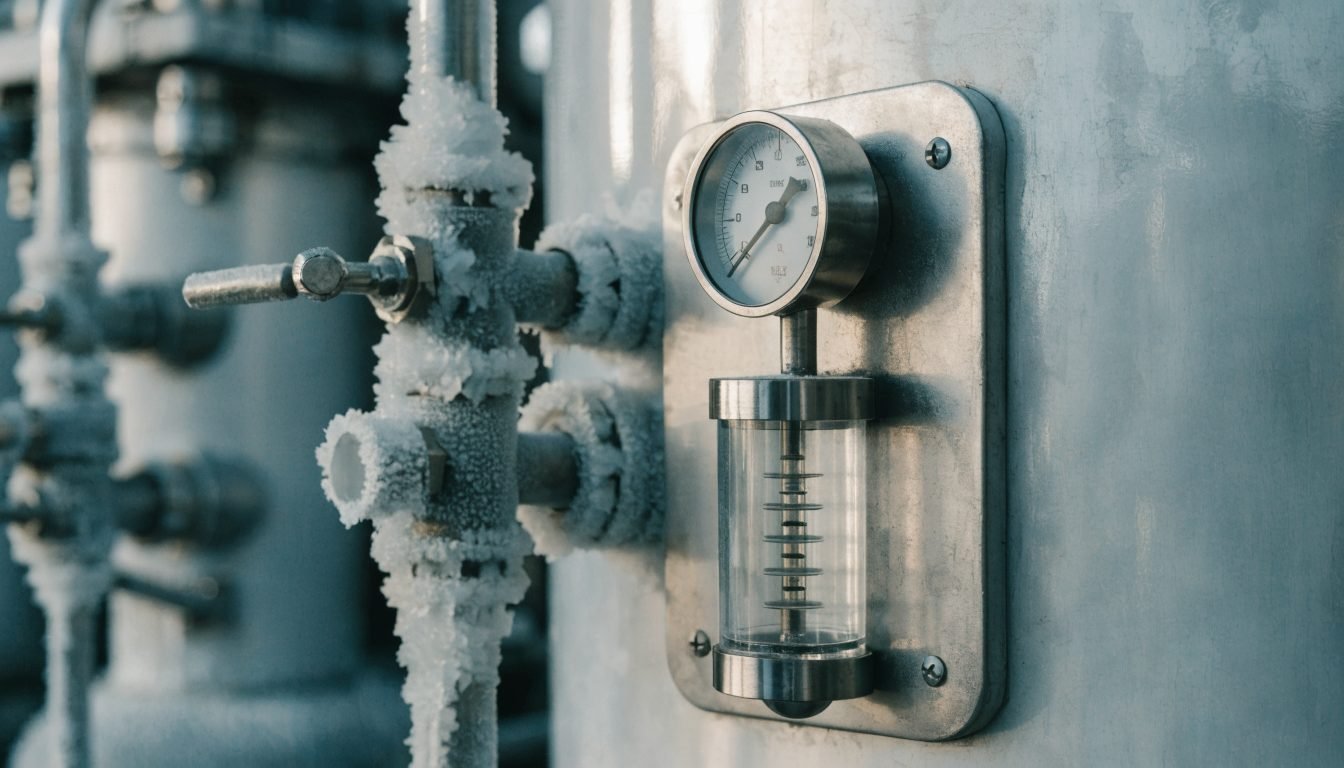
The boil-off rate of a cryogenic tank is the share of stored liquid that evaporates each day as heat slowly enters the vessel. For modern stationary cryogenic tanks, the normal static boil-off rate is roughly 0.2 to 0.6 percent of contents per day, depending on tank size and insulation quality.
This guide defines boil-off, explains what drives it, gives the normal range you can cite, and shows how to tell a healthy tank from one with a developing fault. It is written for operators and buyers who want to judge a tank by its numbers.
The figures here are general industry values. KAF verifies vacuum and pressure on every certified second-hand unit, so a tank you buy arrives with its insulation performance checked rather than assumed.
What is boil-off in a cryogenic tank?
Boil-off, also called boil-off gas or BOG, is the vapor produced when a small amount of the stored cryogenic liquid evaporates. It happens because no insulation is perfect, so a little heat always reaches the liquid, and that heat turns some of it to gas.
The evaporated gas collects in the top of the tank and gradually raises the pressure. This is normal and expected behavior; the tank is designed to manage it. Boil-off becomes a concern only when the rate climbs above the tank's normal range, which points to a loss of insulating performance.
What is a normal boil-off rate?
For modern stationary cryogenic tanks, the normal static boil-off rate is roughly 0.2 to 0.6 percent of contents per day, depending on tank size and insulation quality. Larger tanks tend toward the lower end of that range because they have less surface area relative to their volume.
- Larger tanks: lower percentage loss per day, toward the 0.2 percent end.
- Smaller tanks: higher percentage loss per day, toward the 0.6 percent end.
- Static rate assumes the tank is holding liquid without active withdrawal.
This is the number to keep in mind when judging a tank. If a unit is losing far more than its expected daily rate, the insulation or vacuum is likely degrading.
What drives the boil-off rate?
Boil-off is driven by how much heat reaches the liquid. Several factors determine that, and understanding them helps you interpret a rate rather than just read it.
- Vacuum quality: the vacuum between the shells is the main heat barrier; a weakening vacuum raises boil-off.
- Insulation: multilayer insulation in the jacket reduces radiant heat transfer.
- Tank size: larger tanks have less surface area per unit of volume, so they lose a smaller percentage per day.
- Ambient temperature: hotter surroundings drive more heat into the tank.
- Fill level: a fuller tank changes the ratio of liquid to vapor and affects observed loss.
Of these, vacuum quality is the one that changes over a tank's life and is worth monitoring, because a slow vacuum decline shows up first as rising boil-off.
How do you tell normal boil-off from a problem?
The key is comparison against the tank's own baseline and the normal range. A tank that has always lost a steady amount per day and continues to do so is healthy; a tank whose daily loss suddenly increases is not.
- Within roughly 0.2 to 0.6 percent per day and stable: normal for a modern stationary tank.
- Suddenly losing much more than its established baseline: investigate the vacuum and insulation.
- Rising boil-off with frost or sweating on the outer shell: a strong sign of vacuum loss.
- Faster pressure build alongside higher loss: consistent with degrading insulation.
Frost or sweating on the outer shell, rising boil-off, and faster pressure build are the verified symptoms of vacuum loss, and they usually appear together.
How does boil-off relate to holding time?
Holding time is how long a tank can sit closed before pressure rises enough to vent. Boil-off and holding time are two views of the same physics: the slower the boil-off, the longer the tank holds before it needs to vent or be used.
- Lower boil-off means longer holding time and less product lost to venting.
- A tank sitting idle relies on good insulation to avoid venting losses.
- Higher fill levels and higher pressure classes both affect how long a tank holds.
For operations where tanks sometimes sit idle between uses, a low, stable boil-off rate directly protects both product and cost.
How do you measure and track boil-off?
You track boil-off by monitoring the tank level and pressure over time under known conditions. A simple log turns a vague sense that a tank feels off into a clear trend you can act on.
- Record daily liquid level under static, no-withdrawal conditions where possible.
- Note pressure behavior and any frost or condensation on the outer shell.
- Read vacuum every 6 to 12 months so a slow decline is caught before it costs product.
- Compare the trend against the normal 0.2 to 0.6 percent per day range.
Tracking these together makes it easy to separate a normal tank from one where boil-off is drifting upward due to vacuum loss.
How does KAF help with boil-off performance?
Boil-off performance depends on vacuum and insulation, which is exactly what KAF verifies on its equipment. Every certified second-hand unit is inspected, non-destructive tested, and vacuum and pressure tested before sale, and ships with a document dossier and written warranty, so its insulation performance is checked rather than assumed.
KAF supplies storage tanks new, built to specification, and as certified second-hand units, with certified used stock able to ship in weeks while new fabrication typically takes months. If your tank is losing more than its normal rate, or you want a unit with verified vacuum, KAF can advise on testing, re-evacuation, and supply.
Frequently Asked Questions
What is a normal boil-off rate for a cryogenic tank?
For modern stationary cryogenic tanks, the normal static boil-off rate is roughly 0.2 to 0.6 percent of contents per day, depending on tank size and insulation quality. Larger tanks sit toward the lower end because they have less surface area relative to their volume.
Why do smaller tanks have higher boil-off percentages?
Smaller tanks have more surface area relative to their volume, so proportionally more heat reaches the liquid each day. That is why a small tank can sit near 0.6 percent per day while a large one sits closer to 0.2 percent, even with similar insulation.
Is boil-off gas wasted?
Some boil-off is unavoidable because no insulation is perfect, and a well insulated tank keeps it low. Excess boil-off, above the tank's normal range, represents lost product and usually signals a vacuum or insulation problem worth investigating.
What does rising boil-off mean?
A boil-off rate that climbs above the tank's established baseline usually means the vacuum or insulation is degrading. It often appears together with frost or sweating on the outer shell and faster pressure build, which are the verified symptoms of vacuum loss.
How is boil-off connected to pressure rise?
As liquid evaporates, the resulting gas collects at the top of the tank and raises the pressure. Normal boil-off produces gradual, predictable pressure cycling. A sharp, sustained pressure climb alongside higher loss is consistent with degrading insulation.
How can I keep boil-off low?
Maintain the vacuum and insulation that limit heat ingress. Read vacuum every 6 to 12 months, watch for frost on the outer shell, and act on any sustained rise in daily loss. Buying a tank with verified vacuum, as KAF supplies, starts you from a known-good baseline.
Related reading
Losing more liquid than you should?
Tell KAF your tank's daily loss and pressure behavior. We can advise on vacuum testing and re-evacuation, or supply a certified unit with verified insulation performance.
Get advice from KAF