
Holding Time and NER: How Long Cryogenic Liquid Lasts
What NER and holding time mean, what affects them, and typical static evaporation of roughly 0.2 to 0.6 percent per day for modern stationary cryogenic tanks.
KAF Cryogenics7 min read
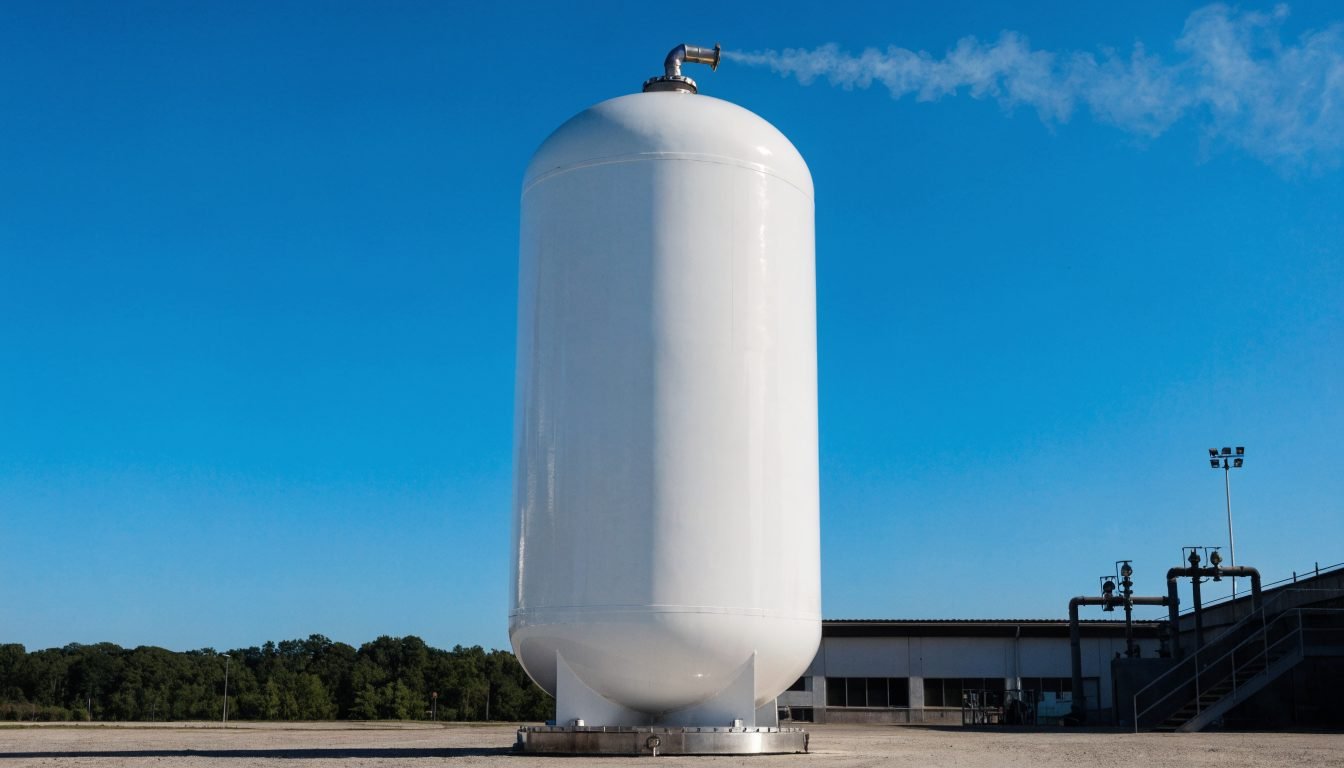
Holding time is how long a cryogenic tank can store liquid before pressure or loss forces venting, and NER, the normal evaporation rate, is the daily percentage of liquid that boils off from heat ingress. For modern stationary cryogenic tanks the static evaporation rate is roughly 0.2 to 0.6 percent per day, depending on size and insulation quality.
These two figures tell a buyer how much stored product a tank keeps over time and how quickly it will approach a vent condition if it sits without use. They are set by vacuum quality, insulation, fill level and ambient temperature, and they are among the clearest indicators of a healthy cryogenic vessel.
This guide defines holding time and NER, explains what drives them, gives the typical figures you can plan around, and shows how to tell a normal loss from a developing fault.
What is the normal evaporation rate (NER) of a cryogenic tank?
Normal evaporation rate, often written NER and sometimes called the static boil-off rate, is the percentage of a tank's contents that evaporates each day while the tank sits closed and undrawn. It exists because no insulation is perfect, so a small, steady amount of heat reaches the liquid and turns a fraction of it to gas. NER is measured with the tank static, meaning no product is being withdrawn.
For modern stationary cryogenic tanks, static evaporation is roughly 0.2 to 0.6 percent per day depending on size and insulation. A larger, well insulated tank sits toward the low end, and a smaller tank toward the higher end, because a small tank has more surface area relative to the volume it holds.
What is holding time and how does it differ from NER?
Holding time is the period a tank can hold liquid without any draw before rising pressure reaches the relief valve set point and the tank begins to vent. NER is a rate, a percentage per day. Holding time is a duration, the number of days before venting starts. They are linked, because the same heat ingress that drives NER also builds the pressure that ends the holding time.
- NER is the daily percentage of liquid lost to evaporation while static
- Holding time is how many days pass before pressure forces venting
- A low NER and a large MAWP margin both extend holding time
- Both assume no product is being drawn from the tank
Holding time depends not only on the evaporation rate but also on how much pressure headroom the tank has below its maximum allowable working pressure. A tank with more margin can absorb boil-off as pressure for longer before it has to vent.
What affects the evaporation rate and holding time?
Four factors dominate. Together they explain why two tanks of the same nominal size can hold liquid differently.
- Vacuum quality, the condition of the vacuum in the insulating jacket, which is the single biggest factor
- Insulation, the type and integrity of the material between inner and outer vessels
- Fill level, since a fuller tank generally shows a lower percentage loss than a nearly empty one
- Ambient temperature, because a warmer environment drives more heat into the liquid
Of these, vacuum quality matters most. The vacuum in the jacket is what suppresses heat transfer. As it degrades, more heat reaches the liquid, NER climbs and holding time shrinks. This is why vacuum should be checked periodically and why a rising boil-off is treated as a warning sign.
What is a normal boil-off figure I can plan around?
For planning, use the range of roughly 0.2 to 0.6 percent per day for modern stationary cryogenic tanks. A large, well insulated stationary tank in a moderate climate tends to sit near the lower end. A smaller stationary tank, or one in a hot climate, tends toward the upper end. Transport tanks and very small vessels can differ, so treat this as the stationary storage range.
This figure lets you estimate inventory loss over a delivery cycle. If a tank is refilled frequently, a fraction of a percent per day is minor. If it sits for many days between draws, the same rate adds up to a meaningful share of the contents, which is why low use sites should account for it in sizing.
How does fill level change the percentage loss?
Evaporation is driven by heat reaching the liquid, and the heat load is fairly steady regardless of how full the tank is. When the tank is full, that steady loss is a small percentage of a large quantity. When the tank is nearly empty, the same loss is a larger percentage of a small quantity. So the percentage NER tends to look higher as the tank empties, even though the absolute amount boiling off has not changed much.
This is worth remembering when comparing readings. A boil-off percentage taken on a nearly empty tank is not directly comparable to one taken on a full tank.
How do I tell a normal evaporation rate from a problem?
A stable boil-off within the expected range, with the tank cold to the touch on the outer shell and no visible frost, is normal. A developing fault usually announces itself through a change over time rather than a single reading. The clearest signals are a rising boil-off, a holding time that keeps shrinking, and physical symptoms on the outer vessel.
- Frost or sweating on the outer shell, which points to lost vacuum in the jacket
- A boil-off rate that climbs above the normal range over successive checks
- Pressure building faster than it used to and venting more often
- Holding time falling short of what the tank previously achieved
These are the same symptoms that indicate vacuum loss. If you see them, the vacuum in the insulating jacket is the first thing to check. Our guide on vacuum loss in a cryogenic tank explains how to detect and confirm it.
How often should vacuum be checked to protect holding time?
Because vacuum quality is the largest single driver of NER and holding time, it should be monitored on a schedule. A vacuum reading every 6 to 12 months is a reasonable interval for a stationary tank in normal service. Catching a slow vacuum decline early prevents the steady rise in boil-off and loss of holding time that follows a neglected jacket.
Routine relief valve checks and gauge checks belong on the same maintenance rhythm. Keeping to these intervals is the practical way to hold NER near where it started and preserve the holding time you sized the tank for.
How does KAF verify holding time on the tanks it supplies?
Holding time and boil-off depend on vacuum integrity, which is exactly what KAF Cryogenics tests on the equipment it sells. New tanks are built to specification with their insulation and vacuum verified. Certified second-hand tanks are inspected, non-destructively tested, and vacuum and pressure tested, then sold with a document dossier and a written warranty, so a buyer sees evidence that the vacuum and insulation perform.
Because a certified used tank has documented vacuum integrity and can ship from stock in weeks rather than the months typical of new fabrication, buyers can source a tank with proven holding characteristics without a long lead time. KAF also buys used equipment and accepts trade-in on new orders.
Frequently Asked Questions
What is a normal boil-off rate for a cryogenic tank?
For modern stationary cryogenic tanks, static evaporation is roughly 0.2 to 0.6 percent per day depending on size and insulation. Larger, well insulated tanks sit near the lower end, and smaller tanks or those in hot climates toward the upper end. This is the range to plan around for stationary storage.
What is the difference between NER and holding time?
NER, the normal evaporation rate, is the daily percentage of liquid that boils off while the tank is static. Holding time is how many days the tank can sit without draw before rising pressure forces venting. NER is a rate, holding time is a duration, and both are driven by heat reaching the liquid.
What is the biggest factor affecting holding time?
Vacuum quality in the insulating jacket is the single biggest factor. The vacuum suppresses heat transfer, so as it degrades more heat reaches the liquid, the evaporation rate climbs and holding time shrinks. Insulation, fill level and ambient temperature also contribute, but vacuum condition dominates.
Why does boil-off percentage look higher when the tank is nearly empty?
The heat load reaching the liquid is fairly steady regardless of fill level, so the same amount boils off whether the tank is full or nearly empty. As a percentage, that steady loss is small against a full tank and larger against a nearly empty one. Readings on a full and an empty tank are not directly comparable.
How do I know if my boil-off is a problem?
A stable rate within the normal range, with no frost on the outer shell, is fine. Warning signs are frost or sweating on the outer vessel, a boil-off that climbs over successive checks, faster pressure build, and shrinking holding time. These point to lost vacuum in the jacket, which should be checked first.
How often should I check the vacuum to protect holding time?
A vacuum reading every 6 to 12 months is reasonable for a stationary tank in normal service. Since vacuum quality is the largest driver of evaporation and holding time, monitoring it on this schedule catches a slow decline early, before boil-off rises and holding time falls.
Does holding time matter for a low use site?
Yes. On a site where the tank sits for many days between draws, even a fraction of a percent per day adds up to a meaningful share of the contents. Holding time and NER should be factored into sizing for low use sites so the tank does not vent product before it is used.
Related reading
Want a tank with verified holding time?
KAF Cryogenics supplies new and certified second-hand tanks with tested vacuum integrity, documented and warranted. Tell us your gas and delivery cycle and we will match a tank with the holding characteristics you need.
Talk to KAF Cryogenics