
Why Pressure Rises in a Cryogenic Tank
Cryogenic tank pressure rise is caused by heat ingress and boil-off. Learn normal pressure cycling, the role of coils, and when rising pressure signals.
KAF Cryogenics8 min read
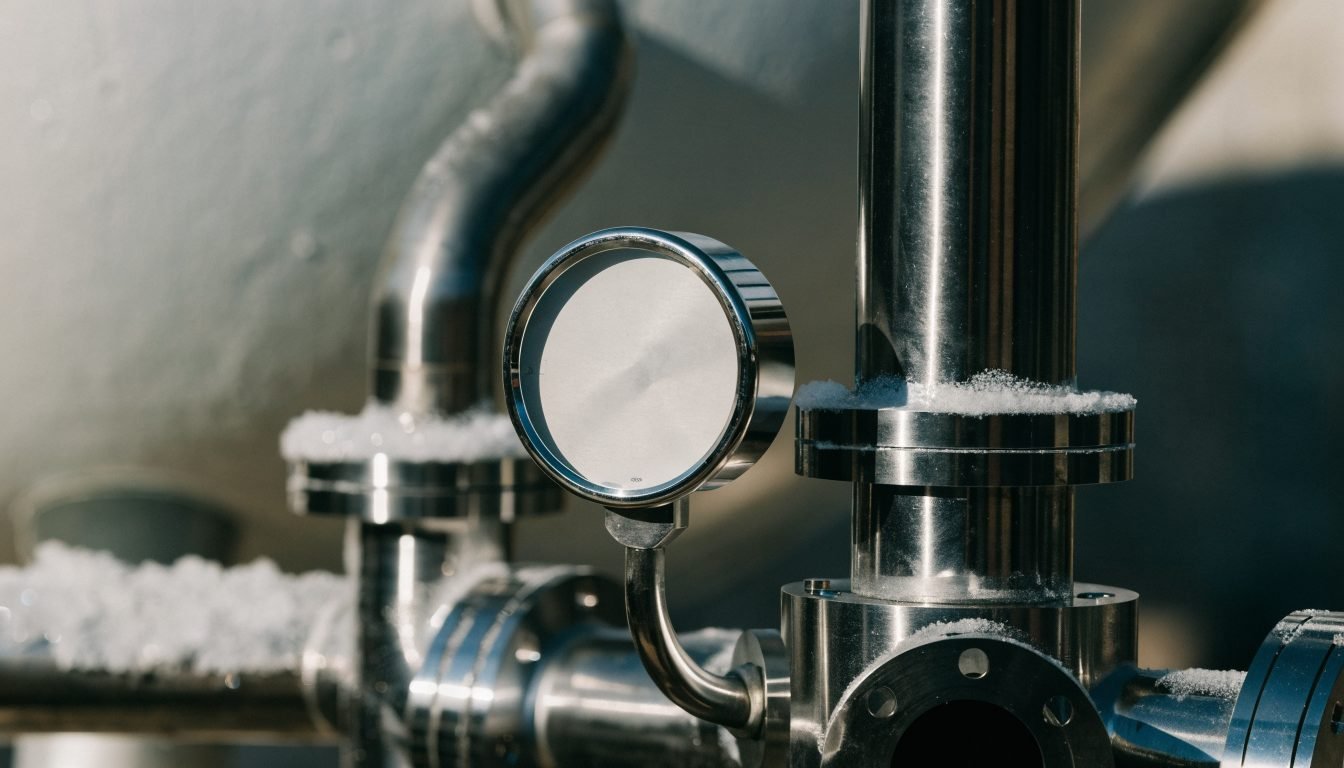
Cryogenic tank pressure rise happens because heat leaks through the insulation into the cold liquid, some of that liquid boils into gas, and the gas has nowhere to expand in a closed vessel. This is normal physics. Pressure becomes a problem only when it rises faster than usual or refuses to settle.
Every stationary cryogenic tank holds liquid at a temperature far below ambient. The surrounding air is always warmer, so a small amount of heat always crosses the vacuum-insulated jacket. Understanding how that heat turns into pressure, and how a healthy tank manages it, helps operators tell routine cycling from an early warning.
This guide explains the mechanism, the parts that control it, what normal behavior looks like, and the signs that point to a vacuum or usage issue worth investigating.
What actually causes pressure to rise in a cryogenic tank?
A cryogenic tank stores a liquefied gas such as liquid nitrogen, oxygen, argon, LNG or LCO2 at very low temperature. The liquid sits at its boiling point for the tank pressure. Any heat that reaches the liquid adds energy, and the easiest place for that energy to go is into evaporation. Liquid becomes vapor, and in a sealed vessel that vapor raises the internal pressure.
Heat reaches the liquid through several paths, even in a well-built tank:
- Conduction through the vacuum-insulated jacket, which is small but never zero
- Conduction through piping, supports and the neck of the vessel
- Radiation across the insulation space
- Warm product entering during a fill, which briefly disturbs the equilibrium
The rate at which pressure builds is directly linked to how much heat gets in. That is why the quality of the vacuum insulation matters so much. A tank with a strong vacuum has a low, predictable pressure rise. A tank losing vacuum lets in more heat, boils off more liquid, and builds pressure faster.
How does heat ingress turn into boil-off and pressure?
The chain is short and mechanical. Heat crosses the insulation, warms the liquid, and part of the liquid evaporates. This evaporated gas is called boil-off gas, or BOG. Because the tank is closed between deliveries and draws, the BOG accumulates in the vapor space above the liquid and pushes the pressure up.
For context, modern stationary cryogenic tanks have a static evaporation rate of roughly 0.2 to 0.6 percent of contents per day, depending on tank size and insulation quality. Smaller tanks have more surface area relative to volume, so they tend toward the higher end. That daily boil-off is the raw material of pressure rise when the tank is not being used.
If you draw liquid or gas regularly, you remove energy and vapor from the system, and pressure tends to stay in a working band. If the tank sits idle, boil-off has nowhere to go and pressure climbs until a control device acts.
What is the difference between the pressure-building coil and the economizer?
Two components manage pressure in opposite directions, and confusing them is a common source of operator questions.
The pressure-building coil raises pressure
When pressure is too low to push product to the process, a pressure-building circuit routes a little liquid through an external coil or vaporizer. The liquid warms, turns to gas, and returns to the tank to raise the head pressure. A pressure-building regulator opens and closes this circuit to hold a set delivery pressure.
The economizer releases excess pressure
When pressure climbs too high, the economizer circuit draws warm vapor from the top of the tank and feeds it to the use line first, instead of drawing only cold liquid. This uses up the excess gas productively and keeps the tank from venting. The economizer is one reason a busy tank stays stable while an idle one climbs.
What does normal pressure cycling look like?
A healthy cryogenic tank does not hold one fixed pressure. It cycles within a band set by its regulators and its use pattern. Operators should learn the normal rhythm of their own tank rather than expect a flat gauge.
- Pressure rises slowly when the tank is idle, driven only by background boil-off
- Pressure falls when liquid or gas is drawn for the process
- The pressure-building regulator lifts pressure back toward the delivery setpoint after a heavy draw
- The economizer trims pressure when it climbs toward the top of the band
- The relief valve or vent regulator releases gas only if pressure reaches the safety setting
Occasional venting on a hot day, after a fill, or after a long idle period is expected. It is the tank protecting itself. The question is always whether the rise is within the normal band and pace for that tank.
When does rising pressure signal a problem?
Pressure that rises faster than the tank's own history, or that keeps venting during normal use, deserves attention. Two root causes dominate: a usage change or a loss of vacuum.
Usage pattern changes
If consumption drops, the tank sits fuller and idler than designed, and background boil-off has more time to build pressure between draws. A tank sized for high throughput that now serves a low demand will vent more often. This is not a fault, but it is a sign the sizing or the delivery schedule no longer matches the load.
Loss of vacuum in the jacket
The more serious cause is degraded vacuum insulation. When the vacuum weakens, heat ingress rises, boil-off climbs above the normal 0.2 to 0.6 percent per day range, and pressure builds noticeably faster. Watch for these combined symptoms:
- Frost or sweating on the outer shell, which should normally stay dry and near ambient
- Boil-off and venting clearly higher than the tank's established baseline
- Faster pressure build after a fill or during idle periods
- The relief valve lifting more often than it used to under the same conditions
If these appear together, the vacuum jacket is the likely cause and the tank should be checked by a specialist.
How can operators tell normal boil-off from a fault?
The most reliable method is comparison against the tank's own baseline, not against a generic number. Keep a simple log so deviations stand out.
- Record tank pressure at the same time each day, ideally under similar draw conditions
- Note the outer shell condition, looking for any frost or condensation
- Track how often the tank vents and whether that frequency is increasing
- Watch level loss during idle periods against past idle periods
- Log ambient conditions, since hot weather naturally raises boil-off and pressure
A tank that has always cycled and vented in a certain pattern, and still does, is behaving normally. A tank that suddenly vents more, frosts on the outside, or loses level faster while idle is telling you the insulation or the vacuum has changed.
What should you do when pressure rises too fast?
Take a structured approach rather than assuming the worst. Many pressure complaints trace back to usage or ambient conditions, not to the vessel itself.
- Confirm relief and safety devices are functioning and set correctly, so the tank is never at risk while you investigate
- Compare current pressure and boil-off against your logged baseline
- Check whether consumption has dropped, leaving the tank idle and full
- Inspect the outer shell for frost or sweating that points to vacuum loss
- If vacuum loss is suspected, arrange a vacuum reading and, if needed, re-evacuation by a specialist
Routine maintenance catches many of these issues early. A vacuum reading every 6 to 12 months, along with valve and relief-device checks, keeps pressure behavior predictable and flags a weakening vacuum before it becomes a boil-off problem.
How does KAF Cryogenics support pressure and vacuum health?
KAF Cryogenics is an Istanbul-based manufacturer and trader of cryogenic and pressurized gas equipment. On its certified second-hand tanks, the vacuum is measured and the vessel is pressure tested as part of the process, so a buyer starts with a documented, verified insulation condition rather than an unknown.
Whether you buy new built to specification or a certified second-hand unit, every tank leaves with a document dossier and a written warranty. For operators troubleshooting persistent pressure rise, matching tank size and pressure class to actual demand is often the practical fix, and KAF sizes both new and stock units to the load rather than to a catalog default.
Frequently Asked Questions
Is it normal for a cryogenic tank to vent gas?
Yes. Venting is the tank protecting itself when pressure reaches the safety setting. Occasional venting on hot days, after a fill, or after long idle periods is expected. Frequent venting during normal use, especially with frost on the outer shell, points to a possible vacuum problem.
How fast should pressure rise in an idle cryogenic tank?
There is no single figure because it depends on tank size, insulation and ambient temperature. The reliable guide is the tank's own history. A rise noticeably faster than that tank's established baseline, or one paired with external frost, suggests heat ingress has increased.
What is boil-off gas and how does it relate to pressure?
Boil-off gas, or BOG, is the vapor formed when heat evaporates a small part of the stored liquid. In a closed tank this vapor accumulates in the space above the liquid and raises the pressure. Modern stationary tanks boil off roughly 0.2 to 0.6 percent of contents per day.
Can low usage cause high tank pressure?
Yes. When consumption drops, the tank sits fuller and idler, so background boil-off has more time to build pressure between draws. This is not a fault, but it may mean the tank size or delivery schedule no longer matches the demand.
Does frost on the outside of a cryogenic tank mean the vacuum is failing?
Frost or sweating on the outer shell is a strong warning sign. The outer shell should normally stay near ambient temperature and dry. Visible frost, together with higher boil-off and faster pressure build, indicates likely vacuum loss and warrants a specialist check.
What is the pressure-building coil for?
The pressure-building coil raises head pressure when it is too low to deliver product. It routes a little liquid through an external vaporizer so it turns to gas and returns to the tank. A regulator opens and closes this circuit to hold the target delivery pressure.
How often should I check a cryogenic tank to keep pressure predictable?
Take a vacuum reading every 6 to 12 months and check valves, gauges and relief devices on the same routine. Logging daily pressure and shell condition between service visits lets you spot a rising trend early, before it becomes a boil-off or venting problem.
Related reading
Persistent pressure rise on your tank?
KAF Cryogenics can help you assess whether your tank's pressure behavior points to a vacuum issue, a sizing mismatch, or normal cycling, and supply new or certified second-hand tanks matched to your demand. Tell us your gas, capacity and pressure needs for an accurate quote.
Talk to KAF Cryogenics