
Cryogenic Tank Insulation: Perlite vs Multilayer Insulation
Compare vacuum perlite and multilayer insulation on cryogenic tanks: heat leak, boil off, weight, repairability and what to check when buying a used tank.
KAF Cryogenics12 min read
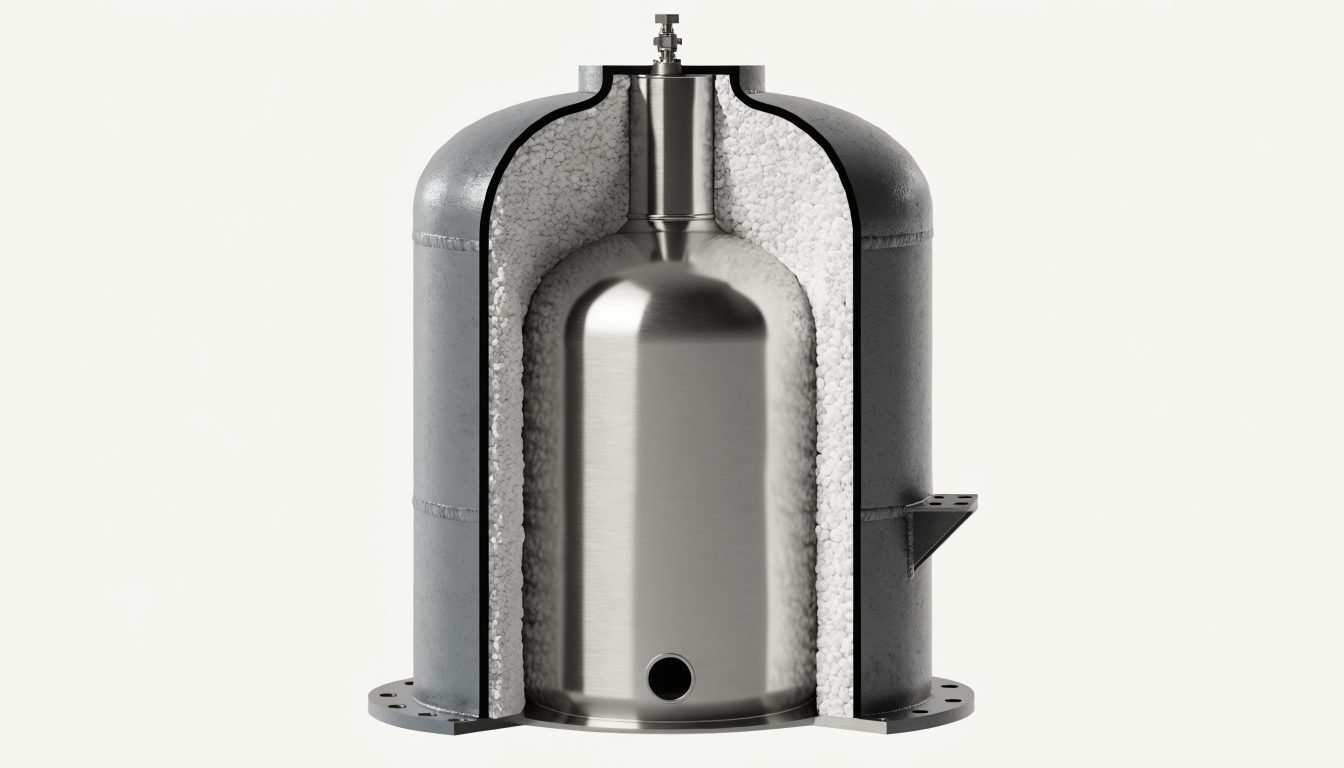
Cryogenic tank insulation works by combining a high vacuum in the annular space with a filler that blocks radiation. The two common systems are vacuum perlite, a granular fill used mainly on larger stationary tanks, and multilayer insulation or MLI, also called superinsulation, a wrapped reflective blanket used where low heat leak and low weight matter most.
Both systems depend on the vacuum. Neither works without it. The choice between them affects boil off rate, tare weight, annular gap thickness, cost and how the tank is repaired if the vacuum is ever lost.
This article explains the physics briefly, compares the two systems honestly on the points that affect a purchase, and shows why insulation type is one of the first questions to ask when two used tanks of the same nominal volume are quoted at different prices.
How does vacuum insulation work on a cryogenic tank?
Heat reaches the cryogenic liquid by three routes, and a cryogenic tank insulation system has to address all three.
- Gas conduction and convection: heat carried by gas molecules in the annular space between the cold inner vessel and the warm outer jacket
- Radiation: infrared energy emitted by the warm outer jacket and absorbed by the cold inner vessel, which does not need any medium to travel
- Solid conduction: heat travelling along the structural supports that hold the inner vessel, and along the pipework that penetrates the jacket
Evacuating the annular space removes almost all of the gas conduction and convection. That is the largest single gain, and it is why every modern cryogenic tank is vacuum insulated. But a vacuum does nothing about radiation, and it does nothing about the supports. So the annular space is also filled or wrapped with a material chosen to block radiation, and the supports are made from low conductivity materials with long heat paths.
Because the whole system depends on the vacuum holding, both perlite and MLI tanks include an adsorbent, often a molecular sieve or activated carbon, in the annular space. The adsorbent captures gas molecules that outgas from the metal surfaces over years of service, which is what keeps the vacuum from degrading on its own. A vacuum reading should still be taken every 6 to 12 months.
What is vacuum perlite insulation?
Perlite is expanded volcanic glass, processed into a light granular powder. The annular space is filled with perlite and then evacuated. The particles scatter and absorb radiation across the gap, and with the gas removed there is very little conduction path between them.
Characteristics that matter commercially:
- Lower material and labour cost than a wrapped MLI system, particularly on large vessels where the surface area is substantial
- Robust and tolerant. It does not care about small imperfections in how it was installed, and it is not damaged by handling of the vessel during fabrication
- It needs a wider annular gap to reach a given heat leak, which increases the outer jacket diameter and the overall footprint
- It is heavier, both from the perlite itself and from the larger outer jacket
- It can settle and compact over time, especially on vessels that are transported or subjected to vibration
Settling is the practical weak point. As the perlite compacts, a void can open at the top of the annular space, giving a local area of higher heat leak, while the compacted material lower down can exert load on the inner vessel. Vertical vessels that are moved between sites are more exposed to this than vessels that stay in one place, which is part of why perlite is the standard choice for stationary tanks and is far less common on road transport equipment.
Perlite is also hygroscopic in the sense that matters here. If the vacuum is lost and air with moisture enters, the perlite absorbs water. Recovering that requires more than pumping the space down again.
What is multilayer insulation or MLI?
Multilayer insulation, commonly called MLI or superinsulation, is a wrapped blanket. Thin reflective films, typically aluminised polyester, alternate with a low conductivity spacer material such as glass paper or a fine net. The blanket is wound around the inner vessel before the outer jacket is closed and the space is evacuated.
The reflective layers attack radiation directly. Each layer reflects most of the incoming infrared energy, and each successive layer sits at a lower temperature than the one outside it, so the temperature drop is divided across many stages. The spacer keeps the films from touching, because films in contact would create a solid conduction bridge and destroy the benefit.
Characteristics that matter commercially:
- Lower heat leak per unit of surface area than perlite for the same annular gap
- A much thinner annular gap, which reduces overall diameter for a given inner volume
- Significantly lighter, which is decisive on road transport equipment where every kilogram of tare weight is a kilogram of lost payload
- More sensitive to workmanship. Layer density, overlaps and the treatment of penetrations all change the result
- More demanding on the vacuum. MLI performance degrades faster than perlite as vacuum quality falls, so a partial vacuum loss shows up sooner
MLI is standard on cryogenic semi trailers, ISO tank containers, MicroBulk vessels and smaller stationary tanks. On large stationary vessels the picture is more mixed, and some manufacturers use a combination, wrapping the inner vessel with MLI and filling the remaining space with perlite.
How does insulation type affect boil off rate?
Boil off, also called static evaporation rate or normal evaporation rate, is the percentage of the tank contents that evaporates per day when the tank is full and idle. Modern stationary cryogenic tanks fall in a range of roughly 0.2 to 0.6 percent per day, depending on size and insulation.
Two things drive where a tank sits in that range:
- Tank size. A larger vessel has less surface area per unit of stored volume, so the same quality of insulation gives a lower percentage figure. A small tank at 0.5 percent per day and a large tank at 0.25 percent per day may have identical insulation quality
- Insulation system and vacuum quality. For two tanks of similar size, an MLI system in good vacuum will generally give a lower figure than a perlite system, because the radiation path is better blocked in a thinner space
This is why a boil off percentage on its own is not a specification you can compare across quotations. Ask for the figure together with the vessel volume, the product it was measured on, and the test conditions. Our article on cryogenic tank boil off rate sets out how the number is defined and how to read it in a datasheet, and the related holding time or normal evaporation rate figure is what actually tells you how long product can sit before pressure reaches the relief valve setting.
One more caution. A published boil off figure describes a tank in good condition with its vacuum intact. It says nothing about the condition of a specific used unit standing in a yard. Only a measurement or a vacuum reading tells you that.
How does insulation affect weight, size and transport?
For stationary tanks, weight matters at installation. A perlite filled vessel is heavier and larger in diameter for the same capacity, which affects the foundation design, the crane required to set it, and the footprint on a site that may already be crowded. On a greenfield site with space, this is rarely a decisive factor. On a retrofit into an existing compound, it sometimes is.
For transport equipment, the calculation is different and much sharper:
- Road transport is limited by gross vehicle weight, so tare weight directly reduces the payload of every trip for the life of the vehicle
- A thinner annular gap allows more inner volume within the legal envelope of the trailer or the fixed dimensions of an ISO frame
- Transport vessels are subject to constant vibration and to shock loads, which is the condition under which granular fill can settle
This is why cryogenic semi trailers, bobtails and T75 ISO tank containers are built with MLI rather than perlite. It is a design consequence, not a preference. If you are comparing road transport options, our guide to cryogenic road tankers covers how tare weight interacts with payload and route economics.
Which insulation system is easier to repair?
This question only becomes relevant after a vacuum loss, but that is precisely when it becomes expensive. The visible symptoms are the same for both systems: frost or sweating on the outer shell, rising boil off, and faster pressure build between deliveries.
If the vacuum degraded slowly and the space stayed dry
In the best case the space can be re evacuated, often with the adsorbent regenerated by heating during the pump down, and performance is restored. This is broadly similar for both systems, and it is the outcome you hope for when a tank is caught early. Our article on vacuum loss in cryogenic tanks describes how the condition develops and how early it can be caught.
If air and moisture entered the annular space
Here the systems diverge. Wet perlite has to be removed and replaced, which means opening the jacket, extracting the fill, drying or renewing the material, refilling and re evacuating. It is a workshop operation with significant labour and material content, but the material itself is inexpensive and the process is well understood.
Wet or contaminated MLI generally has to be unwrapped and replaced. The material cost is higher and the rewrap has to be done to the correct layer density, which requires a workshop that does this regularly. On the other hand, MLI does not need to be extracted from a confined space by vacuum equipment the way perlite does.
In both cases the leak has to be found and repaired first. Re evacuating a jacket with an unresolved leak buys weeks, not years.
Why does insulation type matter when comparing two used tanks?
Two used tanks with the same nameplate volume can differ substantially in running cost, and insulation is one of the reasons. Product lost to boil off is product you paid to liquefy and transport.
When comparing offers, ask for the following on each unit:
- The insulation type stated by the original manufacturer, not assumed from the tank shape
- The original design boil off or normal evaporation rate figure, with the volume and product it refers to
- A current vacuum reading in the annular space, with the date it was taken
- The service history: how many times the vacuum has been pumped down, and whether the tank has ever been reinsulated
- Whether the jacket has been cut and rewelded, which is the signature of a previous insulation repair
- Photographs of the outer shell in cool, humid conditions, when frost patches and sweating are easiest to see
- Whether the annular space relief device has ever operated, which would indicate a past inner vessel leak
A tank with a documented vacuum reading and a clean jacket is worth more than a tank with a lower asking price and no data, and the difference will usually be recovered in product losses within a few seasons. Start the inspection at the vessel nameplate, since it tells you the volume, MAWP and design code you are actually comparing, and follow it with the planned maintenance record.
KAF Cryogenics supplies certified second hand cryogenic tanks that have passed inspection, non destructive testing and vacuum and pressure testing, and are sold with a document dossier and written warranty. Where a specific insulation system, pressure class or configuration is required, new vessels are built to specification. Certified second hand units can be delivered from stock in weeks, while a new build is a matter of months of fabrication.
Frequently Asked Questions
What is the difference between perlite and MLI cryogenic tank insulation?
Perlite is a granular expanded volcanic glass fill poured into the evacuated annular space, and MLI or multilayer insulation is a wrapped blanket of reflective films separated by low conductivity spacers. Perlite is cheaper and more tolerant but needs a wider annular gap and is heavier. MLI gives lower heat leak in a thinner, lighter package but is more sensitive to workmanship and to vacuum quality.
What is a normal boil off rate for a cryogenic tank?
Modern stationary cryogenic tanks show a static evaporation rate of roughly 0.2 to 0.6 percent per day, depending on size and insulation. Larger tanks sit at the lower end because they have less surface area per unit of stored volume. Always read the figure together with the tank volume and the product it was measured on, since the percentage alone is not comparable between different sizes.
Why is MLI used on cryogenic trailers and ISO containers?
Two reasons: weight and vibration. MLI is significantly lighter and needs a thinner annular gap, so it preserves payload within road weight limits and inner volume within the fixed dimensions of a trailer or ISO frame. Granular perlite fill can also settle under the constant vibration of road transport, which can create voids and load the inner vessel.
Does insulation type change how a cryogenic tank should be maintained?
The routine is the same. Take a vacuum reading every 6 to 12 months, inspect the outer shell for frost or sweating, and track boil off and pressure behaviour over time. What differs is the recovery path if the vacuum is lost, because wet perlite must be extracted and replaced while contaminated MLI has to be unwrapped and rewrapped.
Can a perlite insulated tank be converted to MLI?
It is technically possible but rarely economic. Converting means opening the outer jacket, removing all the perlite, wrapping the inner vessel, closing and rewelding the jacket and re evacuating the space. The annular gap was also dimensioned for perlite, so the geometry does not automatically suit an MLI design. In most cases sourcing a vessel built for the required duty is the better route.
How do I know if a used tank has lost part of its vacuum?
The visible signs are frost patches or sweating on the outer shell, rising boil off and faster pressure build between deliveries. None of these are conclusive on their own, so ask for a vacuum reading taken through the dedicated evacuation port, with the date recorded. Any tank offered without a current vacuum reading should be treated as unknown condition.
Does better insulation remove the need for a pressure control system?
No. Heat leak is reduced but never eliminated, so pressure will still rise in a closed vessel and the tank still needs its full pressure protection and pressure control equipment. Better insulation lengthens the holding time before the relief valve lifts, which is a real operational benefit, but it does not change the safety requirements.
Related reading
Comparing cryogenic tanks and unsure about insulation condition?
KAF Cryogenics supplies new vessels built to specification and certified second hand tanks that have passed inspection, NDT, and vacuum and pressure testing, with a document dossier and written warranty. Send us the volume, product and pressure class you need and we will quote against your requirement.
Request a quotation