
Tank Telemetry and Remote Monitoring for Gas Distributors
How cryogenic tank telemetry works, what it measures, how remote level monitoring changes delivery routing, and what to check before retrofitting a tank.
KAF Cryogenics10 min read
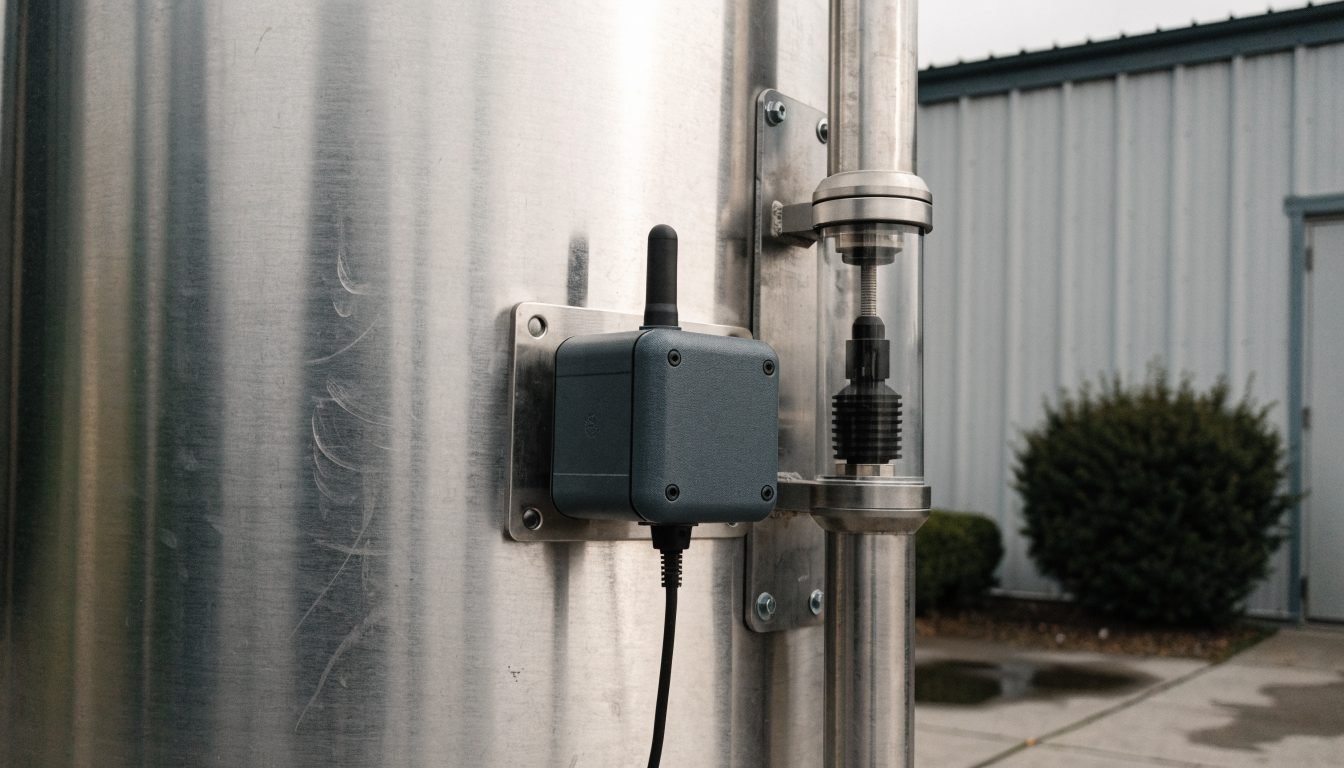
Cryogenic tank telemetry is a remote monitoring unit fitted to a customer station tank that reads liquid level and vapour pressure, sometimes temperature, and sends the values to the distributor over a cellular or satellite link. It lets a distributor plan deliveries from measured stock instead of a fixed calendar schedule.
For a gas distributor, the value is operational rather than theoretical. Once you can see the level in every customer tank each morning, route planning stops being a guess, partial drops fall away, and the emergency call outs that eat margin become the exception instead of a normal part of the week.
This guide explains what a telemetry unit measures, how demand based routing works in practice, what changes in day to day operations, and the technical checks that decide whether an existing tank can be retrofitted without a workshop visit.
What is cryogenic tank telemetry?
Cryogenic tank telemetry is a small instrument package mounted at the tank that converts the existing process measurements into a digital signal and transmits it to a server the distributor can read. Nothing is added inside the vessel and nothing penetrates the vacuum jacket. The unit taps the same liquid and vapour connections that already feed the mechanical gauges.
A typical installation has four parts:
- A differential pressure transmitter connected across the liquid leg and the vapour leg of the inner vessel, which gives liquid level from the hydrostatic head of the column
- A pressure transmitter on the vapour space, reading the same pressure the operator sees on the tank gauge
- A controller or data logger that samples the transmitters at a set interval and stores the readings
- A communication module, usually cellular, with satellite used where there is no mobile coverage
The reading is a level in percent or in units of liquid volume, plus a pressure. Both are the same quantities an operator would read on site. Telemetry does not create new information, it removes the need for somebody to walk to the tank and write it down.
What does a telemetry unit actually measure?
Keeping the measurement list short and honest matters, because the business case rests on what the data can and cannot tell you.
Liquid level
Level comes from differential pressure. The transmitter compares the pressure at the bottom of the liquid column with the pressure in the vapour space, and the difference is proportional to the head of liquid. The conversion to volume depends on the density of the product, so the unit must be configured for the service, whether that is liquid nitrogen, oxygen, argon, LNG or LCO2. A unit configured for the wrong product will read a plausible but wrong number.
Vapour space pressure
Pressure is the second core reading and it is often more diagnostic than level. A tank that sits at a stable working pressure is behaving normally. A tank whose pressure climbs steadily between deliveries is telling you something about heat leak, pressure building regulator settings or economizer behaviour.
Temperature and secondary inputs
Some units add ambient temperature, an internal battery voltage, or digital inputs for a vaporizer alarm or a gate contact. Ambient temperature is useful context because vaporizer performance and pressure behaviour both change with weather. Treat these as supporting data, not as the reason to buy the system.
How does remote monitoring change delivery routing?
Most distributors start with fixed schedules. Each customer is visited every so many days, based on an estimate made when the tank was installed. The schedule is safe because it is conservative, and conservative means the tanker often arrives at a tank that is still more than half full.
With measured level, routing changes in a specific way:
- Deliveries are triggered by a level threshold and a consumption trend, not by a date on a calendar
- Partial drops shrink, because you can wait until the tank has room for a commercially sensible volume
- Loads are planned around which tanks will reach the threshold within the route window, so a full tanker can be emptied across fewer stops
- Customers whose consumption has changed are visible immediately, instead of being noticed after a run out
- Route sequence can be built around the tanks with the shortest remaining days of stock rather than around geography alone
The practical effect is that the tanker carries the same product to fewer, fuller drops. How much that is worth depends on your fleet, distances and product mix, so it should be modelled on your own delivery records rather than assumed from a generic figure.
How does telemetry reduce run outs and emergency deliveries?
A run out is expensive twice over, once in the emergency delivery and once in the customer relationship. Telemetry attacks the problem at the point where run outs actually start, which is a change in consumption that nobody noticed.
Days of stock remaining is calculated from the current level and the recent consumption rate. When a customer commissions a new production line and doubles usage, the days of stock figure collapses within a day or two and the account moves up the priority list before the level becomes critical. Under a fixed schedule the same change is only discovered when the customer calls.
Pressure data adds a second layer of early warning. A tank that begins to build pressure faster than usual between deliveries, or whose pressure no longer falls during withdrawal, is worth a site visit. The same pattern is a classic early indicator of insulation problems, which is covered in more detail in our article on why pressure rises in a cryogenic tank.
What else can you do with the level history?
Once you have several months of readings per tank, the data supports decisions beyond routing.
- Tank right sizing: a customer tank that never drops below a high level is oversized for the site, while one that repeatedly reaches a low level between visits needs a larger vessel or a shorter cycle
- Contract review: measured annual consumption per site replaces estimated volumes in commercial discussions
- Vaporizer capacity checks: level drawdown rate against ambient temperature shows whether the vaporizer is keeping up in winter conditions
- Loss investigation: a level that falls when the customer is not consuming points to venting, a passing valve or a leak
- Asset tracking: a tank that is barely used may be better redeployed to another customer than left in place
Right sizing is the item most distributors underestimate. If you are reviewing station sizing across a customer base, our guide to customer station tank sizing sets out the calculation, and telemetry gives you the real consumption input it needs.
What should you check before retrofitting telemetry to an existing tank?
Retrofits are common and usually straightforward, but a short survey before ordering hardware avoids a wasted site visit. Work through the following list for each tank.
Mechanical and process checks
- Instrument connections: is there a spare port on the liquid leg and vapour leg, or will the existing differential pressure gauge manifold be shared or replaced
- Isolation valves: each transmitter needs isolation valves so it can be replaced without emptying the tank
- Never drill or weld on the outer jacket. Any penetration of the vacuum jacket destroys the insulation and the vessel certification
- Nameplate data: MAWP and pressure class must be known so transmitter ranges are specified correctly
- Product service: units in oxygen service must be cleaned for oxygen service, with no hydrocarbon oils or greases on any wetted part
Site and installation checks
- Hazardous area classification: LNG and LPG installations require equipment certified for the zone, so confirm the zone before selecting the enclosure
- Mobile network coverage at the tank position, not at the site gate, since tanks often sit behind buildings or inside bunded compounds
- Power: mains supply, solar panel or long life battery, and who is responsible for battery replacement
- Mounting: a bracket on the pipework frame or a nearby post, protected from delivery hose movement and from ice falling off the vaporizer
- Customer agreement: access for installation and maintenance, and a clear statement of who owns the data
Data and integration checks
- Reporting interval and how many readings the battery budget allows per day
- Whether the platform exports to your ERP or route planning system, or only to a web dashboard
- Alarm rules for low level, high pressure and loss of signal, and who receives them
- How a lost or delayed reading is displayed, so a stale value is not mistaken for a live one
Where does telemetry fit alongside tank condition monitoring?
Telemetry is a stock and pressure tool. It is not a substitute for physical inspection, and it does not read the vacuum in the annular space. Vacuum should still be checked every 6 to 12 months as part of a planned maintenance routine, and the outer shell should still be inspected for frost patches or sweating, which are the visible symptoms of vacuum loss.
What telemetry does contribute is trend evidence. Modern stationary cryogenic tanks have a static evaporation rate of roughly 0.2 to 0.6 percent per day depending on size and insulation. A tank whose idle level loss drifts above the value it showed a year ago, at similar ambient conditions, is a candidate for a vacuum check before it becomes a product loss problem. Use the readings to schedule the inspection, then confirm with instruments on site.
Does the tank itself need to be new to support telemetry?
No. Any vacuum insulated tank with standard liquid and vapour instrument connections can carry a telemetry unit, including certified second hand vessels. What matters is the condition of the instrument piping, the availability of isolation valves and correct documentation of the vessel pressure rating.
KAF Cryogenics supplies storage tanks and MicroBulk vessels both as new units built to specification and as certified second hand equipment that has passed inspection, non destructive testing and vacuum and pressure testing, and is sold with a document dossier and written warranty. Where a distributor is expanding a customer station network, second hand units can be delivered from stock in weeks against the months of fabrication a new build requires, which is often the difference between winning and losing a customer site.
MicroBulk installations in particular benefit from remote monitoring, because they serve customers whose consumption is small enough that a wasted visit destroys the economics of the route.
Frequently Asked Questions
What does cryogenic tank telemetry measure?
It measures liquid level and vapour space pressure, and on some units ambient temperature and equipment status inputs. Level is derived from a differential pressure transmitter that reads the head of the liquid column, so the unit must be configured for the specific product density. The readings are the same ones an operator would take from the tank gauges on site.
Can telemetry be fitted to an existing cryogenic tank?
Yes, in most cases. The transmitters connect to the existing liquid and vapour instrument lines, so no modification to the vessel is required. The key checks before ordering are available instrument ports, isolation valves, hazardous area classification, mobile network coverage at the tank position and a power source.
Does installing telemetry affect the tank certification?
Not if it is installed correctly. Transmitters are connected to existing process connections, which is a normal instrument change. What would affect certification is drilling, welding or otherwise penetrating the outer vacuum jacket, which must never be done. Any work on pressure retaining parts must follow the manufacturer instructions and the applicable code.
Does telemetry tell you if the tank has lost vacuum?
Not directly, because it does not read the annular space vacuum. It gives indirect evidence, since vacuum loss shows up as faster pressure build and higher idle level loss. Treat an unusual trend as a trigger for a physical inspection and a vacuum reading, which should be taken every 6 to 12 months in any case.
How often does a telemetry unit report?
This is a configuration choice balanced against battery life. Mains powered or solar powered units can report hourly or more often, while long life battery units are commonly set to a small number of readings per day. For delivery scheduling, one or two reliable readings per day is usually enough, with alarm driven reports for low level or high pressure.
What happens if the signal is lost?
The unit continues to log readings locally and uploads the backlog when the connection returns. The important operational point is that your dashboard must show the age of each reading clearly, so a stale value is never treated as current. A loss of signal alarm should also be part of the alarm rule set.
Is telemetry worth it for a small customer base?
The answer depends on delivery distance and drop size rather than on customer count. Sites that are far from the filling plant, or that have small tanks and irregular consumption, generate the most wasted visits and therefore benefit most. Model it against your own delivery records for the last twelve months before deciding.
Related reading
Planning a customer station network?
KAF Cryogenics supplies new and certified second hand storage tanks and MicroBulk vessels for industrial gas distributors, with certified second hand units available from stock in weeks. Tell us your products, volumes and delivery pattern and we will quote against your actual requirement.
Request a quotation