
How Certified Second-Hand Cryogenic Tanks Are Inspected and Tested
See how a certified used cryogenic tank is inspected, NDT tested, and vacuum and pressure tested, then sold with a document dossier and warranty.
KAF Cryogenics5 min read
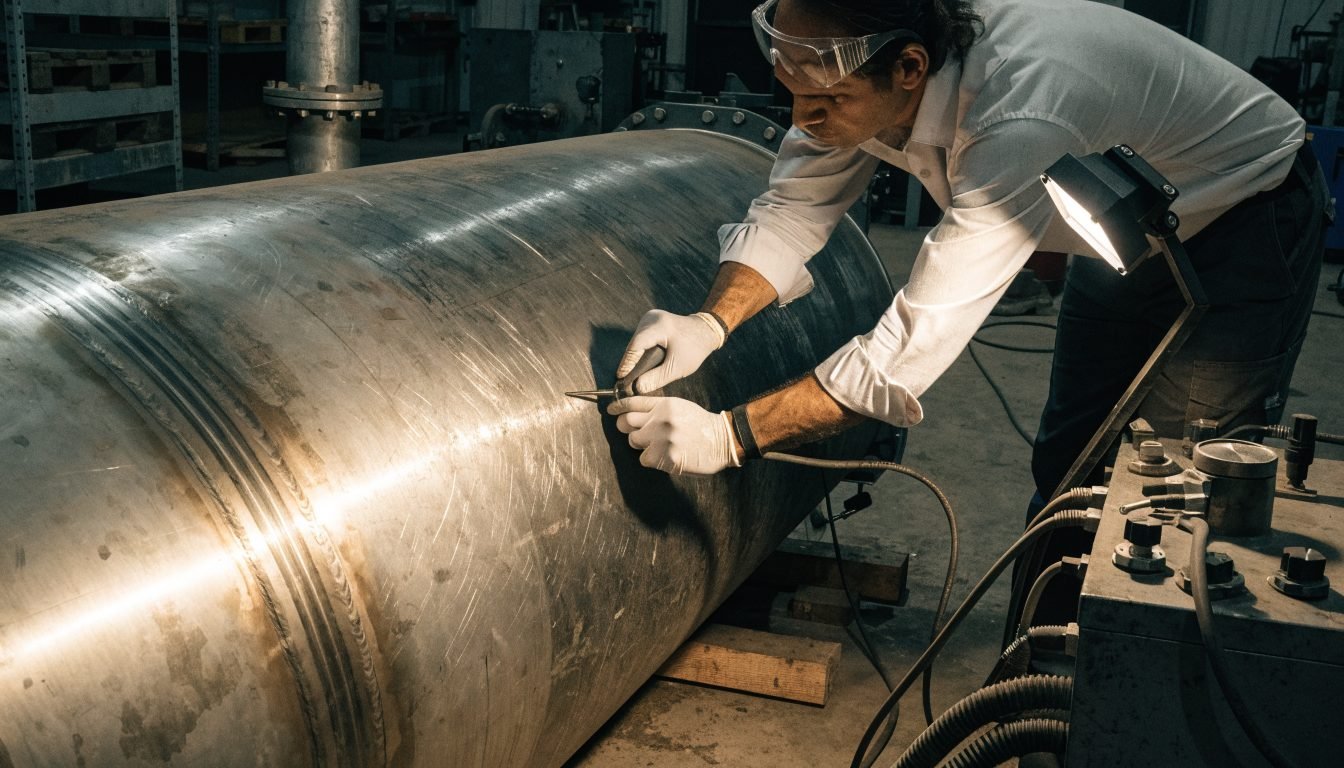
A certified used cryogenic tank is a second-hand unit that has passed visual inspection, non-destructive testing (NDT), a vacuum test, and a pressure test, had its valves and relief devices overhauled, and is sold with a document dossier and a written warranty. Certification is a defined sequence of checks, not a label. This article sets out each step.
The point of the process is to replace assumption with evidence. Every stage produces a record, and those records travel with the tank so the buyer can see exactly what was verified and when.
KAF Cryogenics uses this certified second-hand channel alongside new fabrication. The steps below describe what happens to a used tank before it is offered for sale.
What does certifying a used cryogenic tank actually involve?
Certifying a used cryogenic tank means putting it through a fixed set of inspections and tests, correcting what needs correcting, and documenting the results. A cryogenic tank is a double-walled vessel: an inner pressure vessel holds the liquefied gas, and an outer shell holds a vacuum that insulates it. The process verifies both walls, the vacuum between them, and the safety devices.
The sequence below moves from visual assessment to material testing to functional testing, and ends with documentation. Each step gates the next, so a unit that fails one stage is corrected or rejected before moving on.
Step one: what does the visual inspection cover?
The first step is a detailed visual and dimensional inspection of the whole unit. This identifies external damage, corrosion, and any signs of a vacuum problem before deeper testing begins.
- The outer shell, checked for dents, corrosion, and any frost or sweating that would indicate degraded vacuum insulation.
- The nameplate and identification, confirming design pressure, capacity, and the code the vessel was built to.
- Piping, supports, and fittings, checked for damage and unauthorized modification.
- For transportable units, the frame or chassis and mounting.
Step two: how is NDT used on the inner vessel?
Non-destructive testing examines the pressure-bearing welds and shell for cracks or flaws without cutting into the material. Because the inner vessel holds pressure at cryogenic temperature, its integrity is the core of the certification.
NDT also confirms that the low-temperature materials remain suitable for the cold service range. Cryogenic materials must pass impact (Charpy V-notch) testing to avoid brittle fracture below about -150 C, and the inspection verifies that the vessel is still fit for that duty. Any weld or area of concern is assessed against the original code before the unit proceeds.
Step three: how is the vacuum tested?
The vacuum in the annular space between the two walls is what keeps the tank cold and controls boil-off. The vacuum level is measured, and where it has degraded the unit is re-evacuated before sale.
A sound vacuum shows up in performance. A modern stationary cryogenic tank in good condition loses roughly 0.2 to 0.6 percent of its contents per day. As a maintenance benchmark, the vacuum should be read every 6 to 12 months in service, and certification establishes a known starting point for that schedule.
Step four: how is the pressure test performed?
The pressure test confirms that the inner vessel holds its maximum allowable working pressure. This is a functional check of the pressure boundary that the NDT step examined for flaws.
Passing the pressure test, together with clean NDT results and a verified vacuum, is what allows a used tank to return to service with confidence. The three results are recorded together in the dossier.
Step five: what happens to the valves and relief devices?
Valves, gauges, and pressure-relief devices are the parts most likely to be worn, and they are safety-critical, so they are overhauled or replaced rather than passed on as-is.
- Pressure-relief valves reset to the correct pressure and tested.
- Fill, withdrawal, and vent valves serviced or replaced so they seal correctly.
- Pressure gauges and level indicators checked for accurate reading.
- The pressure-building circuit and economizer, where fitted, confirmed to function as designed.
Step six: what is in the document dossier and warranty?
The final step packages the evidence. The document dossier is what lets a buyer and, later, a market authority see how the tank was verified.
- The original manufacturer data and the code the vessel was built to, PED 2014/68/EU or ASME.
- The applicable standard for the vessel type, EN 13458 for static vessels or EN 13530 for transportable ones.
- The results of the visual inspection, NDT, vacuum test, and pressure test.
- Relief valve settings and overhaul records for the safety devices.
- A written warranty covering the certified unit.
Because certified units are held in stock, a tank that has completed this process can typically be delivered in weeks, while new fabrication to specification takes months. KAF also buys used equipment and accepts trade-in on new orders, feeding units back into the same certification channel.
Frequently Asked Questions
What makes a used cryogenic tank certified rather than as-is?
A certified unit has passed visual inspection, NDT, a vacuum test, and a pressure test, had its valves and relief devices overhauled, and is sold with a document dossier and written warranty. An as-is unit is sold without that verification, so the buyer carries the risk of its unknown condition.
What does NDT check on a used tank?
NDT, or non-destructive testing, inspects the pressure-bearing welds and shell of the inner vessel for cracks or flaws without cutting into the material. It is the primary way to confirm the pressure vessel is sound before the tank returns to service.
Is the vacuum re-established during certification?
Where the vacuum has degraded, the unit is re-evacuated before sale. The vacuum level is measured as part of the process, giving a known starting point. In service, the vacuum should then be read every 6 to 12 months.
What boil-off rate should a certified used tank have?
A modern stationary cryogenic tank in good condition loses roughly 0.2 to 0.6 percent of its contents per day, depending on size and insulation. A certified used tank with a verified vacuum operates in this range, the same as a comparable new unit.
Which certification code will the tank carry?
It carries the code it was built to, either PED 2014/68/EU for the European market or ASME for the US market. The correct one depends on your destination market, not on quality. The dossier confirms which code applies so you can match it to where you operate.
How soon can a certified used tank be delivered?
Because certified units are held in stock, delivery is typically measured in weeks. New fabrication to specification usually takes months. Confirm availability for your specific gas, capacity, and pressure with a quote.
Related reading
Ask to see the test dossier before you buy
KAF Cryogenics certifies each second-hand tank through inspection, NDT, and vacuum and pressure testing, then supplies it with a document dossier and written warranty. Tell us your requirements and we will match a certified unit from stock or quote a new build.
Talk to KAF