
ISO Tank Containers for Cryogenic and Liquefied Gas Transport
How ISO tank containers move cryogenic and liquefied gas: T75 type, multimodal transport, certification, and new vs certified used. Get an accurate quote.
KAF Cryogenics6 min read
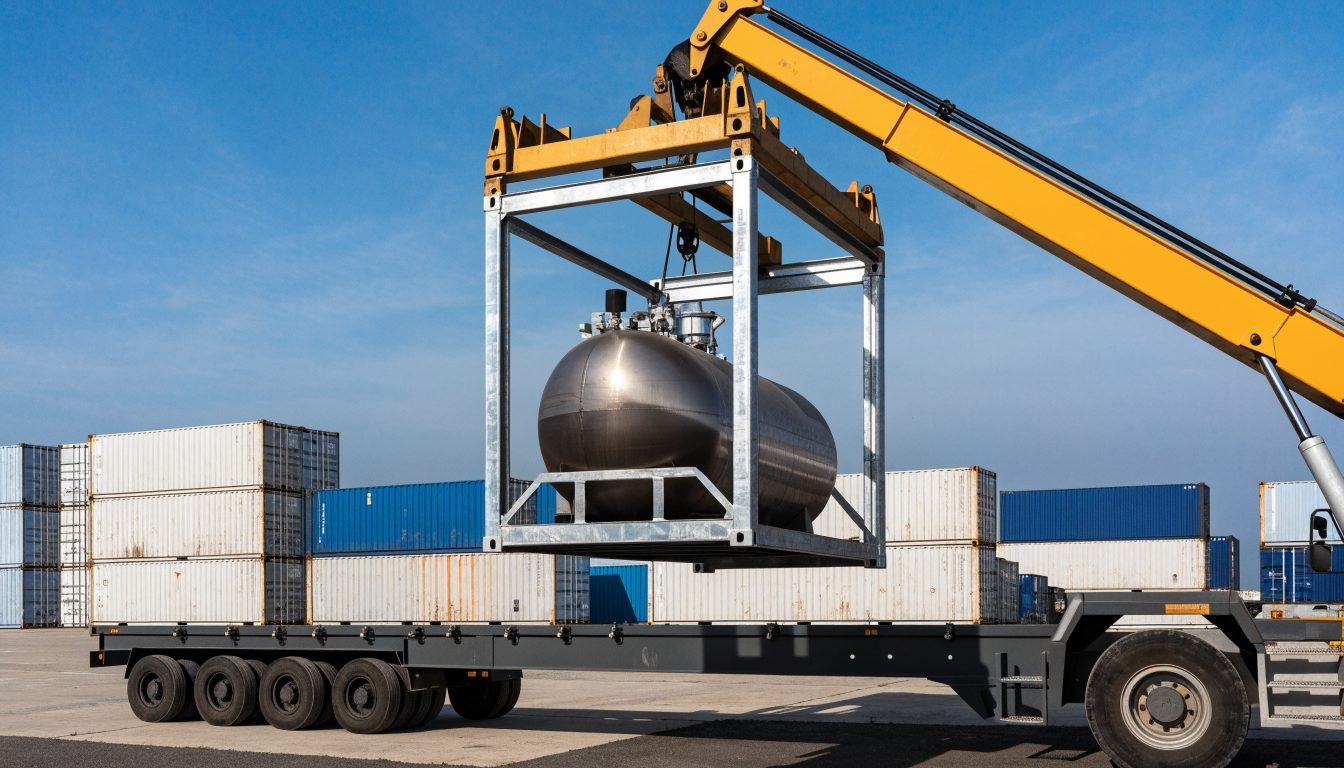
An ISO tank container for cryogenic service is a vacuum-insulated vessel built inside a standard ISO frame, and for cryogenic and liquefied gas it is the T75 type. It moves the same unit by sea, rail, and road without transferring the liquid, which suits export routes and intermodal supply chains better than a road-only trailer.
That single-handling advantage is the reason distributors reach for ISO tanks on long or mixed routes. The load stays in one certified vessel from the fill point to the customer, so there is less product loss, less handling risk, and simpler paperwork across borders.
This guide explains what a cryogenic ISO tank container is, when it beats a semi-trailer, what certifications to demand, and how the new and certified second-hand supply channels differ on lead time and cost.
What is an ISO tank container for cryogenic gas?
An ISO tank container is a pressure vessel mounted inside a standardized ISO frame that matches the dimensions and corner castings of a shipping container. For cryogenic and liquefied gas it uses the T75 portable tank instruction, which covers refrigerated liquefied gases carried in vacuum-insulated tanks.
Like a static cryogenic tank, the T75 uses an inner vessel and an outer shell separated by a vacuum-insulated space to slow heat ingress. The frame lets cranes, spreaders, and container handlers move the full unit the same way they move any box container.
- T75: the ISO portable tank type for refrigerated liquefied cryogenic gases such as LIN, LOX, LAR, and LNG.
- Standard 20 foot ISO frame dimensions and corner castings for stacking and lifting.
- Vacuum-insulated inner and outer vessel to limit boil-off in transit.
- Integrated valves, relief devices, and often a pressure-building circuit for controlled unloading.
How does an ISO tank container differ from a semi-trailer?
A cryogenic semi-trailer is a road tanker fixed to a chassis. An ISO tank container is a detachable vessel that rides on a container chassis for the road leg and transfers to a ship or railcar for the rest of the journey. That difference decides which one fits your route.
- Intermodal reach: the ISO tank moves by sea, rail, and road without decanting the liquid; the trailer is road only.
- Handling: the ISO tank can be lifted off and stored full at a port or depot; the trailer stays coupled to its running gear.
- Payload and geometry: trailers can be built for higher road payloads on domestic runs, while ISO tanks trade some volume for the standard frame.
- Fleet flexibility: one chassis can carry many different ISO tanks, so the vessel and the running gear are decoupled.
For a deeper route-by-route comparison for LNG, see the linked post on ISO tanks versus semi-trailers below.
When does an ISO tank container beat a trailer?
The ISO tank container earns its place when the route crosses a mode boundary or a long distance where keeping the liquid in one vessel avoids loss and handling.
- Export and cross-border supply where a sea or rail leg is involved.
- Long transit times where a single vessel reduces transfer losses and paperwork.
- Sites without a permanent tank that can receive a full ISO tank and use it as temporary storage.
- Spot or project demand where you want to move a unit in and out without committing a trailer and driver.
A road-only, high-frequency domestic delivery pattern with multiple drops usually favors a trailer or bobtail instead. Match the equipment to the route, not the other way round.
What certifications should a cryogenic ISO tank container have?
A cryogenic ISO tank container carries both transport approvals and pressure-vessel approvals. The transport side confirms it is a valid T75 portable tank; the vessel side confirms the pressure design and the low-temperature material behavior.
- T75 portable tank approval for the intended cryogenic liquid.
- PED 2014/68/EU with CE marking for the European market, or ASME Section VIII where the destination market requires the US code.
- EN 13530 for transportable cryogenic vessels.
- Impact (Charpy V-notch) testing of low-temperature materials to guard against brittle fracture below about minus 150 C.
- CSC plate for the container frame and a valid periodic inspection date.
The correct pressure code depends on the destination market, not on quality. ASME is the US code and PED is the European code. Ask for the full document file before you buy, whether the unit is new or used.
New or certified second-hand ISO tank container?
KAF supplies cryogenic ISO tank containers through two channels. New units are built to your specification, which typically means months of fabrication. Certified second-hand units come from stock and can ship in weeks.
New, built to specification
A new build lets you fix the pressure class, gas service, valve layout, and certification code exactly. Choose it when the specification is unusual or when the destination requires a specific code from new.
Certified second-hand
A KAF certified second-hand ISO tank container is inspected, NDT tested, and vacuum and pressure tested, then sold with a document dossier and a written warranty. It ships from stock in weeks rather than months, which matters when a route or contract cannot wait for fabrication.
KAF also buys used equipment and accepts trade-in against a new order, so an idle unit can offset the cost of the next one.
How do you check a used cryogenic ISO tank container before buying?
The checks mirror those for any vacuum-insulated cryogenic vessel, plus the container frame. Confirm the vessel holds vacuum, the structure is sound, and the paperwork is complete.
- Vacuum integrity: a stable vacuum reading and no frost or sweating on the outer shell, which are signs of vacuum loss.
- Boil-off behavior consistent with a healthy unit, without unexplained rapid pressure build.
- NDT of the inner vessel and piping to confirm weld and material condition.
- Valve and relief device condition, recently checked or overhauled.
- Container frame, CSC plate, and corner castings intact for lifting and stacking.
- A complete certification file with T75 approval, pressure code documents, and inspection dates.
What lead time should you expect on an ISO tank container?
Lead time is the practical dividing line between the two channels. New fabrication of a cryogenic ISO tank container commonly runs into months. A certified second-hand unit held in stock can ship in weeks, because the inspection and testing are already done and documented.
If a contract, an export window, or a seasonal peak sets a hard date, the stock route often decides whether the project is viable on time. If the specification is unusual and the timeline is comfortable, a new build gives full control. KAF can quote both against your route and delivery date.
Frequently Asked Questions
What is a T75 ISO tank container?
T75 is the ISO portable tank instruction for refrigerated liquefied cryogenic gases carried in vacuum-insulated tanks. It applies to liquids such as liquid nitrogen, oxygen, argon, and LNG. A cryogenic ISO tank container must meet the T75 requirements for the gas it will carry.
Can an ISO tank container carry LNG?
Yes. A T75 cryogenic ISO tank container can carry LNG and other refrigerated liquefied gases. It uses a vacuum-insulated inner and outer vessel to limit boil-off during multimodal transit by sea, rail, and road.
Is an ISO tank container better than a semi-trailer?
Neither is better in general. An ISO tank container suits export, intermodal, and long routes because the liquid stays in one vessel across sea, rail, and road. A semi-trailer suits road-only, high-frequency domestic delivery. Choose by route and volume.
Are used cryogenic ISO tank containers safe?
A used ISO tank container is safe when it has been inspected, NDT tested, and vacuum and pressure tested, and comes with a document dossier and a written warranty. KAF sells certified second-hand units on exactly that basis and holds vacuum readings and inspection dates on file.
What certifications should an ISO tank container carry?
Look for T75 portable tank approval, PED 2014/68/EU with CE marking or ASME depending on the destination market, EN 13530 for transportable cryogenic vessels, a valid CSC plate, and evidence of low-temperature impact testing. Ask for the full document file before purchase.
How long does it take to get a cryogenic ISO tank container?
A new build to specification usually takes months of fabrication. A certified second-hand unit from stock can ship in weeks because the inspection, NDT, and pressure and vacuum testing are already complete and documented.
Related reading
Need an ISO tank container for your route?
Tell us the gas, capacity, pressure class, and destination market, and KAF will quote new and certified second-hand ISO tank containers with lead times against your delivery date.
Request a quote