
Liquid Nitrogen Storage Tank Buying Guide (LIN)
How to buy a liquid nitrogen storage tank: size by application, match a vaporizer, weigh new against certified used, and get an accurate quote from KAF.
KAF Cryogenics7 min read
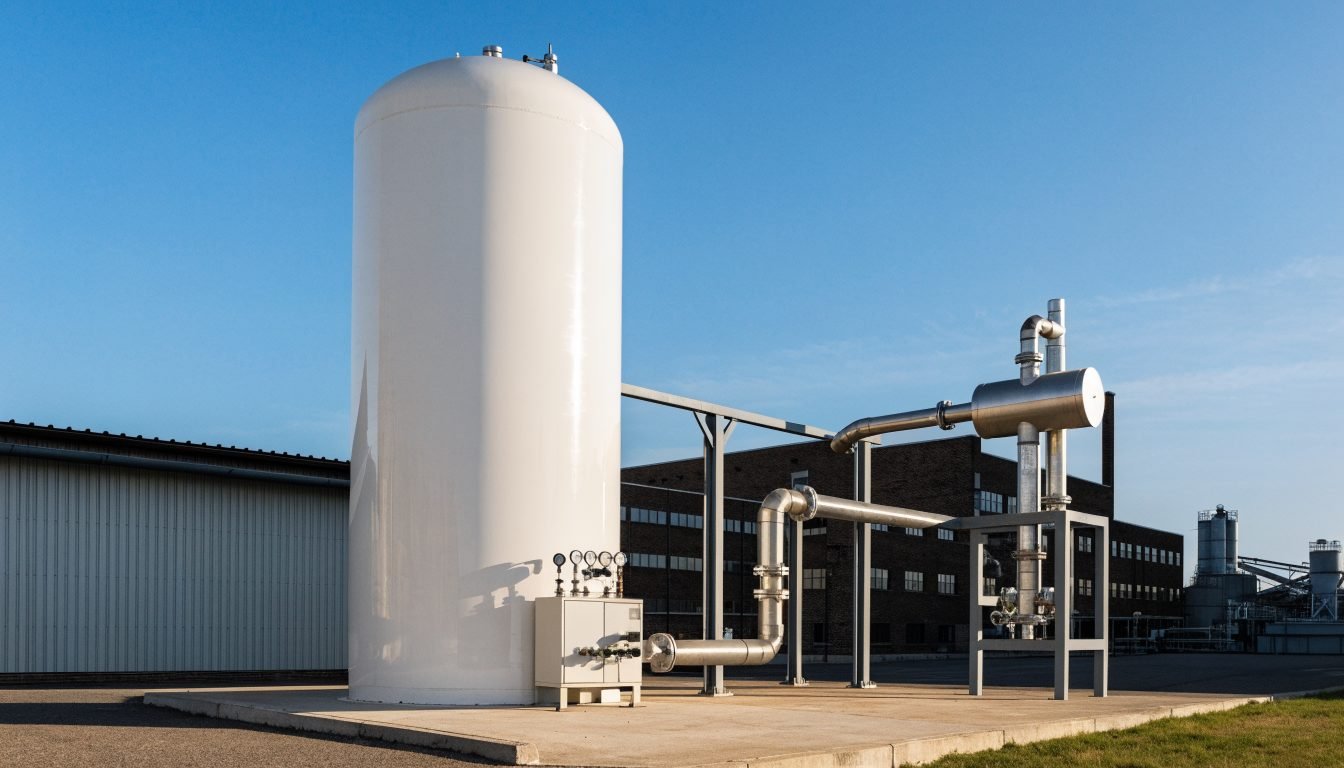
A liquid nitrogen storage tank is a vacuum-insulated vessel that holds LIN at cryogenic temperature for on-site gas supply. To buy one well, size it to your daily consumption and delivery frequency, choose a pressure class that matches your process, pair it with a correctly sized vaporizer, and decide between new fabrication and a certified second-hand unit.
Liquid nitrogen serves food freezing, metal treatment, electronics, laboratories, and inerting across many plants. The tank you install shapes delivery cost, gas pressure at the point of use, and how much product boils off between deliveries.
This guide walks through capacity, pressure, vaporizer pairing, the documents to demand, and the two supply channels KAF Cryogenics offers so you can specify with confidence and request an accurate quote.
What does a liquid nitrogen storage tank do?
A liquid nitrogen storage tank keeps LIN in liquid form under low temperature and moderate pressure until it is drawn off and vaporized into gas. The vessel is a double wall design: an inner pressure vessel holds the liquid, and an outer shell surrounds a vacuum-insulated space that slows heat entering from ambient air.
Because heat always leaks in slowly, a small amount of liquid turns to gas over time. This is normal boil-off. A quality vacuum keeps that rate low, which protects the product you paid for and steadies the pressure inside the tank.
- Inner vessel holds the liquid nitrogen at cryogenic temperature
- Vacuum-insulated jacket slows heat ingress and limits boil-off
- Pressure-building circuit maintains delivery pressure as liquid is used
- Relief devices protect the vessel against overpressure
- Withdrawal line feeds a vaporizer that converts liquid to gas
How do you size a liquid nitrogen storage tank?
Sizing starts with how much nitrogen you use and how often it can be delivered. A tank should hold enough for the days between deliveries plus a safety margin for peak demand, so the plant never runs dry and delivery trucks are not called out more often than needed.
Work through these inputs before you settle on a capacity.
- Average daily consumption in your working units
- Peak daily demand during your busiest shifts
- Delivery frequency your gas supplier can commit to
- Autonomy days you want between deliveries as a buffer
- Site constraints such as footprint, access for the delivery truck, and setback distances
- Boil-off allowance so the usable volume accounts for a small daily loss
A larger tank reduces delivery frequency and the risk of running out, but costs more and takes more space. A smaller tank costs less to install but needs more frequent deliveries. Our team can size a tank to your demand pattern; for the underlying method, see our storage tank sizing guide.
What pressure class does your process need?
Pressure class determines the pressure at which gas leaves the tank and reaches your equipment. A process that needs higher supply pressure calls for a higher pressure class vessel, which also changes how the tank manages boil-off and pressure build between uses.
Match the class to the pressure your application actually requires rather than defaulting to the highest available. Over-specifying pressure adds cost without benefit, while under-specifying leaves your equipment starved at peak flow. Share your required delivery pressure and peak flow with the supplier so the class is chosen on evidence.
How do you pair a vaporizer with the tank?
Most liquid nitrogen is used as gas, so the tank feeds an ambient air vaporizer that warms the liquid into gas using heat from the surrounding air. The vaporizer must be sized to your peak gas flow, not just the average, or gas will leave the vaporizer too cold during heavy draw.
- Size the vaporizer to peak flow, with margin for cold weather
- Consider duty cycle and defrost time, since ambient vaporizers ice up and need to recover
- Use parallel vaporizers where continuous flow cannot pause for defrost
- Confirm gas outlet temperature meets your process requirement
In cold climates, ambient vaporizers are commonly oversized because there is less heat in the air to draw from. Our ambient air vaporizer sizing guide covers the calculation in detail.
Should you buy new or certified second-hand?
KAF Cryogenics supplies liquid nitrogen tanks through two channels. New units are built to your specification, which suits projects with specific requirements and time to wait for fabrication. Certified second-hand units are inspected, NDT tested, and vacuum and pressure tested, then sold with a document dossier and written warranty.
The practical difference is often lead time. New fabrication typically takes months, while a certified used tank held in stock can ship in weeks. When a project timeline is tight, the certified used route can change the economics of the whole installation.
- New: built to spec, longer lead time, current design
- Certified second-hand: inspected, NDT tested, vacuum and pressure tested, warranty and document file, stock delivery in weeks
- Trade-in: KAF buys used equipment and accepts trade-in against new orders
For a full cost and timeline comparison, see our guide on new versus used cryogenic tanks.
What documents and certifications should you demand?
A pressure vessel is only as trustworthy as its paperwork. Ask for the certification file before purchase, whether the tank is new or certified used, and confirm the code matches the market where the tank will operate.
- PED 2014/68/EU for the European market, or ASME Section VIII for markets that require the US code
- EN 13458 conformity, the standard for static vacuum-insulated cryogenic vessels
- Material impact test records, since low-temperature service needs Charpy V-notch testing to avoid brittle fracture
- For certified used units: inspection report, NDT results, vacuum and pressure test records, and the written warranty
- Relief device sizing and set pressure documentation
The right code depends on the destination market, not on quality. A tank certified to PED is not lower quality than one certified to ASME; they serve different regulatory regions.
What boil-off rate is normal for a LIN tank?
Modern stationary cryogenic tanks lose roughly 0.2 to 0.6 percent of contents per day to static evaporation, depending on size and insulation. Larger tanks generally show lower percentage loss because they have less surface area relative to volume.
If you see frost or sweating on the outer shell, a rising boil-off rate, or faster pressure build than usual, the vacuum insulation may be degrading. A vacuum reading is recommended every 6 to 12 months. Our boil-off rate guide explains how to tell a normal rate from a developing problem.
How do you get an accurate price?
There is no fixed list price for a liquid nitrogen storage tank because the cost depends on the specification. Capacity, pressure class, material, certification code, insulation, and whether the unit is new or certified used all move the number.
To get an accurate quote, share your consumption, required delivery pressure, peak flow, destination market, and preferred lead time. With those inputs, KAF can propose a new build or a certified used unit from stock and price it against your actual needs.
Frequently Asked Questions
How big a liquid nitrogen tank do I need?
Size the tank to your average and peak daily consumption, your delivery frequency, and the number of autonomy days you want as a buffer. A tank should carry you between deliveries with margin for busy shifts. Share your usage pattern and KAF can size a suitable capacity.
Do I need a separate vaporizer for a LIN tank?
Yes, in most cases. If your process uses nitrogen as a gas, the tank feeds an ambient air vaporizer that warms the liquid into gas. The vaporizer must be sized to your peak gas flow, and in cold climates it is often oversized to compensate for less available ambient heat.
Is a certified second-hand liquid nitrogen tank reliable?
A certified second-hand tank has passed inspection, non-destructive testing, and vacuum and pressure testing, and comes with a document dossier and written warranty. That evidence is what makes it reliable. KAF sells used units only after this process.
What is a normal boil-off rate for a stationary LIN tank?
Modern stationary cryogenic tanks lose roughly 0.2 to 0.6 percent of contents per day, depending on size and insulation. Larger tanks tend toward the lower end. A sudden rise in boil-off, frost on the outer shell, or faster pressure build can indicate vacuum loss.
Which certification does a LIN tank need, PED or ASME?
It depends on the destination market. PED 2014/68/EU applies in Europe and carries CE marking, while ASME Section VIII is required in markets that specify the US code. The correct choice is about where the tank operates, not about quality.
How quickly can I get a liquid nitrogen storage tank?
New fabrication typically takes months. A certified used tank held in stock can ship in weeks. If your timeline is tight, ask KAF whether a suitable certified used unit is available from stock.
Can I trade in old equipment against a new tank?
Yes. KAF buys used cryogenic equipment and accepts trade-in against new orders. If you have an idle tank, its condition and documentation affect the credit it can carry toward a new purchase.
Related reading
Specify your liquid nitrogen tank with confidence
Send us your consumption, pressure, and lead-time needs. KAF Cryogenics will propose a new build or a certified second-hand unit from stock and give you an accurate quote.
Request a quote