
New vs Used Cryogenic Tank: Total Cost of Ownership Compared
Compare a new vs used cryogenic tank across price, lead time, lifespan, and certification. See when each makes sense and how to lower total cost.
KAF Cryogenics5 min read
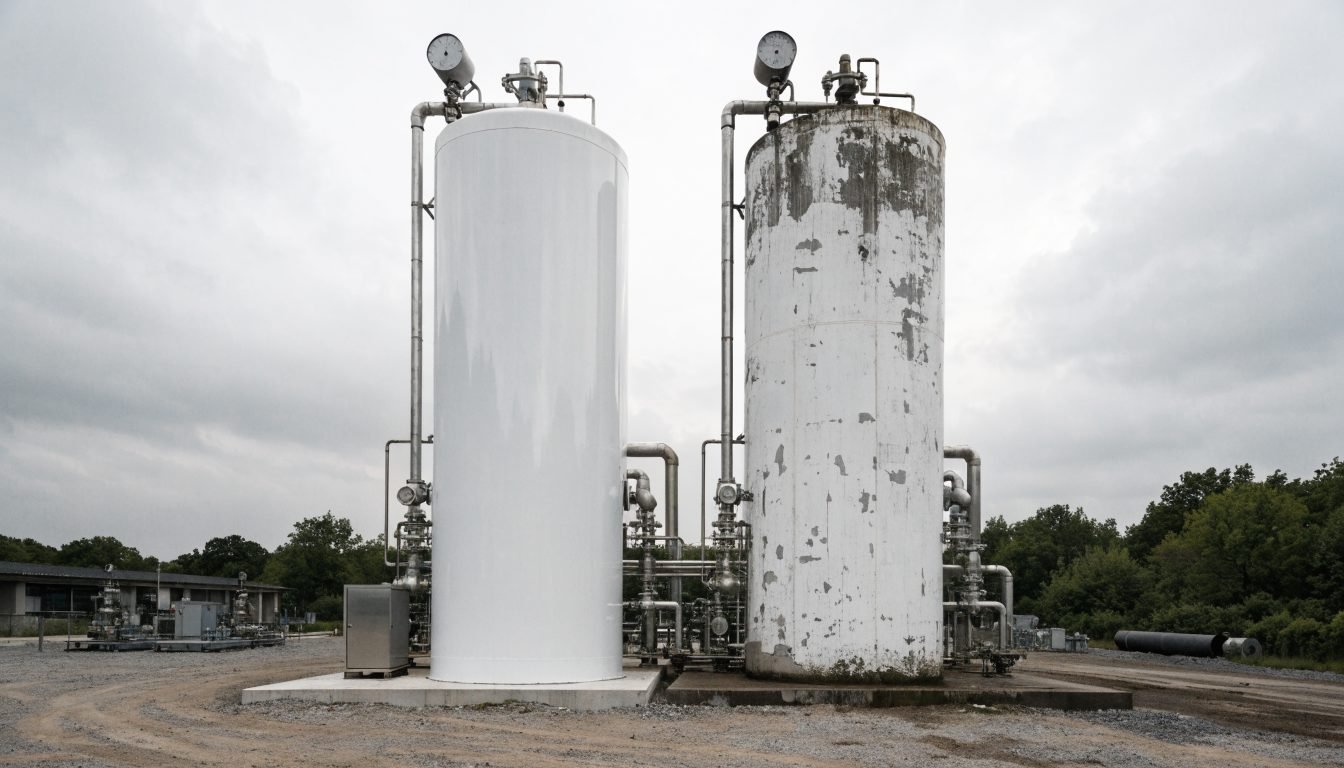
Choosing between a new vs used cryogenic tank comes down to total cost of ownership, not purchase price alone. A new tank is built to your exact specification but takes months to fabricate. A certified used tank is inspected, NDT tested, and vacuum and pressure tested, ships from stock in weeks, and usually costs less up front. Both can serve for many years.
Total cost of ownership includes the purchase price, the time you wait for the unit, the certification you need for your market, and the operating cost over the tank's life. A cryogenic vessel that is maintained and kept under vacuum performs for decades, so a well-verified used unit and a new unit can have similar working lives.
This comparison walks through each cost driver so you can decide which route fits your project and budget.
What goes into the total cost of a cryogenic tank?
Purchase price is the most visible number, but it is only part of the picture. When you compare a new vs used cryogenic tank fairly, weigh the full set of factors that affect cost and risk over the tank's life.
- Purchase price, which depends on capacity, pressure class, material, insulation, and certification.
- Lead time, or the cost of waiting, including delayed production or a project that cannot start.
- Certification for your destination market, which must be right the first time.
- Operating cost, driven mainly by boil-off and maintenance over the years.
- End-of-life value, including whether the unit can be sold or traded in later.
How do the purchase prices compare?
A certified used cryogenic tank generally has a lower purchase price than an equivalent new build, because the fabrication cost has already been spent. There is no fixed list price for either route. Price depends on capacity, pressure class, material, and certification, so an accurate figure comes from a quote against your specification.
The saving on a used unit is real, but it should be read alongside the verification behind it. A used tank that has been inspected, NDT tested, and pressure and vacuum tested carries a different value from an unverified as-is unit at a lower headline price.
How different are the lead times?
Lead time is often the deciding factor. New fabrication to specification typically takes months. A certified used tank held in stock can usually be delivered in weeks. When a project or a supply contract depends on a firm start date, that difference has a direct cost.
If your timeline has slack and your specification is unusual, waiting for a new build may be worthwhile. If you need to be operational soon, or you are replacing a failed unit, stock availability can outweigh a modest price difference.
Do new and used tanks have different working lives?
Cryogenic storage vessels are designed for decades of service. The working life of a used tank depends on its condition, not simply its age. An inner vessel that has stayed within its pressure limits and kept its vacuum can serve for many more years.
This is why testing matters more than model year. A certified used tank with documented NDT, vacuum, and pressure results gives you a sound basis for expecting a long remaining life. An unverified unit does not, regardless of how new it looks.
Is certification different for new and used tanks?
The certification requirement is set by your market, not by whether the tank is new or used. ASME is the US code and PED 2014/68/EU is the European code with CE marking. The correct one depends on the destination market, not on quality. For the vessel type, EN 13458 covers static cryogenic vessels and EN 13530 covers transportable ones.
For a new build, you specify the required code up front. For a used tank, you confirm the existing certification matches the market where you will operate. Either way, the document dossier should be complete before you commit.
What are the operating costs over time?
The largest ongoing cost is product loss through boil-off, which depends on vacuum quality and insulation. A modern stationary cryogenic tank in good condition loses roughly 0.2 to 0.6 percent of its contents per day. A used tank with a verified vacuum operates in the same range as a new one.
- Boil-off losses, minimized by a sound vacuum and correct sizing for your demand.
- Routine maintenance, including a vacuum reading every 6 to 12 months and relief valve checks.
- Occasional service, such as re-evacuation if the vacuum degrades over the years.
When does new make sense and when does used?
There is no single answer. The right choice depends on your timeline, specification, and budget.
- Choose new when you need an unusual specification, a specific pressure class, or a particular certification built from scratch, and your timeline allows months of fabrication.
- Choose certified used when you need to be operational in weeks, want a lower purchase price, and can match an in-stock unit to your gas, capacity, and pressure requirements.
- In either case, insist on complete documentation and, for a used unit, the inspection, NDT, and vacuum and pressure test results plus a written warranty.
KAF Cryogenics supplies both channels: new tanks built to specification and certified second-hand units from stock. KAF also buys used equipment and accepts trade-in on new orders, which can offset the cost of an upgrade.
Frequently Asked Questions
Is a used cryogenic tank cheaper than a new one?
A certified used tank generally has a lower purchase price because the fabrication cost is already spent. There is no fixed list price for either, since cost depends on capacity, pressure class, material, and certification. An accurate figure comes from a quote against your specification.
How much faster is a used tank to get?
A certified used tank held in stock can usually be delivered in weeks, while new fabrication to specification typically takes months. When a project depends on a firm start date, this lead-time difference often outweighs a modest price gap.
Does a used tank cost more to operate?
Not if its vacuum is verified. The main operating cost is boil-off, and a used tank with a sound vacuum loses product in the same range as a new one, roughly 0.2 to 0.6 percent per day for a modern stationary tank. Testing before purchase is what confirms this.
Will a used tank last as long as a new one?
Cryogenic vessels are designed for decades of service, and a used tank's remaining life depends on condition rather than age. A unit with documented NDT, vacuum, and pressure results gives a sound basis for a long working life.
Can I trade in my old tank against a new one?
Yes. KAF buys used equipment and accepts trade-in on new orders. Trade-in credit can reduce the net cost of an upgrade and gives you a route to move on a unit you are replacing.
Does the certification differ between new and used tanks?
The certification requirement is set by your destination market, not by whether the tank is new or used. ASME applies to the US market and PED 2014/68/EU to the European market. Confirm the tank's certification matches where you will operate before you commit.
Related reading
Compare a new build against stock before you decide
Tell KAF Cryogenics your gas, capacity, pressure, and target market. We will quote a new tank built to specification and, where available, a certified used unit from stock, so you can compare price and lead time on the same basis.
Get a comparison quote