
LNG Regasification Basics for Distributors
How LNG regasification works at distribution scale: storage, ambient air vaporization, pressure and temperature control, and send-out.
KAF Cryogenics6 min read
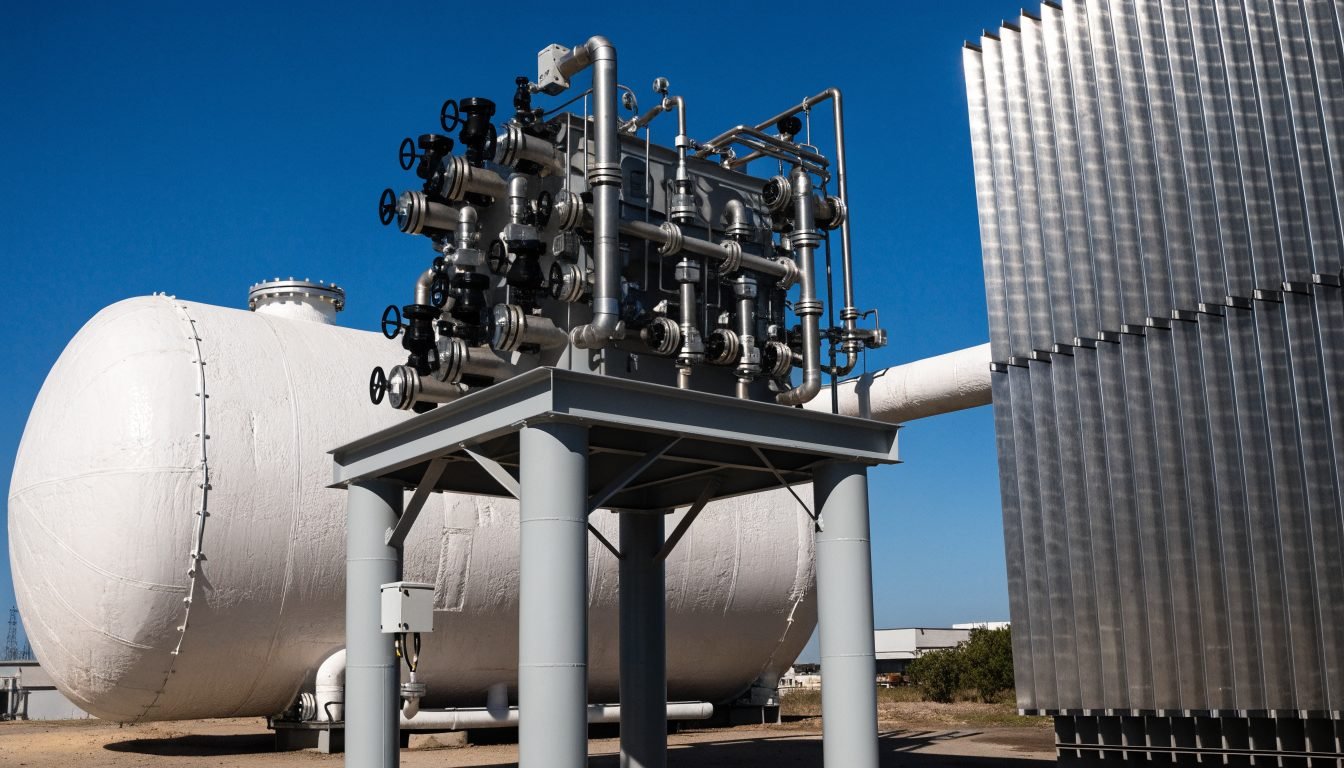
LNG regasification is the process of warming stored liquefied natural gas back into pipeline quality gas. At distribution scale the LNG regasification equipment is a chain of a cryogenic storage tank, ambient air vaporizers that add heat, pressure and temperature control, and metered send out to a network or industrial user.
This primer explains each stage in plain terms for a distributor new to LNG. Regasification is not complicated once the sequence is clear, but sizing and control decide whether the site holds steady pressure and temperature through the day. The sections below follow the gas from stored liquid to metered delivery.
KAF Cryogenics supplies the storage tank and ambient vaporizers that carry most of the regasification duty, new to specification or certified second hand from stock, so a distributor can match capacity to demand rather than to a fixed package.
What is LNG regasification?
LNG regasification is the conversion of liquefied natural gas back into gas by adding heat. LNG is stored at cryogenic temperature, near minus 162 degrees Celsius, so that a large volume of gas fits in a small liquid volume. To use it, the liquid is warmed until it returns to gas at the pressure the network needs.
At distribution scale this happens at a satellite station or a customer site fed by road tanker rather than by pipeline. The station stores the LNG, vaporizes it on demand, controls the pressure and temperature, and meters the gas out. Regasification is the middle of that chain.
How does the regasification process work step by step?
The process is a short, ordered sequence. Each stage prepares the gas for the next, and the sizing of one stage sets the requirement for the others.
- Storage: LNG is held cold in a vacuum insulated cryogenic tank
- Pressure build: tank pressure is raised so liquid flows to the vaporizer
- Vaporization: an ambient air vaporizer adds heat and turns liquid into gas
- Temperature and pressure control: the gas is regulated to send out conditions
- Metering and odorization: the gas is measured and odorized where required
- Send out: the gas passes to the network or the industrial user
What equipment does distribution scale regasification need?
The core equipment is a cryogenic LNG storage tank and one or more ambient air vaporizers, supported by pressure and temperature control, metering, odorization, and safety systems. The tank and vaporizers are the largest items and set the capacity of the site.
Ambient air vaporizers are the common choice at distribution scale because they draw heat from the surrounding air and need no fuel or electric heat input. They are simple to run, though they frost over in use and are usually installed in parallel so one can defrost while another carries the load.
How does an ambient air vaporizer regasify LNG?
An ambient air vaporizer is a set of finned tubes. Cold LNG flows through the tubes while air passes over the fins, transferring heat that warms the liquid until it becomes gas. Because the heat comes from the air, the vaporizer has no running fuel cost for the heat itself.
Why frost and defrost matter
As the vaporizer runs, moisture in the air freezes onto the fins as frost, which reduces heat transfer over time. The station manages this by rotating duty between vaporizers in parallel, letting a frosted unit defrost while another carries the flow. In cold climates, where ambient heat is scarce and frosting is faster, the vaporizer capacity is increased or more units are added.
How is regasification equipment sized?
Sizing links storage to demand and vaporization to peak flow. The storage tank is sized from average daily demand multiplied by the days of autonomy you want between deliveries, plus margin for peak demand and reserve. The vaporizers are sized to peak send out flow, not average, so the site holds pressure on the highest demand day.
Boil off is part of the storage calculation. Modern stationary cryogenic tanks lose roughly 0.2 to 0.6 percent of contents per day to static evaporation, depending on size and insulation. Factor that into the working reserve. For the vaporizers, account for the gas type, ambient temperature, and the defrost cycle so the rated capacity holds up in real conditions.
How are pressure and temperature controlled on send out?
After vaporization the gas must leave at the right pressure and a temperature the network can accept. A pressure regulation stage drops and holds the gas at send out pressure, while temperature is managed by ensuring the vaporizer is sized so the gas leaves warm enough rather than still cold.
Undersized vaporization or a frosted unit can let gas leave too cold, which downstream equipment may not tolerate. This is why vaporizer sizing and the duty and standby arrangement are central to a stable site rather than an afterthought.
What safety and certification apply to regasification equipment?
Safety spans the whole site: pressure relief on the tank and piping, gas detection, and an emergency shutdown system, with siting and fire protection to the local code. On the equipment itself, the pressure vessel code depends on the destination market. PED 2014/68/EU applies for CE marking in Europe and ASME Section VIII is the United States code, with EN 13458 for static cryogenic vessels.
Low temperature service also requires impact, or Charpy V notch, testing of materials to avoid brittle fracture below about minus 150 degrees Celsius. KAF builds to PED and ASME and holds ISO 9001, ISO 14001, and ISO 3834-2 for welding quality, supplying the documents with the equipment.
How should a new distributor plan the equipment?
Start from the demand profile and delivery interval, size the storage and vaporization to that, then specify control, metering, and safety around them. Decide between a new build to specification and a certified second hand tank from stock, weighing lead time against the fixed project date.
New fabrication commonly takes months, while a certified second hand tank in stock can ship in weeks. Certified used units are inspected, NDT tested, vacuum and pressure tested, and sold with a document dossier and written warranty, so a stock unit can be compared to a new build on real terms.
Frequently Asked Questions
What is LNG regasification?
LNG regasification is the conversion of liquefied natural gas back into pipeline quality gas by adding heat. The LNG is stored cold, near minus 162 degrees Celsius, then warmed in a vaporizer until it returns to gas at the pressure the network needs.
What equipment is needed to regasify LNG?
At distribution scale you need a cryogenic LNG storage tank, ambient air vaporizers, pressure and temperature control, metering, odorization, and safety systems. The storage tank and vaporizers are the largest items and set the site capacity.
How does an ambient air vaporizer work?
An ambient air vaporizer passes cold LNG through finned tubes while air flows over the fins, transferring heat that warms the liquid into gas. It needs no fuel or electric heat for the vaporization, but it frosts over in use and needs a defrost rotation.
How is regasification equipment sized?
Size the storage tank from average daily demand times the days of autonomy between deliveries, plus reserve, and size the vaporizers to peak send out flow rather than average. Account for boil off in storage and for gas type, ambient temperature, and defrost in vaporization.
What is the boil off rate at a regasification site?
Modern stationary cryogenic tanks lose roughly 0.2 to 0.6 percent of contents per day to static evaporation, depending on size and insulation. Larger tanks show a lower percentage loss because of their better surface area to volume ratio.
Which certification does regasification equipment need?
Use PED 2014/68/EU for the European market or ASME Section VIII for the United States market, with EN 13458 for static cryogenic vessels. The correct code depends on the destination market, and low temperature materials require Charpy impact testing.
Can I buy regasification equipment second hand?
Yes. KAF supplies certified second hand storage tanks and vaporizers from stock, which can ship in weeks against months for new fabrication. Each unit is inspected, NDT tested, vacuum and pressure tested, and sold with a document dossier and written warranty.
Related reading
Entering LNG distribution?
Share your demand profile and delivery interval with KAF Cryogenics, and we will help size the storage tank and vaporizers and quote both a new build and a certified second hand option from stock.
Request a quote