
Buying LNG Storage Tanks: New, Used and Lead Times
Buying LNG storage tanks: how to size capacity and pressure, compare new against certified used, and read lead times honestly.
KAF Cryogenics6 min read
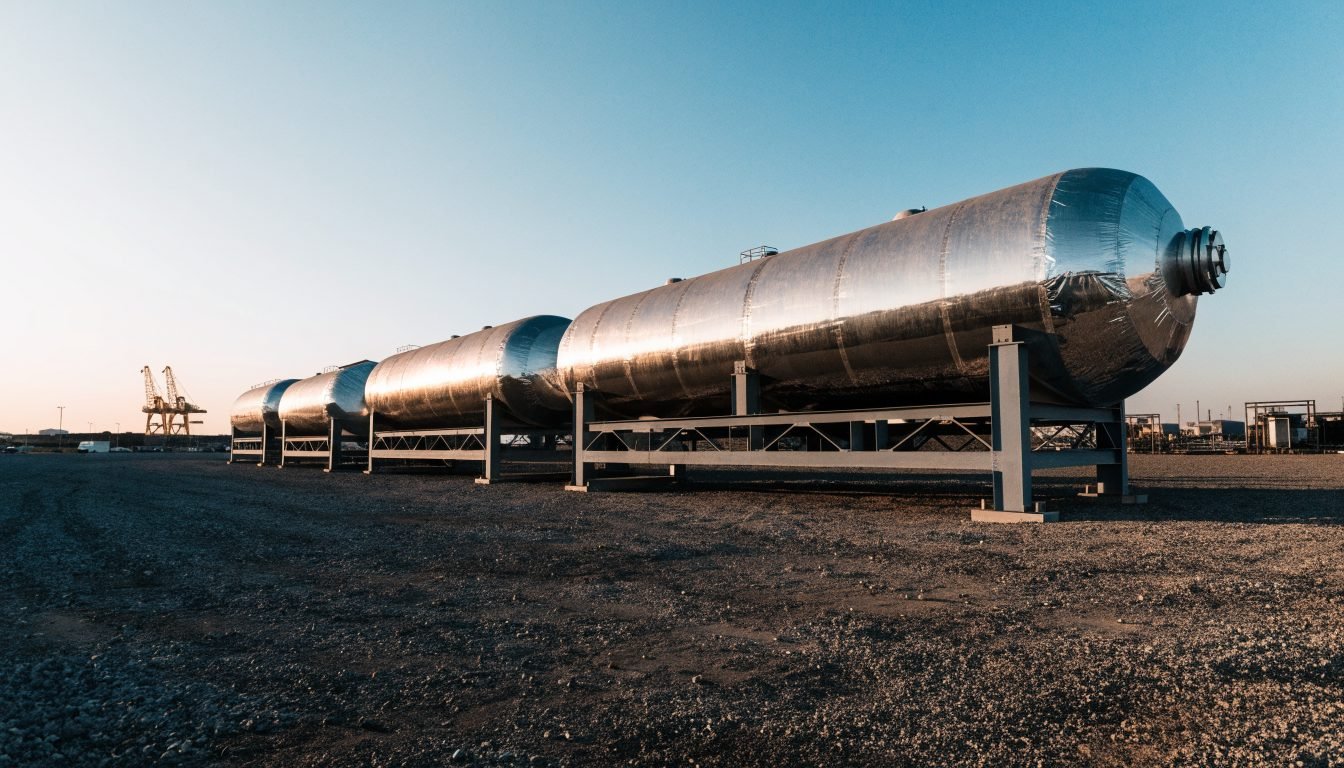
When buying an LNG storage tank, decide the capacity and pressure class from your demand and delivery interval, then choose between a new build to specification and a certified second hand unit. The main practical difference is lead time. New fabrication commonly takes months, while a certified used tank held in stock can ship in weeks.
This guide covers how to specify an LNG storage tank, what separates new from certified second hand, how to read lead times honestly, and which documents to demand before you pay. The aim is to help a buyer compare options on real facts, capacity, pressure, certification, and delivery date, rather than on price alone.
KAF Cryogenics supplies LNG storage tanks through both channels, new to specification and certified second hand from stock, and also buys used equipment and accepts trade in on new orders.
How do you specify an LNG storage tank?
Start with capacity. Size the tank from average daily LNG demand multiplied by the days of autonomy you want between deliveries, then add margin for peak demand and a working reserve. A site that takes a tanker weekly needs far more storage than one that can accept a delivery every couple of days.
Then set the pressure class. The maximum allowable working pressure, or MAWP, affects the send out pressure available and how boil off is managed across the delivery cycle. Match the pressure class to the vaporizer duty and the downstream network so the tank holds steady pressure between fills.
Account for boil off
Modern stationary cryogenic tanks lose roughly 0.2 to 0.6 percent of contents per day to static evaporation, depending on size and insulation. Larger tanks show a lower percentage loss because their surface area to volume ratio is better. Factor this into the working reserve rather than sizing to the bare minimum a single cycle needs.
Should you buy a new or used LNG storage tank?
Both channels deliver a compliant tank. A new tank is built to your exact specification, which suits unusual sizes, special pressure classes, or a certification the market rarely stocks. A certified second hand tank suits standard specifications where availability and lead time matter, and it lets you bring a project online sooner.
- Choose new when the specification is uncommon or a precise configuration is required
- Choose certified used when the specification is standard and the delivery date is tight
- Compare both on total cost and delivery date, not on unit price alone
- Ask about trade in, since KAF accepts used equipment against a new order
How long does an LNG storage tank take to deliver?
This is where the two channels differ most, and it is worth being precise. New fabrication of a cryogenic LNG storage tank commonly takes months, because the vessel is built, welded, tested, and certified to order. That timeline is normal for a made to order pressure vessel and should be planned for, not treated as a delay.
A certified second hand tank that KAF holds in stock can ship in weeks, because the unit already exists and has been through inspection and testing. The contrast is straightforward: months to fabricate a new tank against weeks to deliver a comparable stock unit. Neither is better in the abstract. The right choice depends on whether your project can wait for a new build or needs equipment on site soon.
What does certified second hand actually mean?
Certified second hand is not the same as buying a tank as is. Before KAF sells a used LNG storage tank it goes through a defined process so the buyer knows what they are getting.
- Visual and dimensional inspection of the inner and outer vessel
- Non destructive testing, or NDT, of welds and pressure boundary
- Vacuum testing to confirm the insulation jacket integrity
- Pressure testing to confirm the vessel holds its rating
- Valve and relief device check and overhaul as needed
- A document dossier and a written warranty supplied with the tank
What certifications should an LNG storage tank have?
The pressure vessel code depends on the destination market, not on quality. PED 2014/68/EU applies for CE marking in Europe, and ASME Section VIII is the United States code. Static vacuum insulated cryogenic vessels follow EN 13458. Order the code the market where the tank operates actually requires.
Low temperature service also needs impact, or Charpy V notch, testing of the materials to avoid brittle fracture below about minus 150 degrees Celsius. KAF builds to PED and ASME and holds ISO 9001, ISO 14001, and ISO 3834-2 for welding quality, and supplies the supporting documents with the tank.
What documents should you demand before paying?
The document file is where a tank proves what it is. For a used tank in particular, insist on the full dossier before committing, because papers are far harder to reconstruct after the sale than to hand over at it.
- Manufacturer data report and original certification to PED or ASME
- Inspection and NDT reports from the certification process
- Vacuum and pressure test records
- Nameplate details, including MAWP and capacity
- Service history where available, and the written warranty terms
How is the price of an LNG storage tank set?
There is no fixed list price for an LNG storage tank. The cost is driven by capacity, pressure class, material, certification code, insulation, and options, and a certified second hand unit is priced differently from a new build. The way to get a real figure is a quote against your specification.
Give the supplier your demand profile, delivery interval, and target market so the quote reflects the right size, pressure, and code. KAF provides an accurate quote for both a new build and a certified second hand option, so you can weigh price against delivery date on real numbers.
Frequently Asked Questions
How do I size an LNG storage tank?
Size the tank from average daily LNG demand multiplied by the days of autonomy you want between deliveries, plus margin for peak demand and a working reserve. Delivery frequency is the main driver, since less frequent deliveries need larger storage.
Is a used LNG storage tank safe to buy?
A certified second hand tank is safe when it has passed inspection, NDT, and vacuum and pressure testing and comes with a document dossier and written warranty. Avoid as is units with no test records, since the buyer then carries the condition risk.
How long does a new LNG storage tank take to build?
New fabrication of a cryogenic LNG storage tank commonly takes months, because the vessel is built, welded, tested, and certified to order. A certified second hand tank held in stock can ship in weeks instead.
What is the boil off rate of an LNG storage tank?
Modern stationary cryogenic tanks lose roughly 0.2 to 0.6 percent of contents per day to static evaporation, depending on size and insulation. Larger tanks show a lower percentage loss because of their better surface area to volume ratio.
Which certification does an LNG storage tank need?
Use PED 2014/68/EU for the European market or ASME Section VIII for the United States market, with EN 13458 for static cryogenic vessels. The correct code depends on the destination market, and low temperature materials require Charpy impact testing.
Does KAF buy used LNG tanks or take trade ins?
Yes. KAF buys used cryogenic equipment and accepts trade in on new orders, which can offset the cost of a new build. Contact KAF with the unit details for an assessment.
How much does an LNG storage tank cost?
There is no fixed list price. Cost depends on capacity, pressure class, material, certification, insulation, and whether the unit is new or certified second hand. Provide your specification and KAF will give an accurate quote.
Related reading
Looking for an LNG storage tank?
Send KAF Cryogenics your capacity, pressure, and target market, and we will quote both a new build and a certified second hand tank from stock, with lead times for each.
Request a quote