
Transporting Cryogenic Liquids: Driver, Vehicle and Documentation Requirements
ADR requirements for transporting cryogenic liquids: driver certificate, orange plates, transport documents, on board equipment and tank inspection validity.
KAF Cryogenics12 min read
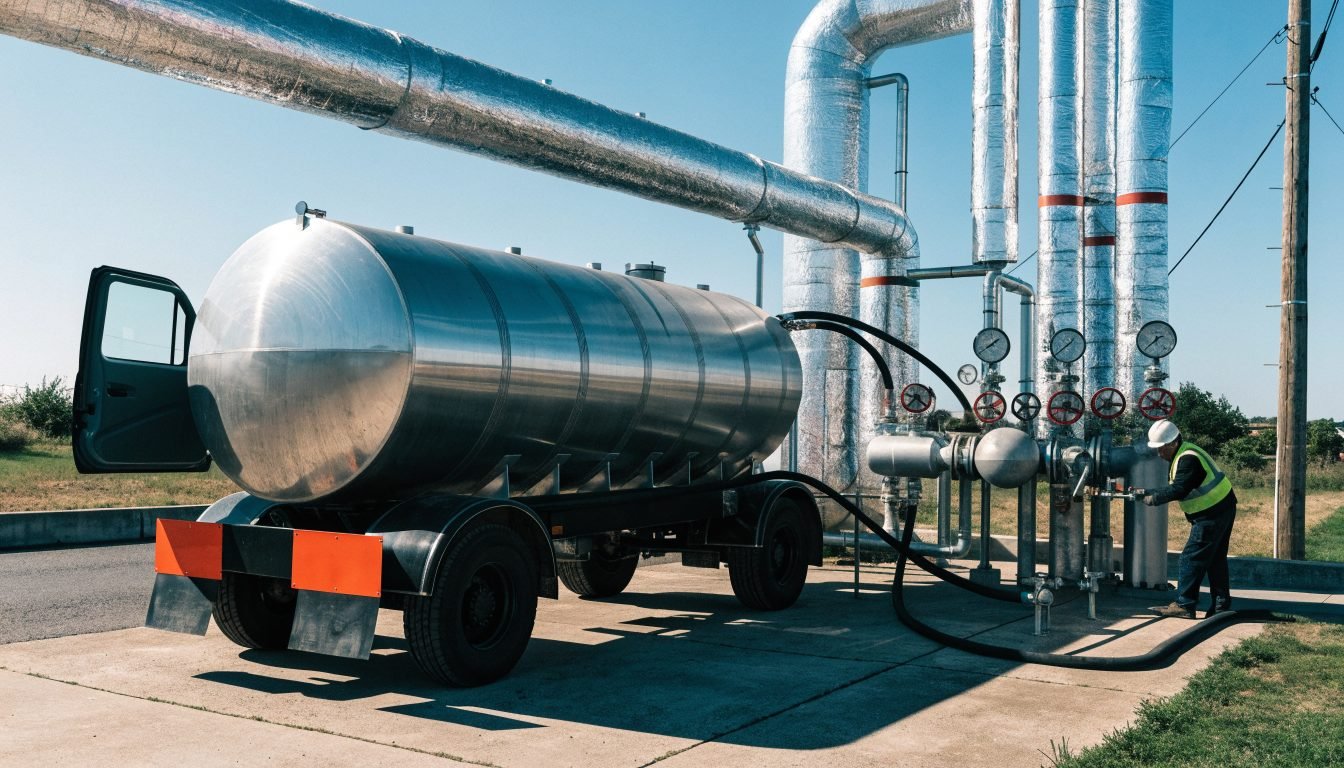
Transporting cryogenic liquids by road in Europe is governed by ADR, the European agreement on the carriage of dangerous goods by road. It sets requirements for the driver's ADR certificate, vehicle marking and orange plates, transport documents, equipment carried on board, and the tank's own inspection validity. National implementation varies, so operators must confirm current rules.
Refrigerated liquefied gases such as liquid nitrogen, liquid oxygen, liquid argon, LNG and LCO2 are dangerous goods of Class 2. The obligations fall on several parties at once: the consignor, the carrier, the driver and the operator of the tank. A gap in any one of them stops the load.
This guide sets out what a logistics operator needs in place before a cryogenic tanker leaves the depot, and where to check that each requirement is current.
What rules apply to transporting cryogenic liquids by road?
The governing instrument is ADR, the European Agreement concerning the International Carriage of Dangerous Goods by Road. It is revised on a two year cycle and each contracting party implements it in national law, which is why the phrase to keep in mind is always the current edition as implemented locally. A rule that was correct three years ago may have been amended, and a transitional provision that applied to older equipment may have expired.
Cryogenic products move under Class 2, gases, in the refrigerated liquefied gas category. Each product has its own UN number and label combination, and these determine most of the downstream requirements.
- Liquid nitrogen and liquid argon: inert gases, carried under Class 2 with the non flammable, non toxic gas label
- Liquid oxygen: carried with the non flammable, non toxic gas label plus the oxidising subsidiary label, which triggers additional segregation and handling rules
- LNG: a flammable gas, carried with the flammable gas label
- LCO2 as a refrigerated liquid: non flammable and non toxic, but a heavy gas with asphyxiation risk at low level
- LPG: carried liquefied under pressure rather than refrigerated, under its own UN entries depending on the mixture
The consignor classifies the goods and provides the correct description. The carrier is responsible for the vehicle, the driver's qualification and the equipment carried. The operator of the tank is responsible for keeping its inspections valid. Enforcement at the roadside checks all of these together.
What ADR training and certificate does the driver need?
A driver carrying cryogenic liquids in a tank needs a valid ADR driver training certificate covering both the basic course and the tank specialisation. Driving a tanker on the basic certificate alone is not permitted.
- Basic course: general dangerous goods training covering classification, documentation, marking, driver obligations and emergency actions
- Tank specialisation: required for carriage in fixed tanks, demountable tanks, tank containers and tank swap bodies, which covers cryogenic road tankers, bobtails and ISO tank containers on a chassis
- Class specific training where the national implementation requires it for the products carried
- The certificate is issued after examination and is valid for a defined period, commonly five years, and is renewed by refresher training and examination before expiry
- The certificate must be carried on the vehicle and produced on request
Beyond the formal certificate, cryogenic service demands product specific competence that ADR training alone does not fully cover: cold burn hazards, oxygen deficiency in enclosed areas, oxygen enrichment around liquid oxygen, correct venting practice and the behaviour of a tank whose pressure rises during a long stand. Most operators run their own product training in addition.
The carrier must also appoint a dangerous goods safety adviser where the national implementation requires one. That role sits with the company, not the driver, and covers procedures, incident reporting and the annual report.
How must a cryogenic tanker be marked and placarded?
Marking tells emergency services what they are dealing with before anyone approaches the vehicle. For tank carriage there are two distinct elements: orange plates and danger labels.
- Orange plates at the front and rear of the transport unit, and on the tank itself where required for the configuration
- For tank carriage, the orange plate normally shows the hazard identification number in the upper half and the UN number in the lower half, identifying the specific product
- Danger labels, the diamond placards, applied to both sides and the rear of the tank according to the class and any subsidiary risk
- For liquid oxygen this means the gas label together with the oxidising subsidiary label
- Plates and labels must be legible, correctly sized, securely fixed and resistant to fire exposure to the extent the regulation requires
- When the tank is empty and uncleaned, marking generally remains in place, since residual product still presents a hazard
A frequent compliance failure is a plate that no longer matches the product actually loaded, for example after a fleet vehicle is switched from nitrogen to oxygen service. Plate changeover has to be part of the loading procedure, not an afterthought.
What transport documents must be carried?
The document set is checked at the roadside and at the gate of most receiving plants. Missing paperwork is the single most common reason a compliant vehicle is refused.
- The dangerous goods transport document, with the product described exactly as the regulation prescribes, including UN number, proper shipping name, class, packing group where applicable, and the quantity carried
- Instructions in writing, provided by the carrier in a language each crew member can read and understand, kept readily available in the cab
- The driver's ADR training certificate
- Photographic identification for each crew member
- The tank certificate or tank record showing the current inspection status, and the vehicle's ADR approval certificate where the configuration requires one
- Where applicable, documentation relating to the tunnel restriction code for the route
- Any additional documents required by the national implementation or by the receiving site
For international movements, confirm the language requirement for the instructions in writing on every leg of the route, not only in the country of loading. This is a common gap on cross border cryogenic deliveries.
What equipment must be carried on the vehicle?
ADR sets out general equipment for every transport unit, additional items keyed to the danger labels of the load, and fire extinguishing equipment scaled to the size of the transport unit.
The general equipment normally includes the following.
- A wheel chock sized for the vehicle
- Two self standing warning signs
- A high visibility warning vest for each crew member
- A portable lighting apparatus for each crew member
- Protective gloves and eye protection for each crew member
Fire extinguishing equipment is scaled to the maximum permissible mass of the transport unit. In the common case of a transport unit above 7.5 tonnes, ADR requires a minimum total capacity of 12 kg of dry powder or equivalent, of which at least one extinguisher of at least 6 kg capacity, and at least one extinguisher of at least 2 kg suitable for a fire in the engine or cab. Confirm the figures for your specific vehicle mass against the current edition and the national implementation.
For cryogenic service, operators normally carry additional personal protective equipment beyond the ADR minimum, because the products themselves cause cold injury on contact.
- Cryogenic gloves, loose fitting so they can be removed instantly if liquid enters them
- Full face shield in addition to eye protection for transfer operations
- Suitable footwear and clothing without cuffs or pockets that can trap spilled liquid
- A personal oxygen monitor where the operator's risk assessment calls for it
What rules apply to loading, securing and parking?
Operational rules matter as much as documentation, and they are where cryogenic transport differs most from other dangerous goods. A cryogenic tank is not inert while parked: heat leak causes pressure to rise, so standing time is an operational variable, not a neutral state.
- Immobilise the vehicle, apply the parking brake and chock the wheels before any transfer begins
- Connect the earthing and bonding point before transfer where the product and the site require it
- Fill by mass or by volume according to the applicable filling limit for the product, never beyond it, since a liquid filled tank has no room for thermal expansion
- Check that all valves are closed and blank caps refitted, and that hoses are drained and stowed, before moving off
- Observe supervision and parking rules for dangerous goods vehicles, and use designated parking where the regulation or the operator's procedure requires it
- Take account of tunnel restriction codes when planning the route, since flammable products are more restricted than inert ones
- Monitor tank pressure during long stands and follow the operator's venting procedure rather than allowing relief devices to lift unattended in an unsuitable location
Delivery site conditions are part of the same picture. The receiving plant's fill point, standing area, earthing point and turning circle all have to suit the vehicle actually sent.
How long is a cryogenic tank's ADR inspection valid?
This is the requirement that most often catches out buyers of used transport equipment. A cryogenic road tanker, bobtail or tank container is only usable for dangerous goods carriage while its own inspection regime is current. The equipment can be in excellent physical condition and still be unable to load legally.
The ADR inspection regime for tanks is structured in stages.
- Initial inspection before the tank enters service, covering design conformity, construction, the pressure test and the equipment fitted
- Periodic inspection at the interval set for the tank type and the products carried
- Intermediate inspection between periodic inspections, generally a leakproofness and equipment check
- Exceptional check after repair, modification or an incident affecting the tank
- Results recorded in the tank record and the relevant dates marked on the tank plate
The specific intervals for tanks carrying refrigerated liquefied gases are set in ADR Part 6 and in the national implementation, and they have been amended across editions. Do not rely on a figure quoted in general material, including this article. Read the dates stamped on the tank plate, cross check them against the tank record, and confirm the applicable interval with the competent body or notified inspection organisation in the country of registration.
For anyone buying a used cryogenic trailer or tank container, three checks belong in the offer stage, not the delivery stage: the next inspection due date, whether that date is close enough to affect utilisation in the first year of ownership, and whether the approval will transfer on change of registration country. An inspection falling due shortly after delivery is a real cost that should be reflected in the price.
How does equipment choice affect ADR compliance?
The tank itself carries a large part of the compliance burden. Transportable cryogenic vessels are designed to EN 13530, while static vacuum insulated vessels follow EN 13458, and the design code applied determines what approvals the tank can hold. A vessel built and certified for static service cannot simply be mounted on a chassis and driven.
- Semi trailers: the highest payload per movement, suited to trunk routes and large customer deliveries
- Bobtails: rigid truck mounted tanks, suited to multi drop urban and customer station routes where access is restricted
- ISO tank containers, T75 type for cryogenic service: intermodal, allowing road, rail and sea legs on the same tank, with their own approval and inspection regime
- Whichever format is chosen, the document dossier travels with the equipment and is what an inspector will ask to see
KAF Cryogenics supplies transport equipment both new to specification and as certified second hand units that have passed inspection, non destructive testing and vacuum and pressure testing, and are sold with a document dossier and a written warranty. Certified second hand units can often be delivered from stock in weeks where new fabrication takes months. KAF also buys used equipment and accepts trade in against new orders, which lets a fleet operator replace units whose inspection cycle no longer suits the route plan.
Whichever route you take, confirm the current ADR requirements and the national implementation in every country on the route before committing. The regulation is the authority; a supplier can tell you what the equipment holds, but only the competent authority can tell you what your operation must satisfy.
Frequently Asked Questions
Does a driver need an ADR certificate to transport liquid nitrogen?
Yes. Liquid nitrogen is a Class 2 refrigerated liquefied gas and a dangerous good under ADR. A driver carrying it in a tank needs a valid ADR driver training certificate covering both the basic course and the tank specialisation, carried on the vehicle and produced on request.
How long is an ADR driver certificate valid?
The certificate is issued after examination and is valid for a defined period, commonly five years, then renewed by refresher training and a further examination before it expires. Because national implementation can differ, confirm the validity period and the renewal window with the issuing authority in the country of registration.
What goes on the orange plate of a cryogenic tanker?
For tank carriage the orange plate normally carries the hazard identification number in the upper half and the UN number of the product in the lower half. Plain orange plates without numbers are used in other configurations. The plate must match the product actually loaded, which makes plate changeover part of the loading procedure.
What are instructions in writing under ADR?
Instructions in writing are the emergency guidance the carrier must provide to the vehicle crew, kept readily available in the cab, in a language each crew member can read and understand. They set out immediate actions in an incident and are checked at the roadside alongside the transport document.
What fire extinguishers must an ADR cryogenic tanker carry?
The requirement is scaled to the maximum permissible mass of the transport unit. For a transport unit above 7.5 tonnes, ADR requires a minimum total capacity of 12 kg of dry powder or equivalent, including at least one extinguisher of at least 6 kg and at least one of at least 2 kg suitable for an engine or cab fire. Confirm the figures for your vehicle against the current edition.
How often does a cryogenic road tanker need ADR inspection?
Tanks are subject to an initial inspection, periodic inspections, intermediate inspections and exceptional checks after repair or incident. The intervals for tanks carrying refrigerated liquefied gases are set in ADR Part 6 and its national implementation and have changed across editions, so read the dates on the tank plate and confirm the applicable interval with the competent body.
Can a used cryogenic trailer be bought with its ADR approval still valid?
Often yes, but the remaining validity is a commercial variable. Check the next inspection due date, whether it falls within the first year of ownership, and whether the approval transfers if the unit changes registration country. An inspection falling due shortly after delivery is a real cost and should be reflected in the price.
Do ADR markings stay on an empty cryogenic tank?
Generally yes. An empty and uncleaned tank still contains residual product and vapour, so it continues to be treated as carrying dangerous goods and the marking, documentation and driver qualification requirements continue to apply. Confirm the exact treatment for your product under the current edition and national implementation.
Related reading
Building or renewing a cryogenic transport fleet?
KAF Cryogenics supplies semi trailers, bobtails, truck mounted tanks and T75 ISO tank containers, new to specification or as certified second hand units with a full document dossier and written warranty. Tell us your products, routes and payload target and we will quote both options.
Request transport equipment options