
Cryogenic Liquid to Gas Conversion: Volumes, Density and Ratios
Cryogenic liquid to gas conversion ratios for nitrogen, oxygen, argon and LNG, with the arithmetic to size storage against your own gas demand.
KAF Cryogenics11 min read
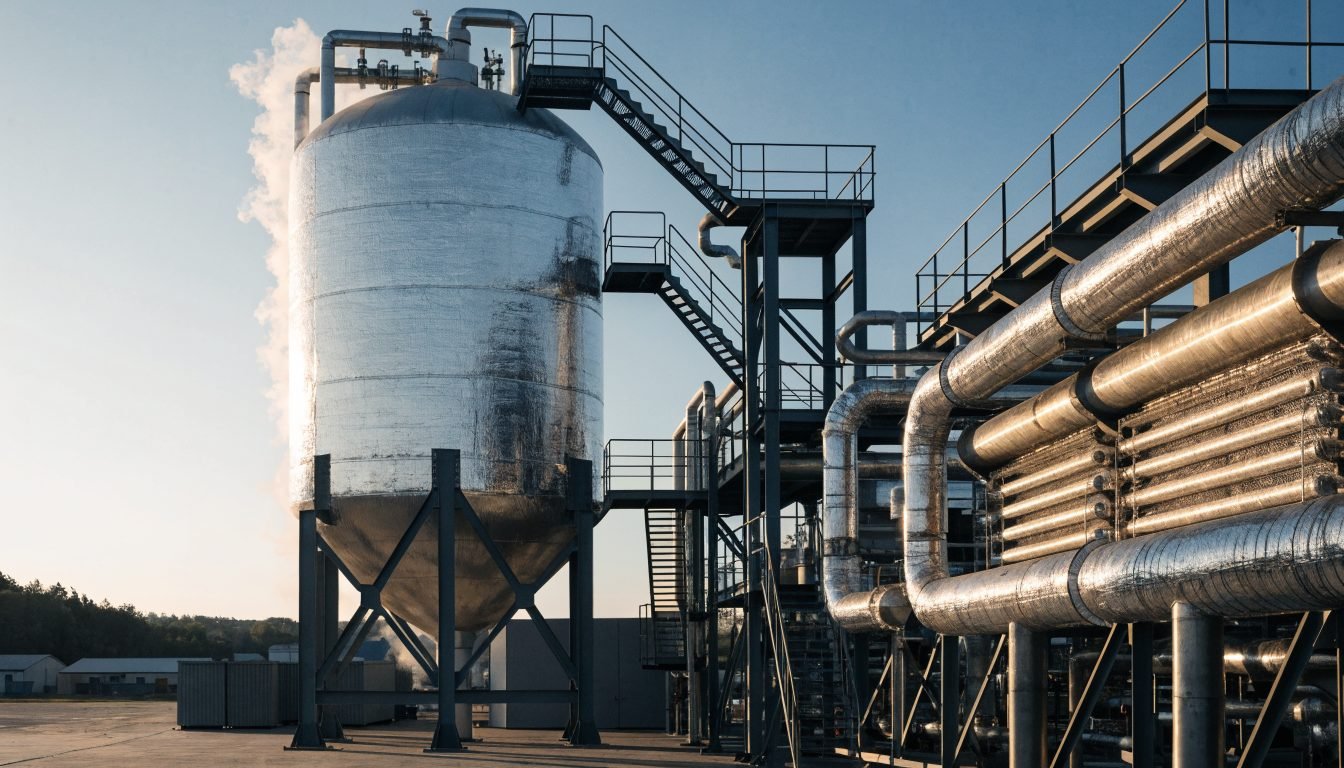
The liquid to gas conversion ratio tells you how much gas one unit of cryogenic liquid produces when it vaporises. At standard conditions, liquid nitrogen expands about 1 to 696, liquid oxygen about 1 to 861, liquid argon about 1 to 847, and LNG about 1 to 600. These ratios drive storage sizing, vaporizer sizing and enclosed space safety.
The arithmetic behind them is simple, and every buyer of bulk cryogenic equipment should be able to do it. Once you know your gas demand in cubic metres per hour, the expansion ratio converts it directly into litres of liquid per hour, and from there into a realistic tank capacity and delivery frequency.
This article gives the ratios, works through the calculations in both directions, and explains why published figures differ slightly between sources.
What is a cryogenic liquid to gas conversion ratio?
A cryogenic liquid to gas conversion ratio, also called the expansion ratio, is the volume of gas produced by one volume of liquid when that liquid is warmed to a reference temperature and pressure. It is written as 1 to a number, where the number is the gas volume.
It exists because liquefying a gas removes almost all the space between its molecules. That is the entire commercial logic of cryogenic supply: it is far more economic to move and store a few cubic metres of liquid than to move several hundred times that volume as compressed gas. The expansion ratio is the number that connects the two worlds.
The ratio is used in three practical places.
- Sizing storage capacity against a plant's gas demand and preferred delivery interval
- Sizing vaporizers and regasification equipment, which must deliver gas flow while consuming liquid flow
- Assessing safety in enclosed spaces, where a small liquid spill produces a large gas volume
What are the expansion ratios for nitrogen, oxygen, argon and LNG?
These are the standard expansion ratios used across the industrial gas and LNG industry, all quoted at standard conditions.
Liquid nitrogen has a liquid to gas expansion ratio of about 1 to 696 at standard conditions. One volume of liquid nitrogen produces roughly 696 volumes of nitrogen gas.
Liquid oxygen has a liquid to gas expansion ratio of about 1 to 861 at standard conditions. One volume of liquid oxygen produces roughly 861 volumes of oxygen gas.
Liquid argon has a liquid to gas expansion ratio of about 1 to 847 at standard conditions. One volume of liquid argon produces roughly 847 volumes of argon gas.
LNG has a liquid to gas expansion ratio of about 1 to 600 at standard conditions. One volume of LNG produces roughly 600 volumes of natural gas.
Summarised as a list for quick reference.
- Liquid nitrogen (LIN): about 1 to 696
- Liquid oxygen (LOX): about 1 to 861
- Liquid argon (LAR): about 1 to 847
- LNG: about 1 to 600
The word about matters. These are the accepted working figures for engineering estimates and for safety assessment. They are not contract settlement values, and the section on reference conditions below explains why.
How do you convert litres of liquid into cubic metres of gas?
The calculation is a single multiplication, and the only thing that catches people out is the unit change from litres to cubic metres.
The rule to remember is that 1,000 litres equals 1 cubic metre. So one litre of liquid nitrogen produces about 696 litres of gas, which is 0.696 cubic metres. One cubic metre of liquid nitrogen produces about 696 cubic metres of gas.
Worked examples
- A 20,000 litre liquid nitrogen tank, filled completely, holds 20,000 multiplied by 696 equals 13,920,000 litres of gas, which is 13,920 cubic metres of nitrogen gas
- A 20,000 litre liquid oxygen tank holds 20,000 multiplied by 861 equals 17,220,000 litres, which is 17,220 cubic metres of oxygen gas
- A 1,000 litre liquid argon vessel holds 1,000 multiplied by 847 equals 847,000 litres, which is 847 cubic metres of argon gas
- A 20 cubic metre LNG tank holds 20 multiplied by 600 equals 12,000 cubic metres of natural gas
Note that these figures assume the vessel is completely full. In practice a tank is filled to a working level and taken down to a refill trigger level, so the usable gas equivalent is lower. That correction is applied in the sizing section below.
How do you work backwards from gas demand to liquid consumption?
This is the direction that matters most to a buyer, because plants measure demand in gas units and suppliers sell liquid. Divide the gas demand by the expansion ratio to get the liquid volume required.
Nitrogen example
Suppose a plant consumes 300 cubic metres per hour of nitrogen gas.
- Liquid required per hour: 300 divided by 696 equals 0.431 cubic metres, which is 431 litres per hour
- Over 24 hours of continuous operation: 431 multiplied by 24 equals 10,344 litres per day, roughly 10.3 cubic metres of liquid nitrogen per day
- Over a 7 day delivery interval: 10,344 multiplied by 7 equals 72,408 litres of usable liquid
Oxygen example
A plant consuming 500 cubic metres per hour of oxygen gas needs 500 divided by 861 equals 0.581 cubic metres per hour, which is 581 litres of liquid oxygen per hour, or about 13,940 litres per day at continuous operation.
The same method works for argon at 847 and for LNG at 600. If your demand is stated in normal cubic metres per hour, keep the units consistent throughout the calculation and confirm which reference condition your supplier applies.
How does the liquid to gas conversion ratio decide storage tank size?
Once you know daily liquid consumption, tank sizing is a question of how long you want to run between deliveries and how much of the tank is genuinely usable.
Continuing the nitrogen example, with 10,344 litres per day and a 7 day delivery interval, the site needs 72,408 litres of usable liquid between deliveries. Usable volume is not the same as geometric capacity. If your operating practice is to order a refill when the tank reaches 20 percent and to fill to 90 percent, then only about 70 percent of the geometric capacity is usable, so the required tank is roughly 72,408 divided by 0.70, which is about 103,000 litres.
Several corrections then apply to that first figure.
- Boil off: modern stationary cryogenic tanks lose roughly 0.2 to 0.6 percent of contents per day depending on size and insulation, so continuous low draw sites must allow for it
- Peak demand: a tank sized on average consumption can still fail to meet a short high flow period, which is a vaporizer and pressure control question as much as a capacity question
- Delivery logistics: the practical delivery interval depends on the tanker size serving the site and the supplier's route, not only on consumption
- Reserve: many sites hold a buffer above the refill trigger to cover a missed delivery
- Future growth: a tank sized precisely for today's demand becomes the constraint on the next production increase
For low to moderate consumption, this arithmetic often points towards a MicroBulk vessel rather than a full bulk tank. For high or growing consumption, it points towards a larger bulk vessel or a manifolded pair.
Why does the expansion ratio matter for safety in enclosed spaces?
The same arithmetic that makes cryogenic storage economic makes cryogenic spills dangerous indoors. A small volume of spilled liquid becomes a large volume of gas, and nitrogen and argon are colourless and odourless, so there is no warning.
Take a spill of 10 litres of liquid nitrogen. At 1 to 696, that produces 6,960 litres of nitrogen gas, which is about 7 cubic metres. In a sealed room measuring 5 metres by 4 metres by 2.5 metres, the room volume is 50 cubic metres. Assuming the released gas mixes and displaces an equal volume of air, the remaining air fraction is (50 minus 7) divided by 50, which is about 0.86. Normal air contains about 20.9 percent oxygen, so the oxygen concentration falls to roughly 18 percent.
Many national regimes treat an oxygen concentration below about 19.5 percent as oxygen deficient. In this example a 10 litre spill in a small room is enough to cross that line, and a larger spill or a smaller space crosses it much faster.
The practical conclusions follow directly from the ratio.
- Site bulk vessels outdoors, or in spaces with ventilation designed for the credible release volume
- Fit oxygen monitoring where inert cryogenic liquids are handled in enclosed or partly enclosed areas
- Treat pits, trenches, basements and stairwells as accumulation points, because cold gas is initially dense
- Apply the same arithmetic in reverse for liquid oxygen, where a spill enriches the atmosphere and makes surrounding materials far more readily ignitable
- Use the expansion ratio when writing the risk assessment, so the assessed release volume is calculated rather than assumed
Why do published liquid to gas conversion ratios differ slightly?
You will find slightly different numbers in different references, and the difference is almost always the reference condition rather than an error.
- Reference temperature: gas volume depends on temperature, and different standards use 0, 15 or 20 degrees Celsius as the reference. A higher reference temperature gives a larger gas volume and therefore a larger ratio
- Reference pressure: normally one atmosphere, but not always stated explicitly
- Liquid condition: the liquid density used may be at the normal boiling point or at a typical storage pressure, which are not identical
- Composition: LNG is a mixture, mainly methane but with varying quantities of ethane, propane and nitrogen depending on source. Its expansion ratio therefore varies with cargo composition, which is why the figure is given as about 1 to 600 rather than an exact value
For engineering sizing and safety assessment, the ratios above are the right working figures. For custody transfer and invoicing, use the values and reference conditions written into your supply contract, since those are the numbers that settle the account.
What about conversion to mass?
Many supply contracts are written in kilograms or tonnes rather than litres. Converting between mass, liquid volume and gas volume requires the density of the specific liquid at its actual storage condition, and for LNG it also requires the cargo composition. Take those density figures from your gas supplier's data sheet for the product as delivered, rather than from a general reference, because a small density assumption error moves the whole calculation.
How does the ratio apply to vaporizer and regasification sizing?
A vaporizer is rated in gas flow, usually normal cubic metres per hour, but it consumes liquid. The expansion ratio is what connects the plant's gas demand to the liquid flow through the vaporizer, and it is the first step in every sizing calculation.
- Start from peak gas demand, not average demand, since a vaporizer sized on averages will fall behind during peaks and deliver cold gas downstream
- Convert peak gas demand to liquid flow using the expansion ratio for the product
- Apply the ambient conditions at the installation site, because ambient air vaporizer capacity falls with lower air temperature and higher humidity
- Plan duty and standby units with changeover so each can defrost, and size the pair for the duty case rather than assuming both run continuously
- For LNG regasification, confirm the required delivery temperature and pressure downstream, since these set the heat duty as much as the flow does
A useful sanity check on any proposal is to convert the quoted gas capacity back to litres of liquid per hour and compare it with the tank capacity. If the vaporizer can empty the tank in a few hours at rated flow, the storage and delivery plan needs review before the equipment is ordered.
Frequently Asked Questions
What is the liquid to gas expansion ratio of liquid nitrogen?
Liquid nitrogen expands about 1 to 696 at standard conditions, meaning one volume of liquid produces roughly 696 volumes of gas. One litre of liquid nitrogen therefore gives about 696 litres, or 0.696 cubic metres, of nitrogen gas. A full 20,000 litre tank holds about 13,920 cubic metres of gas equivalent.
What is the liquid to gas expansion ratio of liquid oxygen?
Liquid oxygen expands about 1 to 861 at standard conditions. One litre of liquid oxygen produces roughly 861 litres of oxygen gas, so a full 20,000 litre vessel holds about 17,220 cubic metres of gas equivalent. The same ratio is used when assessing the enrichment risk from an oxygen spill.
What is the expansion ratio of liquid argon?
Liquid argon expands about 1 to 847 at standard conditions, so one litre of liquid argon produces roughly 847 litres of argon gas. Argon is inert, colourless and odourless, so the same expansion figure is used to assess oxygen displacement risk in enclosed spaces.
How many cubic metres of natural gas does one cubic metre of LNG produce?
LNG expands about 1 to 600 at standard conditions, so one cubic metre of LNG produces roughly 600 cubic metres of natural gas. The figure is given as approximate because LNG is a mixture whose composition varies by source, which shifts the exact ratio slightly from cargo to cargo.
How do I convert my gas demand into liquid consumption per day?
Divide hourly gas demand by the expansion ratio to get hourly liquid volume, then multiply by operating hours. For example, 300 cubic metres per hour of nitrogen gas divided by 696 gives 0.431 cubic metres per hour of liquid, which is 431 litres per hour, or 10,344 litres over 24 hours of continuous operation.
Why do different sources give slightly different expansion ratios?
The main reason is the reference temperature and pressure used for the gas volume, which may be 0, 15 or 20 degrees Celsius depending on the standard applied. The liquid density condition also matters, and for LNG the composition varies by source. Use these figures for engineering and safety work, and use the contract values for invoicing.
How much gas does a spill of liquid nitrogen produce in a room?
Multiply the spilled liquid volume by 696. Ten litres of liquid nitrogen produces about 6,960 litres, close to 7 cubic metres of gas. In a sealed 50 cubic metre room with mixing, that lowers oxygen from about 20.9 percent to roughly 18 percent, below the level commonly treated as oxygen deficient.
Does the expansion ratio account for boil off losses?
No. The expansion ratio only describes how much gas a given volume of liquid produces. Boil off is a separate loss, typically around 0.2 to 0.6 percent of contents per day for modern stationary cryogenic tanks depending on size and insulation, and it must be added on top when planning consumption and delivery intervals.
Related reading
Turn your gas demand into the right tank
Send us your gas consumption in cubic metres per hour, your preferred delivery interval and your peak flow. KAF Cryogenics will size the vessel and vaporizer and quote both new units built to specification and certified second hand units available from stock in weeks.
Get a sizing and quotation