
Oxygen Deficiency and Enrichment: Cryogenic Safety Basics
How the oxygen deficiency hazard works in cryogenic service, why LOX creates enrichment risk, and how monitoring, ventilation and PPE control both.
KAF Cryogenics11 min read
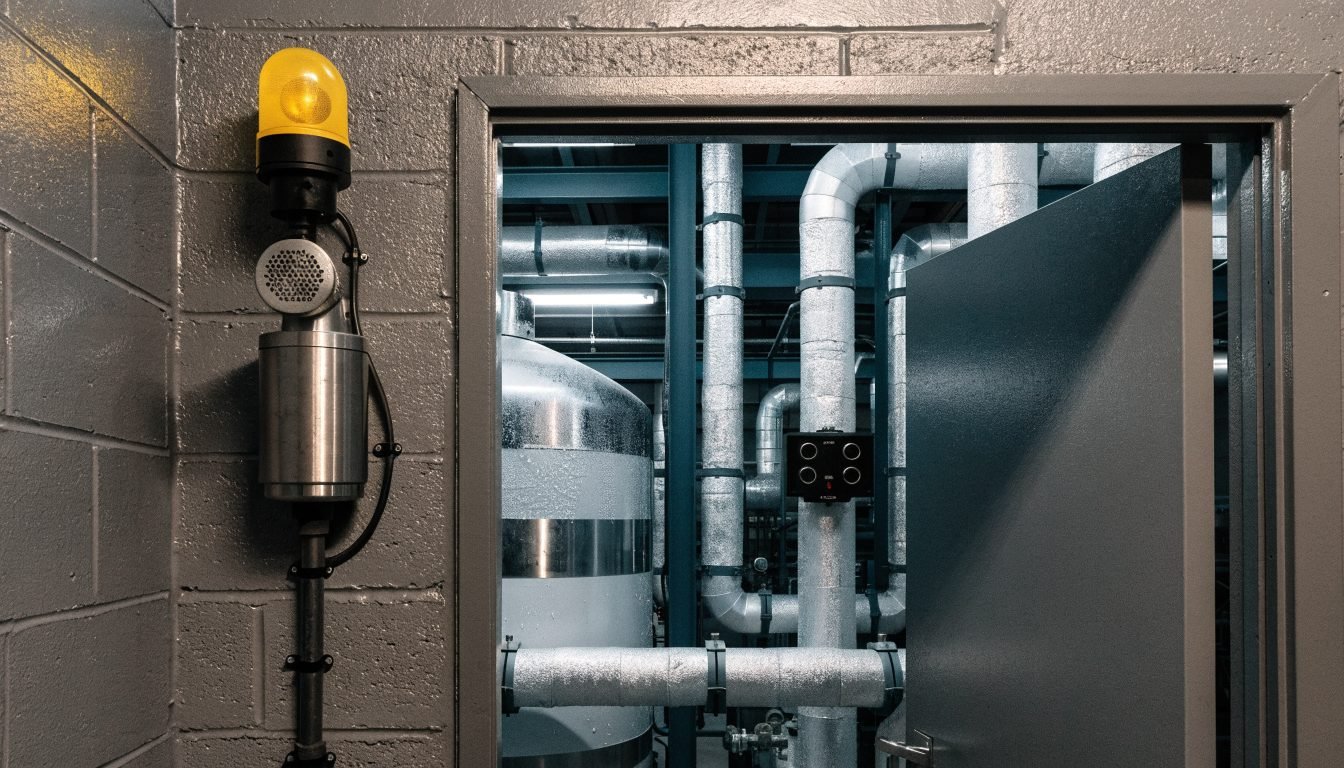
The oxygen deficiency hazard in cryogenic work exists because nitrogen and argon are colourless and odourless, and a small volume of liquid becomes a large volume of gas. In an enclosed space that gas displaces air without any warning sign. Liquid oxygen creates the opposite problem, an enriched atmosphere that makes fires start and spread more easily.
Both conditions are well understood and both are controlled by the same basic measures: keep cryogenic equipment outdoors or in properly ventilated areas, monitor oxygen where people can enter, and route vents to a safe place.
This article explains the mechanism behind each hazard, the physical risks of contact with cold liquid and cold surfaces, and the practical controls that plant operators and equipment buyers should expect to see.
What is an oxygen deficiency hazard?
Air is about 20.9 percent oxygen by volume. An oxygen deficiency hazard exists whenever something displaces part of that air and reduces the oxygen fraction in a space where people work. In occupational practice an atmosphere is commonly treated as oxygen deficient below 19.5 percent oxygen, and many national regulations use that figure or one close to it. Confirm the threshold and the alarm settings that apply in your jurisdiction.
The hazard is not that the displacing gas is toxic. Nitrogen and argon are not toxic. The hazard is that they occupy the space air would otherwise occupy, and the human body gives no reliable warning that the oxygen fraction has dropped. There is no smell, no colour and no irritation. Judgement and coordination can be affected before a person recognises anything is wrong.
This is why oxygen deficiency is managed by engineering and monitoring rather than by relying on people to notice it.
Why do nitrogen and argon displace oxygen so quickly?
Cryogenic liquids are stored at very low temperature and expand enormously when they warm to ambient conditions. One volume of liquid nitrogen becomes roughly 696 volumes of gas at standard conditions, and liquid argon expands by roughly 847 times. A modest release of liquid therefore produces a very large volume of gas.
That expansion ratio is the whole reason the oxygen deficiency hazard is taken seriously in cryogenic service. A quantity of liquid that looks small on the floor can fill an enclosed room with inert gas.
- Cold vapour is denser than warm air at first, so it tends to collect in pits, trenches, basements and low points
- As it warms, the gas mixes with air and disperses, which is why open air installations are inherently safer
- Normal boil off from a tank is continuous, so even without a leak a sealed room accumulates gas over time
- Vent and relief discharges release gas by design, not by fault, and must terminate somewhere safe
- Purging and cooldown operations release inert gas deliberately and need the same controls
If you need the arithmetic for sizing or for a risk assessment, our reference on cryogenic liquid to gas conversion ratios sets out the expansion figures and how to use them.
Where does the risk actually occur on a gas site?
Outdoor tank installations in open air are the normal case and the low risk case. The risk concentrates in specific places where gas can accumulate or where people are close to a release point.
- Cylinder filling halls, pump rooms and any indoor process area handling cryogenic liquid
- Pits, sumps, trenches, basements and inspection chambers below the tank area
- Confined spaces including vessels, tanks and pipework being entered for maintenance
- Vehicle cabs, small vans and enclosed transport spaces carrying containers of cryogenic liquid
- Cold rooms, laboratories and enclosed storage areas holding dewars or MicroBulk vessels
- Areas near a vent stack or relief discharge outlet, especially in still air
Confined space entry deserves particular attention. A vessel that has been purged with nitrogen contains almost no oxygen at all, and entry procedures exist precisely because the atmosphere inside gives no sensory warning.
Why is oxygen enrichment from LOX a fire risk?
Liquid oxygen creates the reverse condition. Oxygen itself does not burn, but it supports combustion, and in an oxygen enriched atmosphere materials ignite at lower energy and burn faster and hotter than they would in normal air. Clothing that has absorbed oxygen can ignite readily and burn rapidly.
Enrichment arises from venting, from small leaks at connections, from spillage during transfer, and from filling operations in poorly ventilated spaces. It is not visible and, like deficiency, it is detected by instrumentation rather than by the senses.
- Keep oils, greases, fuels and combustible material away from LOX equipment and the ground beneath it
- Use only lubricants, seals and sealants approved for oxygen service
- Keep wetted parts oxygen clean, and re clean any component opened during service
- Ventilate any area where oxygen can accumulate, and keep ignition sources at the distance the local regulation requires
- Anyone who has been in an oxygen enriched atmosphere should ventilate their clothing in fresh air before approaching an ignition source
- Post oxygen signage and control access to the tank area
Our guide to liquid oxygen tank safety and selection covers oxygen cleaning, material compatibility and siting in more depth for anyone specifying LOX equipment.
How do oxygen monitors and ventilation control the hazard?
Ventilation removes the accumulated gas and monitoring tells people when the atmosphere has changed. They work together. Ventilation alone can fail silently if a fan stops, and a monitor alone does nothing to correct the condition it detects.
Fixed oxygen monitoring
- Sensors placed where gas will actually collect, taking account of whether cold vapour will settle low or rise as it warms
- Audible and visual alarms both inside the space and at the entrance, so nobody enters an area that is already alarming
- Alarm set points aligned with the applicable national regulation
- Calibration and bump testing at the interval the manufacturer specifies, with records kept
- Alarms linked to ventilation where the design calls for it
Personal monitors and ventilation
- Personal oxygen monitors for staff entering pits, confined spaces or areas without fixed detection
- Mechanical ventilation sized for the enclosed volume and the credible release, designed by a ventilation engineer
- Vents and relief discharges routed outdoors, away from doors, windows, air intakes and walkways
- No unventilated low points where dense cold vapour can pool
- Entry procedures, atmosphere testing before entry and a standby person where required
This is the practical reason cryogenic tanks are sited outdoors wherever possible. Open air installation removes the accumulation mechanism instead of managing it, which is why site layout is a safety decision as much as a logistics one. Our article on cryogenic tank installation and siting requirements covers the layout side.
What are the cold contact and material risks?
Beyond the atmosphere, cryogenic liquids present direct physical risks from extreme cold. These are straightforward to control with correct handling and equipment.
Cold burns and frostbite
Contact with cryogenic liquid, cold vapour or uninsulated cold pipework causes tissue damage similar to a burn. Skin can freeze to an uninsulated cold surface, and the damage may be done before the person can pull away. Splashes to the eyes are a particular concern, which is why face protection is used during transfer operations.
Brittle fracture of materials
Many materials that are ductile at room temperature become brittle at cryogenic temperature and can fail suddenly under load. This is why low temperature service requires impact testing, normally Charpy V notch testing, of materials used below about minus 150 C. It is also why spilled cryogenic liquid must be kept off ordinary structural steel, concrete and asphalt, which can crack when chilled.
Trapped liquid and pressure build
Cryogenic liquid trapped between two closed valves will warm and expand with no route to relieve. Sections of line that can be isolated at both ends are fitted with relief devices for this reason, and relief devices are never blocked or isolated during operation.
What PPE is used when handling cryogenic liquids?
PPE is the last layer, not the first. Siting, ventilation, monitoring and procedure do the main work. The equipment below is standard for transfer, connection and maintenance tasks, and the specific requirement should follow your own risk assessment and local rules.
- Face shield over safety glasses for any operation where splashing is possible
- Loose fitting cryogenic gloves that can be shaken off quickly if liquid enters them
- Long sleeves and trousers worn outside boots so liquid cannot run into footwear
- Closed, non absorbent footwear
- No cuffs, open pockets or turn ups that can catch liquid
- Personal oxygen monitor where fixed detection is absent
- For oxygen work, clothing free of oil and grease contamination
Training matters as much as equipment. Operators should know the properties of the product they handle, the location of monitors and alarms, the evacuation route, and the rule that nobody enters an alarming space to rescue a colleague without breathing apparatus and a proper rescue plan.
How does equipment selection reduce these hazards?
Well specified equipment removes routine releases rather than managing them. A tank with an intact vacuum and a working economizer circuit vents far less than one with degraded insulation, and a properly maintained relief system operates only when it should.
- Sound vacuum insulation keeps boil off in the normal range of roughly 0.2 to 0.6 percent per day for modern stationary tanks
- A working pressure building and economizer circuit uses boil off gas instead of venting it
- Vent and relief lines piped to a safe discharge point rather than terminating at the tank
- Correct valve and seal selection for the service fluid, including oxygen compatible materials for LOX
- A vacuum reading every 6 to 12 months, so degradation is found before it becomes venting
- Certification appropriate to the market: PED 2014/68/EU with EN 13458 for static vacuum insulated vessels, or ASME where the US code applies
Rising boil off, frost or sweating on the outer shell and faster than normal pressure build all point to vacuum loss, which increases venting and therefore increases the gas released into the surrounding area. Our article on vacuum loss in cryogenic tanks explains how to recognise and confirm it.
KAF Cryogenics supplies storage tanks, transport equipment and vaporizers new to specification and as certified second hand units that have passed inspection, NDT, and vacuum and pressure testing, with a document dossier and written warranty. Where a site is replacing equipment that vents excessively, a certified used unit can ship from stock in weeks rather than the months a new fabrication normally takes.
Frequently Asked Questions
What oxygen level is considered deficient?
Air is about 20.9 percent oxygen by volume. Occupational practice commonly treats an atmosphere below 19.5 percent oxygen as deficient, and many national regulations use that figure or one close to it. Confirm the threshold and the alarm set points that apply in your jurisdiction, since the exact values are set locally.
Why is nitrogen dangerous if it is not toxic?
Nitrogen is not toxic, but it is colourless and odourless and one volume of liquid becomes roughly 696 volumes of gas. In an enclosed space it displaces air and lowers the oxygen fraction with no smell, colour or irritation to warn anyone. That absence of warning is the hazard, which is why monitoring and ventilation are used.
Is liquid oxygen flammable?
Oxygen does not burn itself, but it strongly supports combustion. In an oxygen enriched atmosphere materials ignite at lower energy and burn faster and hotter than in normal air, and clothing that has absorbed oxygen can ignite readily. Controlling enrichment means ventilation, oxygen clean equipment and keeping combustibles and ignition sources away.
Why are cryogenic tanks installed outdoors?
Outdoor siting lets vented and boiled off gas disperse in open air, which removes the accumulation mechanism behind both oxygen deficiency and oxygen enrichment. Where part of an installation must be enclosed, the design has to add ventilation sized for the space, oxygen monitoring with alarms, and vent lines routed to a safe outdoor point.
Where should oxygen monitors be placed?
Sensors go where gas will actually collect, which means accounting for cold vapour settling in pits and low points before it warms and disperses. Alarms should be audible and visible both inside the space and at the entrance so nobody walks into an area already in alarm. Calibrate and bump test at the manufacturer's stated interval.
What PPE is needed for handling cryogenic liquids?
Standard items are a face shield over safety glasses, loose fitting cryogenic gloves that can be shaken off quickly, long sleeves and trousers worn outside closed footwear, and a personal oxygen monitor where there is no fixed detection. For oxygen service, clothing must be free of oil and grease. The specific requirement follows your risk assessment and local rules.
Why do cryogenic materials need impact testing?
Many materials that are ductile at room temperature turn brittle at cryogenic temperature and can fail suddenly under load. Low temperature service therefore requires impact testing, normally Charpy V notch testing, for materials used below about minus 150 C. Material and impact test records should be part of the tank documentation.
Does vacuum loss increase the oxygen deficiency risk?
Indirectly, yes. A tank that has lost vacuum boils off and vents far more product than one with intact insulation, which increases the gas released into the surrounding area. Frost or sweating on the outer shell, rising boil off and faster pressure build are the usual signs, and a vacuum reading every 6 to 12 months catches the problem early.
Related reading
Equipment that vents less needs less managing
If a tank on your site frosts, vents often or builds pressure faster than it used to, KAF Cryogenics can assess it and quote a replacement new or as a certified second hand unit with full documentation.
Talk to KAF