
Cryogenic Pump Selection: Centrifugal vs Reciprocating
Cryogenic pump selection explained: when you need a pump, centrifugal versus reciprocating duties, NPSH and cavitation, cooldown, and filling station use.
KAF Cryogenics13 min read
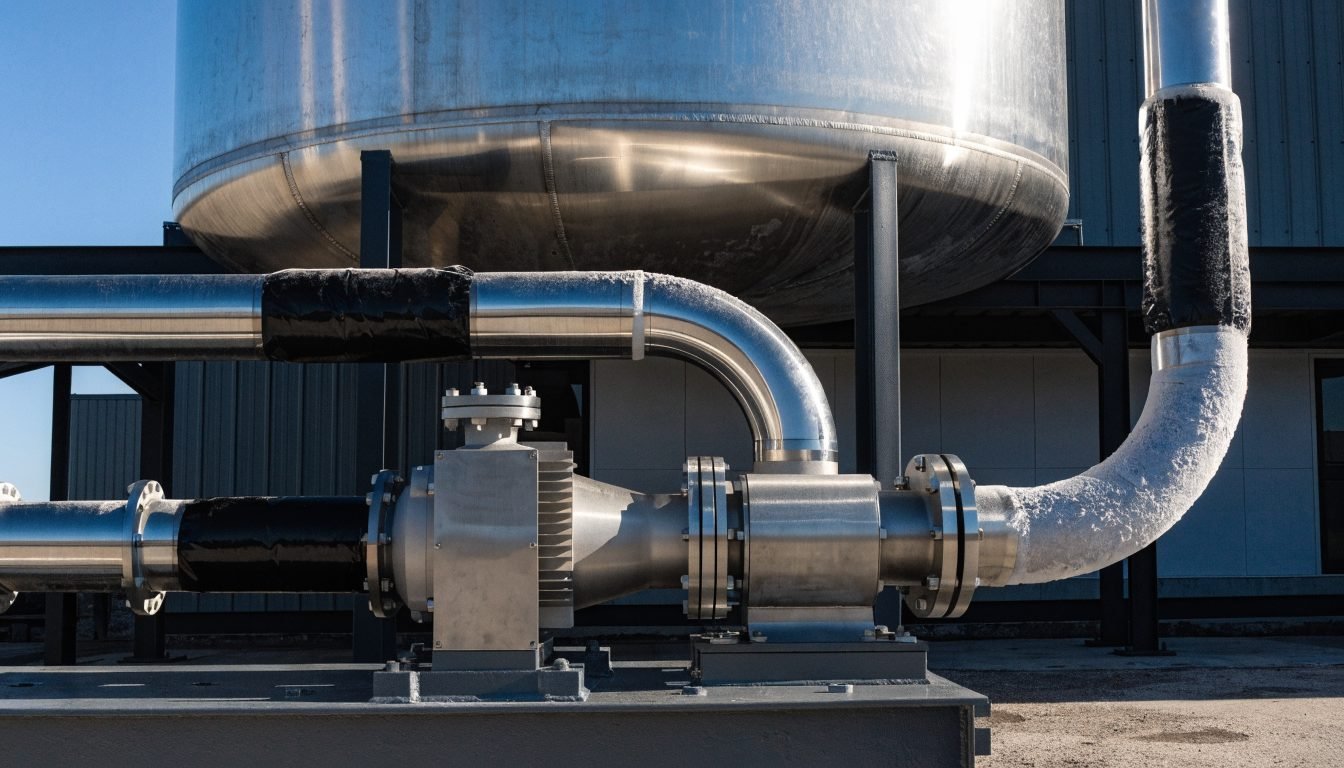
Cryogenic pump selection starts with one question: do you need flow or do you need pressure. Centrifugal pumps move high flow at moderate discharge pressure and suit bulk transfer and tanker offloading. Reciprocating pumps deliver high pressure at lower flow and suit cylinder filling. NPSH, cooldown and duty cycle then decide the detail.
Many cryogenic installations need no pump at all. Tank pressure alone can move liquid where the required delivery pressure is modest and the distance is short, and that is usually the simpler and cheaper arrangement.
This guide explains when a pump becomes necessary, how the two main pump families differ, why cavitation behaves differently in cryogenic service than in water service, and what to specify so a supplier can propose the right machine.
Do you actually need a cryogenic pump?
A cryogenic tank can push liquid out using its own vapour pressure. The pressure building circuit takes liquid from the bottom of the tank, vaporizes it in an external coil and returns the gas to the vapour space, raising tank pressure so liquid flows out under its own head. For many duties that is enough.
Pressure transfer has real limits, though. Tank pressure cannot exceed the MAWP of the vessel, so the delivery pressure available is capped by the pressure class of the tank. Raising tank pressure also warms the liquid and consumes product, and the flow rate is limited by how fast the pressure building circuit can work.
Pressure transfer is usually sufficient when
- The required delivery pressure is well below the tank MAWP
- Flow rate demand is moderate and intermittent
- The transfer distance and line losses are small
- Product loss from pressure building is acceptable
- The receiving vessel is at lower pressure than the supply tank
A pump becomes necessary when
- The discharge pressure needed exceeds what the tank pressure class can provide
- You are filling high pressure cylinders or bundles
- You need high flow with a short transfer window, such as trailer offloading on a schedule
- You are feeding a high pressure vaporizer for gas supply at elevated pressure
- Repeated pressure building would consume too much product
- The receiving vessel is at similar or higher pressure than the supply tank
If the constraint turns out to be tank pressure class rather than flow, check the pressure class question before specifying a pump. Our guide to cryogenic tank MAWP and pressure class explains how delivery pressure is set at the tank.
What is the difference between centrifugal and reciprocating cryogenic pumps?
The two families solve different problems. A centrifugal pump uses a rotating impeller to add kinetic energy to the liquid, which becomes pressure at the discharge. A reciprocating pump uses a piston or plunger in a cylinder to displace a fixed volume per stroke against whatever pressure the discharge presents.
That difference in mechanism drives everything else. A centrifugal pump produces a head that depends on impeller speed and diameter, and its flow varies with system resistance. A positive displacement reciprocating pump produces roughly the same flow per stroke regardless of discharge pressure, so pressure is limited by the machine and the drive rather than by the impeller.
Centrifugal cryogenic pumps
- Suited to high flow at moderate discharge pressure
- Smooth, continuous flow with low pulsation
- Typical duties: bulk transfer, trailer and ISO container offloading, tank to tank transfer, feeding low and medium pressure vaporizers
- Flow varies with system resistance, so the operating point moves along a curve
- Multistage designs raise head where a single stage is not enough
- Generally simpler mechanically, with fewer wearing parts in the liquid path
Reciprocating cryogenic pumps
- Suited to high discharge pressure at lower flow
- Positive displacement, so flow is set by stroke and speed rather than by discharge pressure
- Typical duties: cylinder and bundle filling, high pressure gas supply through a vaporizer, tube trailer filling
- Pulsating flow, which the piping design must accommodate
- Requires a discharge relief device, because a positive displacement pump against a closed valve will keep building pressure
- More wearing parts, so seal and packing maintenance is part of the operating plan
Some stations use both: a centrifugal pump for bulk movement and a reciprocating pump for the high pressure filling duty. That is normal rather than redundant, because forcing one machine to cover both duties usually means it does neither well.
How do you match the pump to the duty?
Selection is a conversation about the duty point, not about the pump. Define what the system has to do and the machine follows. The parameters below are what any competent supplier will ask for, and having them ready shortens the process considerably.
- Service fluid: LIN, LOX, LAR, LNG or LCO2, since properties and material requirements differ
- Required flow rate, average and peak, and whether flow must be continuous or is batch based
- Required discharge pressure at the point of use, not at the pump
- Suction conditions: tank pressure, liquid level range and the geometry of the suction line
- Duty cycle: continuous running, frequent starts, or occasional use
- Cooldown allowance you can accept before each start
- Drive arrangement and available electrical supply
- Site classification, particularly for LNG and other flammable products
- Whether the pump serves one station or must be movable between points
Two of these deserve emphasis. Peak flow rather than average flow sizes the machine, and the pressure needed at the point of use rather than at the pump discharge is what determines the required head once line and vaporizer losses are counted.
Oxygen service adds its own requirements. Wetted parts must be oxygen compatible and oxygen clean, and only lubricants and seals approved for oxygen use may be fitted. Our guide to liquid oxygen tank safety and selection covers those rules.
What is NPSH and why does cavitation matter in cryogenic service?
NPSH stands for net positive suction head. It is the margin between the pressure of the liquid arriving at the pump suction and the vapour pressure of that liquid at its temperature. If the margin disappears, the liquid boils inside the pump. Vapour bubbles form, collapse and disrupt the flow. That is cavitation, and it destroys performance and damages the machine.
Cryogenic service makes this harder than water service for a specific reason: the liquid in the tank sits at or near its boiling point for the tank pressure. It is already saturated. Any small heat input or pressure drop on the way to the pump can start vaporization in the suction line.
- NPSH available is set by the system: tank pressure, liquid height above the pump, and suction line losses
- NPSH required is set by the pump and comes from the manufacturer for the selected machine and speed
- NPSH available must exceed NPSH required by a margin throughout the operating range, including at low tank level
- Mount the pump below the tank liquid level wherever possible, so static head works in your favour
- Keep the suction line short, straight, generously sized and fully vacuum jacketed or well insulated
- Minimise fittings, elbows and restrictions in the suction line
- Provide a vent or return line so vapour generated in the suction line can escape back to the tank
- Check the worst case, which is usually the lowest tank level combined with the highest flow
Warning signs of cavitation in operation include noise and vibration at the pump, unstable or falling discharge pressure, and flow that drops away without any change in demand. Left unaddressed it damages the impeller or plunger and the bearings.
There is a design tension worth naming. Raising tank pressure increases NPSH available, but it also raises the saturation temperature of the liquid, and warmer liquid vaporizes more readily. The right answer is a suction system designed properly, not simply more tank pressure.
Why does a cryogenic pump need cooldown before start?
A cryogenic pump at ambient temperature will instantly boil the first liquid that reaches it. The pump would then be trying to move vapour rather than liquid, which produces no useful flow and can damage the machine. Cooldown is the process of chilling the pump and its suction line to liquid temperature before the pump is started.
Cooldown also protects the machine mechanically. Cryogenic components contract as they cool, and clearances are designed for the cold condition. Starting a warm pump means running it with the wrong clearances while it is also handling vapour.
- Open the suction valve and allow liquid to flow through the pump with the vent or return line open
- Allow vapour generated during chilling to vent back to the tank rather than into the discharge line
- Wait until liquid, not vapour, is passing through the return, indicating the pump body is cold
- Only then start the drive against the discharge system
- Allow the cooldown time the manufacturer specifies rather than a habit based estimate
- Keep the pump cold between frequent operations where the duty allows, to avoid repeated cooldown
Cooldown time is a real operational cost. On a station with frequent short transfers, a machine that must be re chilled before every start reduces throughput, and that is often what pushes a design toward keeping the pump cold or toward a different duty split. Factor it into the station layout rather than discovering it in service. The same principle applies to the tank itself during first fill, covered in our cryogenic tank commissioning guide.
What duties do pumps handle in filling stations and offloading?
Trailer and ISO container offloading
Offloading is a high flow, moderate pressure duty with a time constraint, since the vehicle is waiting. Some road tankers carry their own pump, in which case the receiving site may need none. Where the site provides the pump, a centrifugal machine is the usual choice. Confirm early whether the delivering vehicle pumps or relies on pressure transfer, because that decides who supplies the equipment. Our overview of ISO tank containers for cryogenic transport and our comparison of semi trailers and bobtails cover the vehicle side.
Cylinder and bundle filling
Filling high pressure cylinders is the classic reciprocating pump duty. The pump raises liquid pressure, a high pressure vaporizer converts it to gas, and the gas fills the cylinders. Flow is moderate, pressure is high, and the duty is repetitive. Discharge relief protection is essential because a positive displacement pump against a closed valve keeps building pressure.
LNG fuelling and satellite stations
LNG stations vary widely. Some rely on tank pressure and a vaporizer with no pump at all, while others use a pump for dispensing or to feed a high pressure regasification skid. Hazardous area classification applies to the equipment. Our LNG satellite station equipment checklist sets out the full scope.
Process and customer station supply
Where a customer station simply supplies gas to a process at moderate pressure, tank pressure through an ambient air vaporizer is usually sufficient and a pump adds cost and maintenance for no benefit. Size the vaporizer to the gas demand first and see whether a pump is needed at all.
What else should be specified around the pump?
A pump is a component in a system. Most reported pump problems on cryogenic sites trace back to the suction line, the controls or the operating procedure rather than to the machine itself.
- Vacuum jacketed or well insulated suction piping, sized generously and kept short
- Vent or return line back to the tank for cooldown and for vapour release
- Discharge relief device, mandatory on positive displacement pumps
- Isolation valves that allow maintenance without draining the tank
- Relief protection on any line section that can be isolated at both ends, since trapped cryogenic liquid warms and expands
- Instrumentation for suction and discharge pressure, and flow where the duty needs it
- Drive selection and, where variable flow is needed, speed control
- Equipment rated for the hazardous area classification on LNG and other flammable service
- Access for maintenance of seals and packing, which is routine on reciprocating machines
Include the pump in the site maintenance plan rather than treating it separately. Our cryogenic tank maintenance schedule covers the intervals for the surrounding equipment, including the recommendation to take a vacuum reading every 6 to 12 months.
How can KAF Cryogenics help with a pumped installation?
KAF Cryogenics supplies the equipment around the pump: storage tanks for LIN, LOX, LAR, LNG, LCO2 and LPG, ambient air vaporizers and process equipment, MicroBulk tanks, and transport equipment including semi trailers, bobtails, truck mounted tanks and ISO tank containers.
That matters for pump selection because the tank pressure class, the suction arrangement and the vaporizer duty are what set the pump requirement in the first place. Getting those right often reduces the pump duty, and sometimes removes the need for a pump entirely.
- Tank pressure class selected against the delivery pressure your process actually needs
- Vaporizer capacity sized to the gas demand and the ambient conditions at your site
- Tank layout and connection positions that allow a short, low loss suction line
- Equipment supplied new to specification, or as certified second hand units that are inspected, NDT tested, vacuum and pressure tested, with a document dossier and written warranty
- Certification matched to the destination market under PED 2014/68/EU with EN 13458, or ASME where the US code applies
- Delivery from stock in weeks on certified used units, against months for new fabrication
Send the duty: fluid, flow, pressure at the point of use, and what the station has to do. We will tell you what the tank and vaporizer side should look like and where a pump genuinely earns its place.
Frequently Asked Questions
When do you need a cryogenic pump instead of pressure transfer?
You need a pump when the required discharge pressure exceeds what the tank pressure class can deliver, when you are filling high pressure cylinders, when high flow is needed in a short window, or when repeated pressure building would consume too much product. If delivery pressure is modest and flow is intermittent, tank pressure alone is usually simpler and cheaper.
What is the difference between centrifugal and reciprocating cryogenic pumps?
A centrifugal pump uses a rotating impeller and suits high flow at moderate discharge pressure, such as bulk transfer and tanker offloading. A reciprocating pump is positive displacement and suits high pressure at lower flow, such as cylinder filling. The mechanism, not brand or size, is what determines which duty each one fits.
What is NPSH in a cryogenic pump?
NPSH is net positive suction head, the margin between the pressure of the liquid at the pump suction and its vapour pressure at that temperature. NPSH available must exceed the pump's NPSH required throughout the operating range. Cryogenic liquid sits near its boiling point already, so this margin is tighter than in water service.
Why does a cryogenic pump cavitate?
Cavitation occurs when the liquid boils inside the pump because the suction pressure margin has been lost. In cryogenic service the liquid is already saturated, so heat leak into the suction line, excessive line losses, a low tank level or a high flow demand can each trigger it. Noise, vibration and falling discharge pressure are the usual signs.
Why must a cryogenic pump be cooled down before starting?
A warm pump instantly boils the first liquid reaching it, so the machine handles vapour instead of liquid and produces no useful flow. Cooldown also brings components to the temperature their clearances were designed for. Circulate liquid with the vent line open until liquid rather than vapour passes through the return, then start the drive.
Does a reciprocating pump need a relief valve on the discharge?
Yes. A positive displacement pump delivers a fixed volume per stroke regardless of discharge pressure, so running it against a closed valve keeps building pressure until something fails. A discharge relief device is essential. Any line section that can be isolated at both ends also needs relief, because trapped cryogenic liquid warms and expands.
Can one pump handle both bulk transfer and cylinder filling?
It is rarely a good arrangement. The two duties sit at opposite ends of the flow and pressure range, and a machine forced to cover both usually performs poorly at each. Many stations use a centrifugal pump for bulk movement and a separate reciprocating pump for high pressure filling.
Does KAF supply cryogenic pumps?
KAF Cryogenics supplies storage tanks, transport equipment, ambient air vaporizers, process equipment and MicroBulk tanks, new to specification or as certified second hand units. Since tank pressure class, suction arrangement and vaporizer duty determine the pump requirement, we can advise on the station design and tell you where a pump is genuinely needed.
Related reading
Send the duty, not the part number
Tell us the fluid, the flow rate, the pressure you need at the point of use and what the station has to do. KAF Cryogenics will propose the tank, pressure class and vaporizer arrangement, new or certified second hand.
Discuss your station