
Commissioning a Cryogenic Tank: Purging, Cooldown and First Fill
Cryogenic tank commissioning step by step: leak check, purging, controlled cooldown, staged first fill and handover documents. Why rushing damages equipment.
KAF Cryogenics12 min read
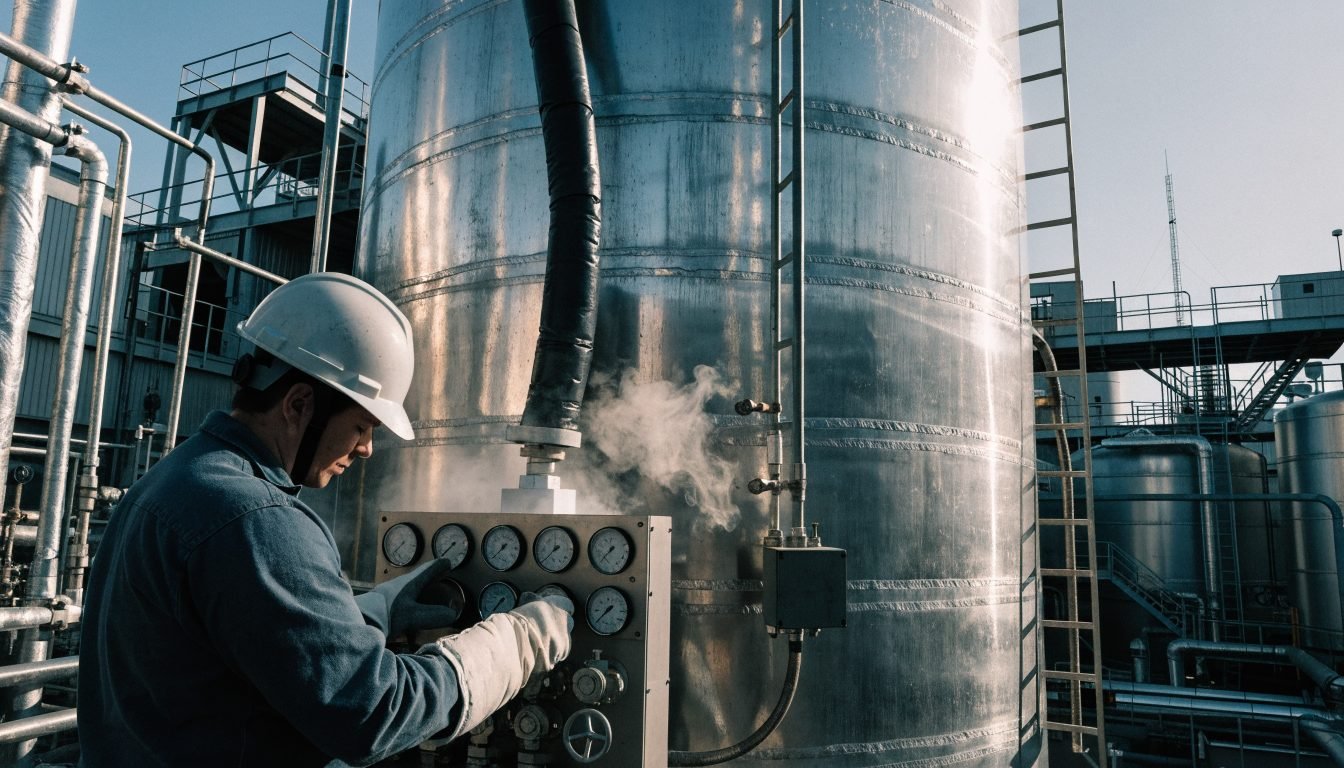
Cryogenic tank commissioning is the controlled sequence that takes an installed vessel from ambient and empty to cold and in service. It runs from pressure and leak checks, through purging to remove air and moisture, to a slow cooldown and a staged first fill. Rushing purge or cooldown causes ice blockages and thermal shock damage.
The sequence matters as much as the steps. Every stage exists to remove one specific problem before the next stage can create it, and skipping a stage does not save time, it simply moves the failure to a point where it is harder and more expensive to correct.
This guide sets out the commissioning sequence for a bulk cryogenic vessel and explains the reasoning behind purging and controlled cooldown. It applies to new tanks built to specification and to used or relocated tanks, which need the same discipline.
What does cryogenic tank commissioning actually involve?
Commissioning is not a single operation. It is a documented sequence carried out by a competent team, normally with the supplier or a specialist contractor present, and witnessed by the operator who will take responsibility for the vessel afterwards.
A typical cryogenic tank commissioning sequence follows this order.
- Mechanical completion check: vessel set on its foundation, anchored, piping connected, supports and earthing complete
- Documentation and nameplate verification against the order and the certification file
- Vacuum reading on the annular space of a vacuum insulated vessel
- Pressure and leak test of the connected pipework and valve assembly
- Purging of the inner vessel and pipework to remove air and moisture
- Controlled cooldown of the inner vessel and lines
- Staged first fill with the service liquid
- Functional checks of relief devices, level and pressure instrumentation, pressure building circuit and economizer
- Operator training and formal handover with the document dossier
Each of the later steps assumes the earlier ones were completed properly. Filling a vessel that was never purged, for example, means the moisture problem is now frozen inside a cold vessel where it cannot be removed by any simple procedure.
What checks come before any gas enters the tank?
The pre purge checks confirm that the vessel is mechanically sound and correctly installed. They are quick, and they are the last easy opportunity to correct a problem.
- Confirm the nameplate data matches the intended service: product, maximum allowable working pressure, capacity, design code and manufacture data
- Read and record the annular vacuum. A poor reading before the vessel is even cold points to a problem that will not improve in service
- Verify that all relief devices specified in the documentation are fitted, correctly rated and not isolated
- Check that isolation valves are in the correct position and that the fill, withdrawal, vent and pressure building lines are connected as drawn
- Pressure test the connected pipework and joints, and confirm there is no leakage at ambient temperature before cold makes leaks worse
- Confirm earthing and bonding continuity, and that the fill point earthing connection is available for the delivery vehicle
- Confirm the site is ready: access, lighting, signage, gas detection where fitted, and a clear area around the vessel
A leak that is barely detectable at ambient temperature can open significantly as joints contract at cryogenic temperature. Finding it warm is far easier than finding it cold.
Why is purging a cryogenic tank so important?
Purging replaces the air inside the inner vessel and the connected pipework with a dry, inert gas, normally nitrogen, before any cryogenic liquid is introduced. There are two independent reasons for it, and each on its own would justify the step.
Moisture freezes and blocks the system
Ambient air carries water vapour. When the vessel and its lines cool towards cryogenic temperature, that water freezes as ice on internal surfaces. Ice does not stay where it forms. It collects at restrictions: valve seats, orifices, instrument take off points, gauge lines and the small bore tubing of the level and pressure system.
The consequences are practical and immediate. A frozen level gauge line reads incorrectly, so the operator no longer knows how much liquid is in the vessel. A partly blocked pressure building circuit cannot maintain delivery pressure. Worst of all, an ice obstruction in a relief path compromises the vessel's overpressure protection. Once the vessel is cold and full, the only way to remove that ice is to warm the vessel back up, which means emptying it and losing the product.
Air itself is a hazard in the wrong vessel
In an LNG or LPG vessel, residual air means oxygen inside a space that is about to be filled with a flammable product. Purging to an agreed low oxygen concentration before any hydrocarbon enters the vessel is a fundamental safety requirement, not a refinement.
Air causes problems in cryogenic service even where flammability is not the issue. Nitrogen boils at about minus 196 degrees Celsius at atmospheric pressure, which is cold enough to condense and freeze other air components inside the vessel. Carbon dioxide present in air solidifies well above cryogenic temperature and contributes to the same blockage problem.
How is a cryogenic tank purged in practice?
Purging is done with dry gas at ambient or near ambient temperature, following the manufacturer's written procedure for the specific vessel. Two methods are common, and they are often combined.
- Pressure and vent cycling: pressurise the vessel with dry nitrogen, hold, then vent to near atmospheric pressure, and repeat. Each cycle dilutes the remaining air by a predictable factor
- Flow through purging: admit dry nitrogen at one point and vent continuously at another, so the whole internal volume and all dead legs are swept
- Purge every branch, not only the vessel shell. Fill lines, withdrawal lines, the pressure building circuit, instrument lines and any bypass all need to be swept individually
- Verify the result by measurement, not by elapsed time. Check oxygen content, and dew point where the procedure requires it, at the vent until the acceptance criterion is met
- Record the readings and the number of cycles in the commissioning report
The most frequent mistake is purging the vessel body and assuming the pipework followed. Dead legs, closed branches and instrument tubing hold air and moisture very effectively, and they are exactly the places where an ice blockage does the most damage.
Why does cooldown have to be controlled?
Cooldown brings the inner vessel and the pipework from ambient temperature down to the operating temperature of the product, for example around minus 196 degrees Celsius for liquid nitrogen or around minus 162 degrees Celsius for LNG. That is a very large temperature change, and the rate at which it is applied decides whether the vessel arrives in service undamaged.
Two mechanisms cause the damage when cooldown is rushed.
- Thermal shock: dumping liquid into a warm vessel cools the wetted surface almost instantly while the surrounding metal is still near ambient. The resulting temperature gradient creates high local stress at welds, nozzles and support attachments
- Differential contraction: metal contracts as it cools. When one part of an assembly cools much faster than the part it is bolted or welded to, the difference in contraction loads the joint. Piping systems, internal supports and instrument connections are the usual casualties
There is a further reason for patience. Below roughly minus 150 degrees Celsius, materials that are not qualified for low temperature service become brittle, which is why low temperature vessels use materials verified by impact testing, normally the Charpy V notch test. Controlled cooldown keeps stresses within the range those materials are designed for. Uncontrolled cooldown applies a shock load at exactly the point where a defect matters most.
In practice, cooldown is achieved by admitting cold gas first, then small quantities of liquid at intervals, allowing the temperature to equalise between steps, and following the cooldown rate and hold times given in the manufacturer's procedure. Damage caused by a rushed cooldown is often not visible at the time. It appears later as a vacuum failure, a leaking joint or a cracked support, and by then the cause is difficult to prove.
How is the first fill carried out in stages?
The first fill continues the cooldown philosophy. It is not a normal delivery, and it should not be scheduled as one.
- Start with a small quantity, typically a low percentage of capacity, and hold while the vessel temperature stabilises
- Watch the vessel pressure during each stage. Rapid pressure rise means the liquid is boiling off against warm metal, which is normal early on and should decline as the vessel cools
- Vent as required by the procedure so that the vessel does not lift its relief devices during cooldown
- Increase the quantity in further stages, allowing stabilisation between each
- Inspect the outer shell, piping and joints between stages for frost patches, sweating or visible movement
- Complete the fill only when the vessel is stable and the instrumentation is reading correctly
- Record the fill stages, pressures and observations
Frost or condensation appearing on the outer shell during or after the first fill is a warning sign, not a cosmetic issue. It usually indicates a vacuum problem in the annular space, and it should be investigated before the vessel is accepted.
How are relief devices and instrumentation verified?
Functional checks are carried out once the vessel is cold and holding liquid, because several systems only behave realistically at operating temperature.
- Confirm that every relief device is in place, correctly set, correctly oriented and not isolated by a closed valve
- Check that any changeover arrangement between duty and standby relief devices operates and is left in the correct position
- Compare the level indication against the delivered quantity and confirm the reading is stable and plausible
- Confirm the pressure gauge and any transmitter read consistently with each other
- Operate the pressure building circuit and confirm the vessel builds and holds the required delivery pressure
- Check the economizer or pressure control arrangement responds as designed during withdrawal
- Observe the pressure rise over a recorded standing period so the site has a baseline for future comparison
Recording a baseline at commissioning is the single most useful maintenance action available at this stage. Later questions about rising boil off or unexplained pressure build can only be answered against a known starting point.
What should the commissioning handover pack contain?
Commissioning ends with a documented handover. The operator should not accept the vessel into service without a complete file, because that file is what an inspector, an insurer or a future buyer will ask for.
- Manufacturer data report and design code documentation, for example PED 2014/68/EU or ASME, and the applicable standard such as EN 13458 for static vacuum insulated cryogenic vessels
- Material and welding documentation, including impact test evidence for low temperature service
- Nameplate photograph and recorded nameplate data
- Pressure and leak test records for the vessel and connected pipework
- Purge records with the measured acceptance readings
- Cooldown and staged fill log with times, pressures and observations
- Vacuum reading at commissioning, recorded as the baseline
- Relief device certificates and set pressures
- Instrument checks and the recorded pressure rise baseline
- Operating and maintenance manual, plus a record of the operator training given
Store this pack where the site can find it. Missing commissioning records are one of the most common gaps found later during periodic inspection or when equipment changes hands.
Does commissioning differ for a used or relocated tank?
The sequence is the same, and in some respects it needs more attention. A vessel that has been warmed, transported and reinstalled has been exposed to ambient air throughout, so purging is at least as important as on a new unit. Joints that were disturbed during removal and reinstallation need a full pressure and leak check.
- Confirm the vacuum reading before cooldown, since transport and storage are when vacuum degradation typically shows up
- Verify that the certification file matches the physical vessel and the intended new service and product
- Check that the previous product is compatible with the new one, and apply the cleaning procedure required if the service is changing, particularly where oxygen service is involved
- Re verify relief device set pressures against the new installation's operating conditions
- Carry out the same staged cooldown and fill as for a new vessel
KAF Cryogenics supplies certified second hand vessels that have passed inspection, non destructive testing and vacuum and pressure testing, and are sold with a document dossier and a written warranty. Those units can typically be delivered from stock in weeks, where new fabrication takes months, but they go through the same commissioning discipline on site as a new tank built to specification.
Frequently Asked Questions
Why must a cryogenic tank be purged before the first fill?
Purging removes air and the water vapour it carries. Moisture left inside freezes during cooldown and collects at valve seats, orifices, instrument lines and relief paths, causing false level readings, poor pressure control and compromised overpressure protection. In LNG and LPG vessels, purging also removes oxygen before a flammable product is introduced.
What gas is used to purge a cryogenic tank?
Dry nitrogen is the normal purge gas because it is inert, readily available and dry when supplied for this purpose. It is applied either by pressure and vent cycling or by continuous flow through purging, and the result is verified by measuring oxygen content, and dew point where the procedure requires it, at the vent.
What happens if a cryogenic tank is cooled down too quickly?
Rapid cooldown creates a steep temperature gradient between the wetted surface and the surrounding metal, producing high local stress at welds, nozzles and supports. Different parts of the assembly also contract at different rates, loading joints and instrument connections. The resulting damage often appears later as vacuum loss, a leaking joint or a cracked support.
How long does cryogenic tank commissioning take?
It depends on vessel size, product and the manufacturer's specified cooldown rate and hold times, so there is no single figure. Plan it as a staged operation over the period the procedure calls for rather than as a single delivery, and treat any pressure to compress the schedule as a risk to the equipment.
Is frost on the outer shell after the first fill normal?
No. Frost patches or sweating on the outer shell of a vacuum insulated vessel indicate degraded vacuum in the annular space, often together with rising boil off and faster pressure build. It should be investigated and resolved before the vessel is formally accepted into service.
Does a used cryogenic tank need the same commissioning as a new one?
Yes, and often with extra checks. A relocated vessel has been open to ambient air, so purging is essential, and disturbed joints need a full pressure and leak test. Confirm the vacuum reading before cooldown, verify that the certification file matches the vessel and the new service, and apply the cleaning requirements if the product is changing.
What records should be kept from commissioning?
Keep the design and certification documents, pressure and leak test records, purge measurements, the cooldown and staged fill log, the commissioning vacuum reading, relief device certificates and set pressures, instrument checks and a recorded pressure rise baseline. These records are the reference point for every later maintenance question and for periodic inspection.
Related reading
Commissioning a new or relocated cryogenic tank?
KAF Cryogenics supplies bulk cryogenic vessels new to specification and as certified second hand units, each with the manufacturer procedure, relief device data and full document dossier your commissioning team needs. Tell us the product, capacity and pressure class and we will quote against your schedule.
Talk to KAF Cryogenics