
How to Restore Vacuum in a Cryogenic Tank
Cryogenic tank vacuum restoration explained: what re-evacuation involves, when it is worth doing versus replacing, and how a specialist performs.
KAF Cryogenics7 min read
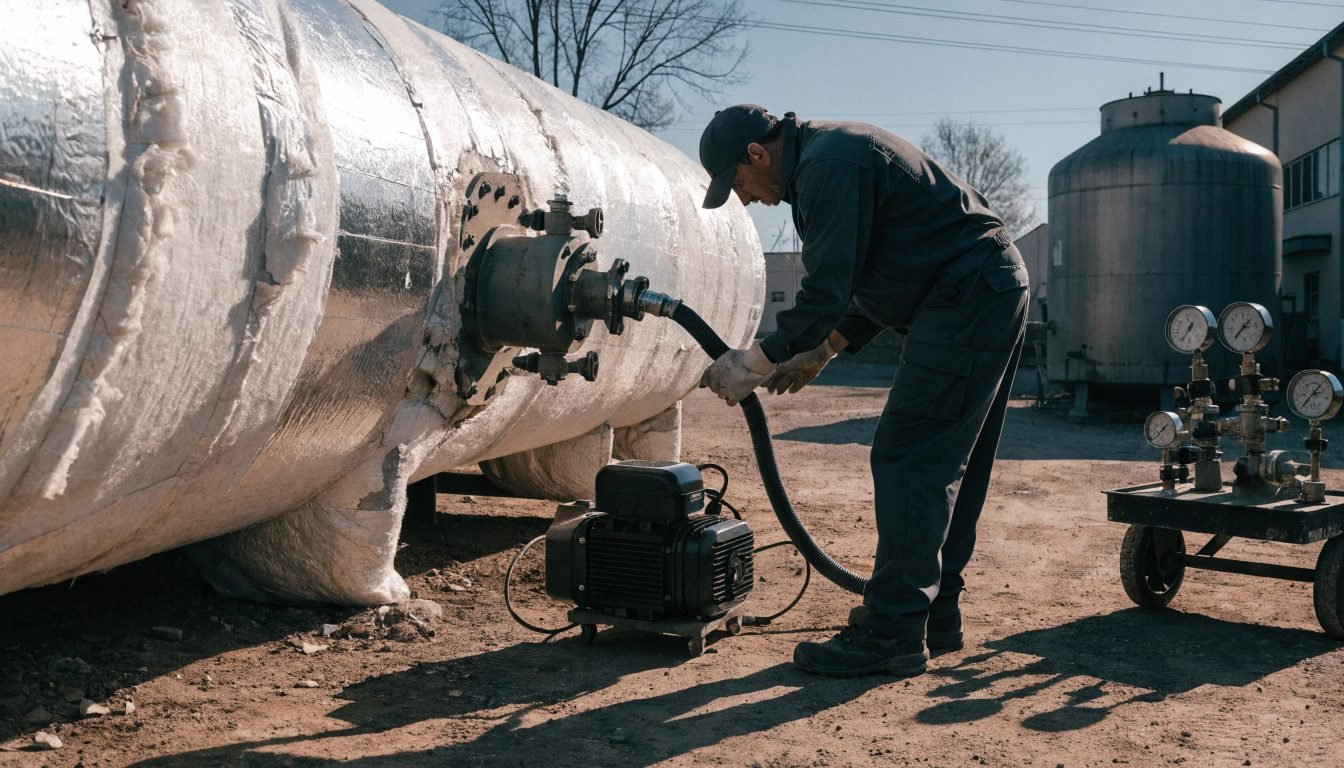
Cryogenic tank vacuum restoration means re-evacuating the space between the inner vessel and the outer shell to bring insulation performance back to normal. A specialist pumps the jacket down, often replaces or reactivates the getter and adsorbent, and verifies the reading. It is worthwhile when the vessel itself is sound.
When a tank loses vacuum, heat ingress rises, boil-off climbs above the normal range, and pressure builds faster. Restoring the vacuum can return the tank to efficient service, but it is not always the right call. The decision depends on the cause of the loss, the age and condition of the vessel, and the economics against replacement.
This guide explains what re-evacuation actually involves, how a specialist performs it, when it is worth doing versus replacing the tank, and what results to expect.
What does restoring vacuum in a cryogenic tank mean?
A cryogenic tank is a vessel within a vessel. The inner tank holds the cold liquid, the outer shell surrounds it, and the space between them is held under vacuum. That vacuum, supported by insulation material and chemical helpers, is what stops heat from reaching the liquid. Restoring vacuum means pumping that space back down to a low pressure and reinstating its ability to hold that pressure.
The jacket usually contains more than empty space. It typically holds multilayer insulation, a getter that absorbs residual gases such as hydrogen, and an adsorbent such as molecular sieve that captures other gases as the tank cools. Over time these can saturate, or a small leak can admit air, and the vacuum degrades.
Vacuum restoration therefore is not only pumping. Depending on the cause, it can also involve finding and sealing a leak, and replacing or regenerating the getter and adsorbent so the restored vacuum stays stable.
How do you know a cryogenic tank has lost vacuum?
Vacuum loss shows itself through a consistent set of symptoms. Any one alone may have another explanation, but together they point clearly to degraded insulation.
- Frost or sweating on the outer shell, which should normally stay near ambient and dry
- Boil-off clearly higher than the tank's baseline, above the usual 0.2 to 0.6 percent of contents per day for a modern stationary tank
- Faster pressure build after a fill and during idle periods
- The relief valve lifting and venting more often than it used to under the same conditions
The definitive confirmation is a vacuum reading taken through the tank's dedicated port with specialist instrumentation. A reading that has drifted from the expected range confirms the loss and provides a starting point to judge how far the vacuum has degraded.
What does the re-evacuation process involve?
Re-evacuation is a controlled procedure carried out by a qualified specialist with the right pumps and gauges. While details vary by tank design, the sequence generally follows these stages.
Assessment and leak check
The specialist first measures the current vacuum and looks for the cause. If air is leaking in, pumping alone will not hold, so the leak must be located, often with a helium leak detector, and sealed before evacuation can succeed.
Pump-down and getter or adsorbent service
A vacuum pump connected to the evacuation port draws the jacket pressure down. Because the adsorbent and getter may be saturated, they are often regenerated or replaced so the restored vacuum will be maintained. Some procedures apply gentle heat to help release trapped gases during pumping.
Verification and sealing
Once the target vacuum is reached and stable, the port is sealed. The specialist confirms the reading holds and documents it. In service, a proper restoration is confirmed by boil-off and pressure behavior returning toward the tank's original baseline.
When is vacuum restoration worth doing?
Re-evacuation makes sense when the pressure envelope is sound and the loss is recoverable. The vessel is the expensive part, so restoring insulation on an otherwise healthy tank is often the economical choice.
- The inner vessel and welds are in good condition and pass inspection
- The vacuum loss traces to a repairable leak or a saturated getter, not to structural damage
- The tank is a size and pressure class you still need
- Re-evacuation returns boil-off and pressure to the tank's original baseline
In these cases restoration can extend a tank's service life for a fraction of replacement cost, and it avoids the lead time of ordering new. It is the same logic that makes a well-inspected used tank a sound purchase.
When is it better to replace the tank instead?
Restoration has limits. When the underlying vessel is compromised or the vacuum will not hold, replacement is the sounder decision, both technically and economically.
- The inner vessel or piping fails non-destructive testing (NDT) or shows corrosion or cracking
- The vacuum loss recurs quickly after re-evacuation, pointing to an inaccessible or structural leak
- The insulation material inside the jacket is degraded beyond regeneration
- The tank no longer matches your capacity, pressure or certification needs
A specialist assessment before committing to re-evacuation avoids spending on a tank that cannot be recovered. If replacement is the answer, a certified second-hand tank from stock is often faster to obtain than new fabrication, which typically takes months.
What results should you expect after re-evacuation?
Set realistic expectations. A successful restoration returns the tank to normal insulation performance, but it does not make an old tank better than new.
- Boil-off should fall back toward the tank's original range, near 0.2 to 0.6 percent of contents per day for a modern stationary tank
- External frost and sweating should disappear as the outer shell returns to near ambient
- Pressure build and venting frequency should return to the normal pattern for that tank
- The vacuum reading should hold stable over the following weeks and at the next scheduled check
If symptoms return soon after re-evacuation, the cause was likely a leak that was not fully sealed or a vessel issue that pumping cannot fix. That outcome usually shifts the decision toward replacement.
How can you prevent vacuum loss in the first place?
You cannot stop a vacuum from ever degrading, but a maintenance routine catches decline early, when a simple re-evacuation is still possible rather than a failed jacket.
- Take a vacuum reading every 6 to 12 months to track the trend, not just the moment
- Log daily pressure, level and shell condition so any rise in boil-off stands out
- Act on early symptoms such as light frost or a small increase in venting
- Protect the outer shell and evacuation port from physical damage on site
Early detection is the whole game. A vacuum caught while it is only beginning to drift is usually recoverable with a straightforward pump-down. A vacuum ignored until the tank frosts heavily and vents constantly is more likely to need vessel work or replacement.
How does KAF Cryogenics handle vacuum and testing?
KAF Cryogenics is an Istanbul-based manufacturer and trader of cryogenic and pressurized gas equipment. On its certified second-hand tanks, the vacuum is measured and the vessel is inspected, NDT tested, and pressure tested, then sold with a document dossier and a written warranty. That process means a buyer starts with verified insulation, not a guess.
If your tank has lost vacuum, the practical first step is a specialist assessment to decide between re-evacuation and replacement. Where replacement is the better route, KAF can supply a new tank built to specification or a certified second-hand unit from stock in weeks, against the industry norm of months for new fabrication.
Frequently Asked Questions
Can a cryogenic tank that lost vacuum be repaired?
Often yes. If the inner vessel is sound and the loss comes from a repairable leak or a saturated getter, a specialist can re-evacuate the jacket and restore insulation performance. If the vessel fails inspection or the vacuum will not hold, replacement is the better option.
What does re-evacuating a cryogenic tank involve?
A specialist measures the current vacuum, locates and seals any leak, connects a vacuum pump to the evacuation port, and pumps the jacket down. The getter and adsorbent are often regenerated or replaced so the vacuum holds. The reading is then verified and the port sealed.
How long does restored vacuum last?
A properly restored vacuum, with any leak sealed and the getter and adsorbent serviced, should hold for years like an original jacket. If symptoms return within weeks, a leak was likely missed or the vessel has an issue that pumping cannot fix, which points toward replacement.
Is it cheaper to restore vacuum or replace a cryogenic tank?
When the vessel is sound, restoration is usually far cheaper than replacement because the pressure vessel is the costly part. When the inner vessel fails NDT or the leak is structural, replacement is the sounder choice. A specialist assessment before committing avoids spending on an unrecoverable tank.
How do I confirm my tank has actually lost vacuum?
Look for combined symptoms: frost or sweating on the outer shell, boil-off above the tank's baseline, and faster pressure build. Confirmation comes from a vacuum reading taken through the dedicated port with specialist instrumentation, which shows how far the vacuum has drifted.
Can I re-evacuate a cryogenic tank myself?
No. Re-evacuation needs the correct vacuum pumps, gauges, leak detection and knowledge of the tank's getter and adsorbent system. It is specialist work. Operators should confirm the symptoms and log readings, then arrange a qualified specialist to carry out the restoration.
How can I avoid losing vacuum again?
Take a vacuum reading every 6 to 12 months and log daily pressure, level and shell condition so decline shows up early. Acting on light frost or a small rise in venting means the vacuum can usually be restored with a simple pump-down rather than a full jacket failure.
Related reading
Lost vacuum, or need a replacement fast?
KAF Cryogenics tests vacuum and pressure on every certified second-hand tank and can supply a new or stock unit matched to your gas, capacity and pressure. Tell us your situation for an accurate quote and a clear repair-or-replace view.
Ask KAF Cryogenics