
Pressure Building Coil and Economizer: How Tank Pressure Is Controlled
How the pressure building coil and economizer control cryogenic tank pressure, how each circuit works, and the symptoms when either one stops working.
KAF Cryogenics14 min read
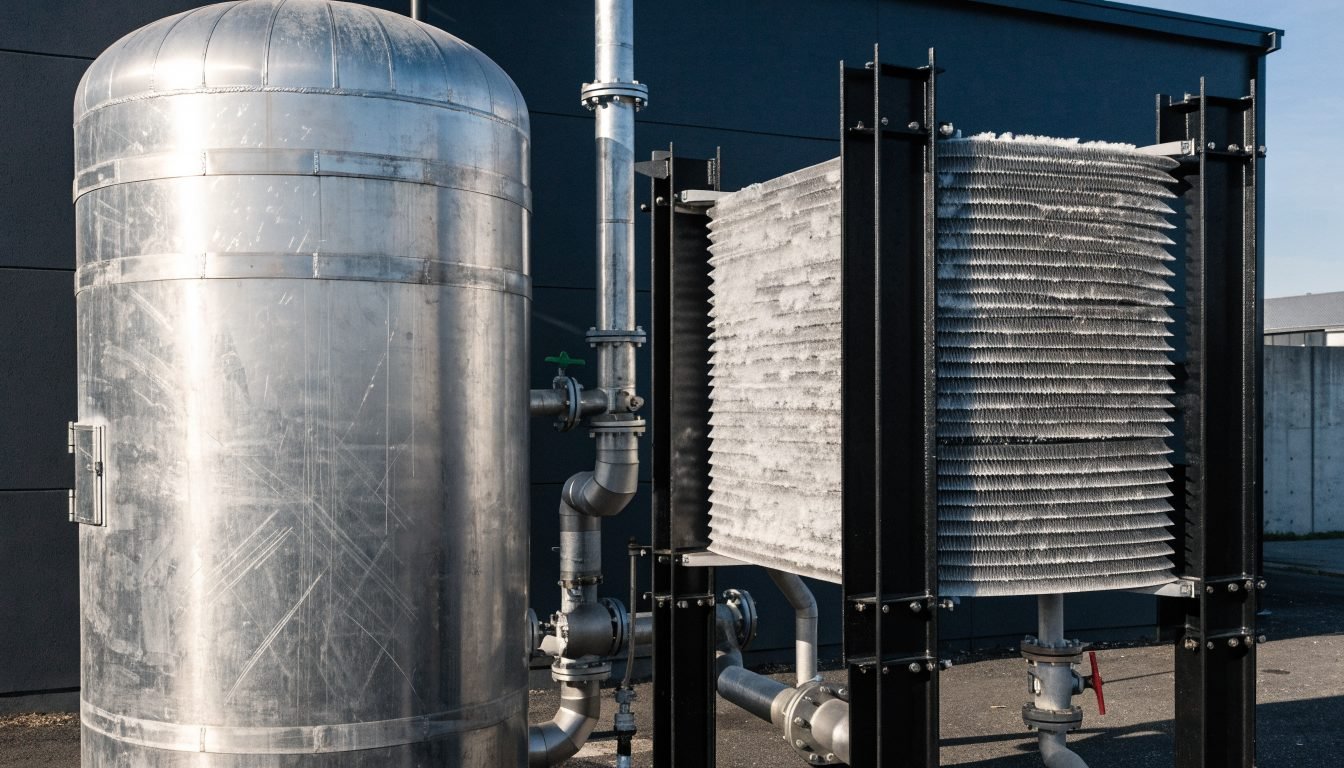
A pressure building coil is an ambient air heat exchanger that draws liquid from the bottom of a cryogenic tank, vaporises it, and returns the gas to the vapour space to raise tank pressure. The economizer works in the opposite direction, drawing vapour off the top when pressure gets high so boil off is used as product instead of being vented.
Between them, these two circuits keep a cryogenic tank at a stable working pressure without wasting liquid and without lifting the relief valve. They are the reason a tank can deliver gas at a steady pressure for weeks while heat leak works against it continuously.
This article explains how each circuit works, how the set points relate to each other and to the relief valve, and what an operator sees when either circuit fails. Most pressure complaints on a customer station trace back to one of these two devices.
Why does a cryogenic tank need a pressure building circuit?
A cryogenic liquid sits in the tank close to its boiling point at the tank pressure. To move product out of the vessel, something has to push it. On a cryogenic storage tank there is normally no pump on a customer station, so the push comes from the pressure of the vapour above the liquid.
That pressure has to be higher than the downstream demand:
- In gas service, tank pressure drives liquid through the vaporizer and gas to the point of use at the required delivery pressure
- In liquid service, tank pressure pushes liquid into a transfer line, a filling hose or a customer vessel
- In both cases, pressure falls as product is withdrawn, because vapour space volume increases while vapour mass is being removed
Heat leak alone produces some pressure rise, but not at a rate that can keep up with active withdrawal. During periods of demand, a tank left to its own devices would lose pressure until delivery stops. The pressure building circuit exists to replace that pressure on demand, automatically.
The opposite problem appears when the tank is idle. Heat leak continues, boil off continues, and with no withdrawal the pressure climbs. Left unmanaged, the relief valve eventually lifts and product is lost to atmosphere. That is the problem the economizer solves.
How does the pressure building coil work?
The pressure building circuit, often abbreviated PB, is a closed loop from the bottom of the inner vessel back to the top of the same vessel.
The sequence is:
- Liquid leaves the bottom of the inner vessel through the pressure building line, past a manual isolation valve
- The pressure building regulator senses vapour space pressure and opens when that pressure falls below its set point
- Liquid flows into the pressure building coil, a finned tube ambient air heat exchanger mounted on the side or the base of the tank
- Ambient air warms the tube, the liquid boils and the gas expands
- The gas returns to the vapour space at the top of the inner vessel, raising tank pressure
- When set pressure is reached, the regulator closes and the circuit stops
There is a thermosiphon effect that makes the loop self driving. Liquid in the coil is warmer and less dense than liquid in the tank, so it rises and pulls more liquid in behind it. No pump or power supply is required, which is why the arrangement is standard on unattended customer stations.
The important consequence for the operator is that pressure building consumes product. Every unit of gas returned to the vapour space came out of the liquid inventory. A pressure building circuit that runs continuously is quietly increasing the customer's consumption figures.
The pressure building regulator
The regulator is a self operated pressure control valve. Its set point defines the working pressure of the tank, and it must be at least as high as the pressure needed at the point of use plus the losses through the vaporizer and the pipework. It is always set below the relief valve setting, which is itself at or below the vessel maximum allowable working pressure. Changing this set point is service work, not an operator adjustment, and it must never be raised toward the relief valve setting to solve a downstream capacity problem.
What does the economizer do on a cryogenic tank?
The economizer, sometimes called the economizer regulator or gas use valve, is a pressure control valve that connects the vapour space to the withdrawal line. Its set point sits above the pressure building regulator setting and below the relief valve setting.
The logic is straightforward. When tank pressure rises above the economizer set point, the economizer opens and product is drawn from the vapour space rather than from the liquid phase. Removing vapour lowers tank pressure, and the vapour that would otherwise have been vented is delivered to the customer as product. When pressure falls back below the set point, the economizer closes and the tank returns to normal liquid withdrawal.
So the economizer does two jobs at once:
- It controls the upper end of tank pressure without venting, keeping the relief valve as a safety device rather than a routine pressure control
- It converts boil off gas into delivered product, so heat leak that would have been a loss becomes part of the sale
This matters more than it first appears. Modern stationary cryogenic tanks have a static evaporation rate of roughly 0.2 to 0.6 percent per day depending on size and insulation. On a tank that is used regularly, a working economizer recovers that boil off into the gas stream instead of releasing it. On a tank that is idle for long periods, there is no withdrawal to absorb the vapour, so pressure will still rise and holding time becomes the governing figure.
How do the pressure settings relate to each other?
There is a fixed order to the set points, and understanding it explains most operating problems. From lowest to highest:
- Pressure building regulator: the lowest of the three, defining the normal working pressure of the tank
- Economizer regulator: set above the pressure building regulator, so the two never fight each other
- Safety relief valve: set at or below the vessel maximum allowable working pressure, above the economizer setting
- Rupture disc: above the relief valve setting, within the limit the applicable code allows
The gap between the pressure building setting and the economizer setting is the operating band the tank lives in. If that gap is too narrow, the two regulators can cycle against each other. If the economizer is set at or below the pressure building setting, the result is a self defeating loop: the pressure building circuit vaporises liquid to raise pressure, the economizer immediately bleeds that pressure into the gas line, and the pressure building circuit starts again. The tank appears to work, but it is consuming extra liquid to do it.
The exact values depend on the vessel pressure class and the required delivery pressure at the customer. They are recorded in the vessel documentation, and any change is a documented service action. Our article on cryogenic tank MAWP and pressure class explains how the vessel rating sets the ceiling for all of these settings.
What are the symptoms when the pressure building circuit fails?
Pressure building faults show up as low pressure, low flow or a tank that will not deliver at all.
Pressure will not build, or falls during withdrawal
- The manual pressure building isolation valve is closed. This is the most common cause and the first thing to check, particularly after a delivery or a maintenance visit
- The pressure building regulator set point is too low for the current demand, or the regulator has failed closed
- The pressure building coil is completely iced over, so it cannot absorb heat from the air and the liquid is not vaporising
- Liquid level is very low, so there is little liquid head to feed the pressure building line
- Demand exceeds what the circuit was sized for, which is a sizing problem rather than a fault
The coil is heavily frosted or icing up
Some frost on a pressure building coil is normal in service. A solid block of ice is not. Ambient air heat exchangers need dry off time to shed the ice that forms as they extract heat from humid air. A coil that never gets a break, because demand is continuous or because the regulator is passing, will progressively ice until its capacity collapses. Cold, humid weather makes this worse, which is why pressure complaints cluster in winter.
Pressure rises continuously and the relief valve lifts
This is the opposite fault: a pressure building regulator stuck open. The circuit keeps vaporising liquid and returning gas to the vapour space with nothing to stop it, so pressure climbs past the economizer setting and eventually reaches the relief valve. The tell is a pressure building coil that stays frosted even when the tank is at or above its normal working pressure.
Note that a continuously lifting relief valve is not always a pressure building fault. Vacuum degradation produces the same symptom by raising heat leak, and the two need to be told apart before parts are ordered. Our articles on why pressure rises in a cryogenic tank and on vacuum loss cover that diagnosis.
What are the symptoms when the economizer fails?
Economizer faults are quieter, because the tank keeps delivering. They show up as product loss and as unstable pressure.
Economizer stuck closed or set too high
- The tank vents through the relief valve or the vent valve while it still holds plenty of product
- Tank pressure regularly sits at the top of the range even when gas is being drawn
- Consumption figures look higher than the customer's actual usage, because vented product is still product that was delivered and paid for
- The operator gets into the habit of manually venting the tank, which normalises a loss that should not be happening
Economizer stuck open or set too low
- Tank pressure will not hold, because vapour is continuously bled into the withdrawal line
- The pressure building circuit runs almost constantly to compensate, so the coil stays frosted and liquid consumption rises
- Gas delivered to the point of use may be colder or of variable temperature, because it is coming from the vapour space rather than through the full vaporizer path
- In liquid withdrawal service, transfer becomes slow or stops as tank pressure collapses
The signature that separates the two circuits is what the pressure building coil is doing. A frosted coil combined with pressure that will not hold points at the economizer or at an oversized withdrawal. A clear, unfrosted coil combined with pressure that will not build points at the pressure building circuit itself.
What should an operator check before calling for service?
A short structured check saves a call out and gives the service engineer something useful to work with. None of the following requires opening pressure containing parts.
- Read and record the tank pressure gauge and the liquid level, and note the time and the ambient temperature
- Confirm the manual pressure building valve is in its normal operating position
- Look at the pressure building coil: clear, lightly frosted or solidly iced
- Look at the vaporizer serving the point of use for the same signs, since an iced process vaporizer produces low delivery pressure that is often blamed on the tank
- Check whether the demand has changed, for example a new production line or a shift pattern change at the site
- Compare the current pressure against the documented pressure building and economizer set points in the vessel file
- Check for audible venting or an ice plume at the vent outlet
- Note whether the problem correlates with cold or humid weather, which points at heat exchanger capacity rather than a regulator
Two rules apply without exception. Do not adjust or interfere with the safety relief valve or the rupture disc under any circumstances, and do not isolate a relief device to stop it venting. Regulator set points are changed only by competent personnel against the documented values for the vessel. If a coil is solidly iced, let it thaw naturally rather than applying heat or striking it, because thermal shock and mechanical damage to a cryogenic heat exchanger are expensive faults to create.
If the pressure building circuit or the vaporizer turns out to be undersized rather than faulty, the fix is a capacity change, not a set point change. Our guide to ambient air vaporizer sizing sets out how to calculate what the site actually needs, including the duty cycle allowance for defrost.
How does this affect tank selection and delivery planning?
The pressure control equipment is part of the specification, not an accessory. When you specify a tank for a customer station, the pressure building circuit and the economizer have to match the duty.
- Peak gas demand and the required delivery pressure set the pressure building capacity and the regulator set point
- The vessel pressure class must be high enough that the working pressure sits comfortably below the relief valve setting
- Continuous duty sites need enough heat exchanger capacity that the coil gets defrost time, or a duplex arrangement
- Intermittent, low usage sites depend more on the economizer, because long idle periods mean boil off accumulates between withdrawals
- MicroBulk installations serving small consumers are especially sensitive, since a low turnover tank spends most of its time idle
This is also why the same nominal tank volume can perform very differently at two sites. Sizing should start from the consumption profile, not from the tank catalogue. Our customer station tank sizing article covers the method.
KAF Cryogenics supplies cryogenic storage tanks, MicroBulk vessels and ambient air vaporizers, both as new units built to specification and as certified second hand equipment that has passed inspection, non destructive testing and vacuum and pressure testing, and is sold with a document dossier and written warranty. Certified second hand units can be delivered from stock in weeks, against the months of fabrication a new build requires.
Frequently Asked Questions
What is a pressure building coil on a cryogenic tank?
It is an ambient air heat exchanger, usually a finned tube coil on the side or base of the tank, that takes liquid from the bottom of the inner vessel, vaporises it using heat from the surrounding air, and returns the gas to the vapour space. The added gas raises tank pressure so product can be pushed out. The circuit is controlled automatically by the pressure building regulator and needs no pump or power supply.
What does the economizer do on a cryogenic tank?
The economizer is a regulator set above the pressure building setting and below the relief valve setting. When tank pressure rises above its set point, it opens a path from the vapour space into the withdrawal line so product is taken as vapour instead of liquid. This lowers tank pressure without venting and turns boil off gas into delivered product.
Why will my cryogenic tank not build pressure?
The most common cause is that the manual pressure building valve is closed, often after a delivery or maintenance visit. Other causes are a pressure building regulator set too low or failed closed, a pressure building coil that is solidly iced over so it cannot absorb heat from the air, a very low liquid level, or a demand rate higher than the circuit was sized for.
Why is my cryogenic tank venting when it is still full?
Venting with product in the tank usually means the economizer is stuck closed or set too high, so boil off is not being drawn into the gas line and pressure climbs to the relief valve setting. The other common cause is a pressure building regulator stuck open, which keeps adding vapour to the tank. Degraded vacuum insulation produces the same symptom by increasing heat leak, so check the vacuum before replacing regulators.
Should the pressure building coil be frosted?
Light frost during active pressure building is normal, because the coil is extracting heat from the air. A solid block of ice is not normal and means the coil has lost capacity. A coil that stays frosted when the tank is already at working pressure suggests the pressure building regulator is passing or stuck open. Let an iced coil thaw naturally rather than applying heat or striking it.
Can the economizer be set below the pressure building regulator?
It should never be. If the economizer set point is at or below the pressure building set point, the pressure building circuit vaporises liquid to raise pressure and the economizer immediately bleeds that pressure into the gas line. The tank appears to operate but consumes extra liquid continuously. The correct order is pressure building lowest, then economizer, then the relief valve at or below the vessel MAWP.
Does a working economizer eliminate boil off losses?
It removes them only while product is being withdrawn, because the recovered vapour has to go somewhere. On a tank in regular use, boil off is absorbed into the gas stream and sold rather than vented. On a tank that sits idle for long periods there is no withdrawal to absorb it, so pressure rises and the holding time of the vessel becomes the limiting figure.
Can an operator adjust the pressure building or economizer set points?
No. Set points are recorded in the vessel documentation and changed only by competent personnel as a documented service action. Raising a set point toward the relief valve setting to compensate for a downstream capacity problem is not a fix and reduces the margin the safety system relies on. Safety relief valves and rupture discs must never be adjusted or isolated at all.
Related reading
Specifying a tank around your consumption profile?
KAF Cryogenics supplies cryogenic storage tanks, MicroBulk vessels and ambient air vaporizers as new units built to specification or as certified second hand equipment with a document dossier and written warranty. Send us your product, peak demand and required delivery pressure and we will quote against the actual duty.
Talk to our team